


Hey, everyone. Matt here The Angry Ohioan.
Yesterday was the League of Women Voters forum for the Cuyahoga County Council District 5 race between incumbent Mike Gallagher and Democratic challenger Courtney Scheff.
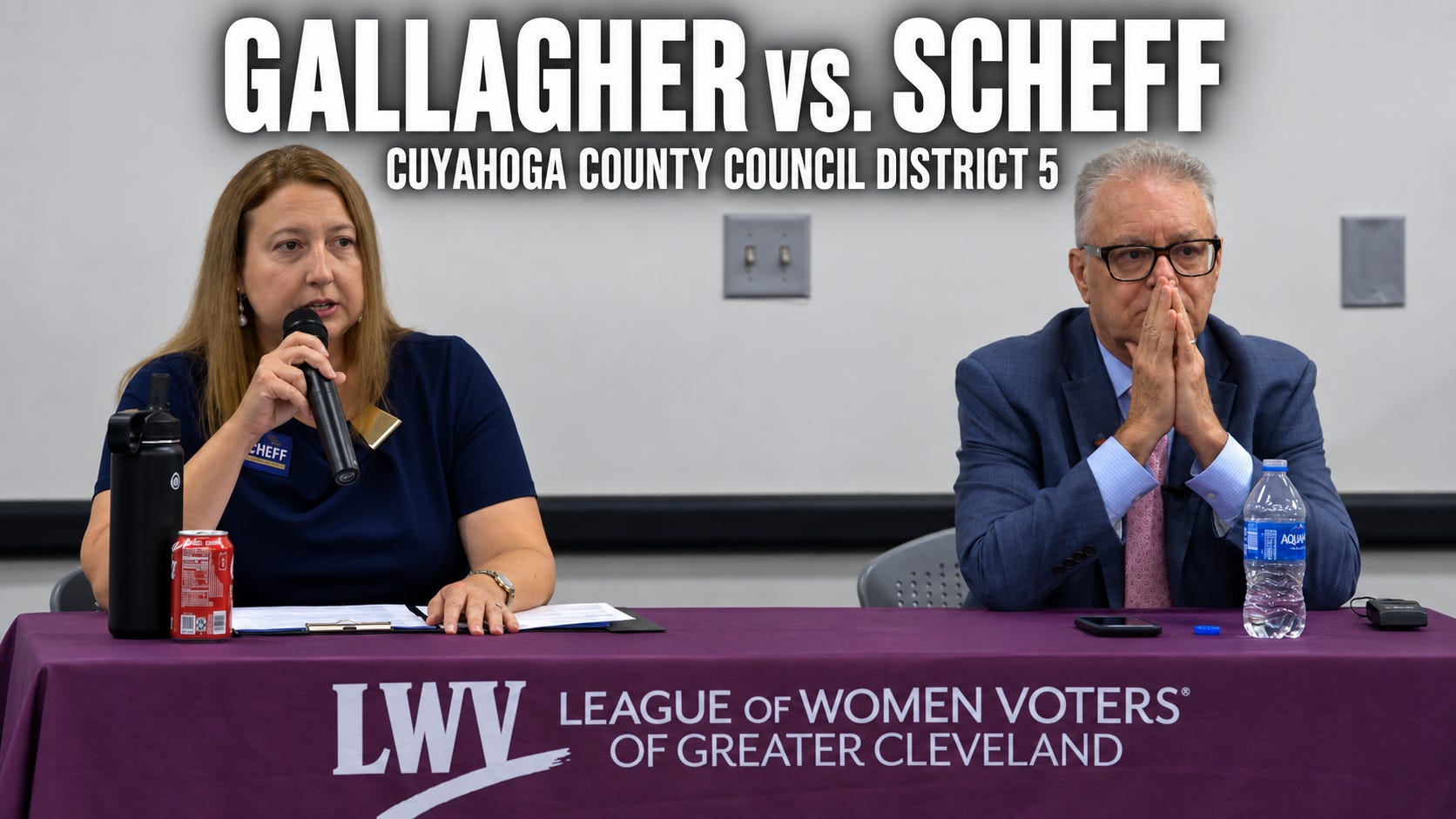
This is my district, so of course I am paying closer attention to this race. I also plan to watch the other League of Women Voters forums and give my opinions on those races.
I watched the entire forum because I enjoy this stuff. I understand that most people do not want to sit through the whole video, so I broke it down into something easier to follow.
First, I am giving you my reaction to the candidates’ opening statements and each major question.
After that, you will find a short TL;DR explaining the central message of each candidate.
Finally, I have included a cleaned transcript (with the help of Chat GPT) of the questions and answers so you can read what the candidates actually said without sitting through the entire forum.
You can also watch the League of Women Voters forum through its YouTube channel.
Opening Statements
Mike Gallagher began with a few jokes and then admitted that he had not prepared an opening statement.
That annoyed me.
This is the same question I had earlier in the campaign.
When I first began comparing the candidates, Mike did not have a real campaign website or a clearly organized platform. I had to go through his public record to determine what he supported. He eventually created a website, which was good, but then he came into what may be the only public forum where voters will see both candidates together and announced that he had not prepared an opening statement.
Why would you not prepare an opening statement?
Courtney came prepared. She was clearly more nervous and jittery than Mike, but experience and familiarity matter in these forums. Mike has spent years in public office and was obviously more comfortable speaking off the cuff.
Courtney still presented a clear statement about what she wanted to accomplish and how she planned to approach the job. Mike talked about his biography, experience and leadership, but Courtney did a better job of presenting an actual plan.
Mike may have more experience, but preparation also tells voters how seriously you take their time.
Question 1: Gridlock and Factionalism
Courtney’s answer was that professionalism, listening and finding common ground could help repair the divisions within county government. She also said she respects both County Executive Chris Ronayne and County Prosecutor Michael O’Malley and hopes she can serve as a bridge between them.
That sounds pleasant, but Courtney sometimes seems determined to be friends with everybody, which can leave voters unsure where she actually stands.
If two powerful county officials are fighting over authority, procedure and public money, the answer cannot simply be that everyone needs to behave professionally. Sometimes one side is wrong. Sometimes somebody has to draw a line.
Mike said something more revealing. He described County Council members learning about major decisions through the newspaper instead of from the executive branch.
I think Mike was saying out loud what usually remains behind the scenes. It is difficult to perform meaningful oversight when the newspaper tells council members what their own government is doing.
If County Council is expected to approve contracts, budgets and borrowing, it should not be the last institution to learn what the executive branch has decided.
Question 2: District Priorities
Mike went directly to county finances, the jail, the justice system and the sales tax used to finance these projects.
That is where my concern is too.
Cuyahoga County has several expensive commitments coming due at the same time. The new Central Services Campus is currently budgeted at approximately $889 million. The county has also committed approximately $150 million to renovating the existing Justice Center. Together, those projects put justice-system capital commitments above $1 billion. The jail campus alone was discussed as roughly a $500 million project in 2021 before increasing to $750 million and then over $900 million.
These are legitimate questions. Where is the money coming from? How much will taxpayers ultimately repay after interest? What else will be crowded out of the budget?
Courtney focused on preserving essential services and improving communication about programs already available to residents.
Those are good goals, but they did not address the financial problem looming over the county. Her answer was largely about what government can provide. Mike’s answer was about how government will pay for everything it has already promised.
Question 3: Gun Violence
Both candidates made legitimate points about gun violence.
Courtney argued for a combination of policing and prevention. Mike focused on illegal guns, gangs and the financial burden of extending sheriff’s services into communities like East Cleveland.
There is a real gun-violence problem in Cleveland and other parts of Cuyahoga County. Prevention programs, effective policing and removing illegal guns from the streets can all be part of the response.
But the money question does not disappear.
Courtney again discussed investing in additional programs. Mike said the Sheriff’s Department is already overstretched.
The county must decide which programs are effective, which responsibilities belong to municipalities and how much the county can realistically afford. Every worthwhile idea still needs a funding source.
Question 4: What Should Be Cut Before Asking for More Money?
This was one of the better exchanges.
Mike proposed a state performance audit that would examine staffing, spending, duplication and long-term planning. He also raised the possibility that artificial intelligence and automation could affect county employment.
Courtney argued that elected council members should not outsource their responsibility to the state. She said council members are elected to decide which programs work, which ones do not and what the county can afford.
Courtney made a good point. A performance audit could provide valuable information, but an audit does not make the political decisions. County Council still has to vote.
She also acknowledged that even if the HHS levy passes, the county should not treat the new revenue as permission to create and expand programs without restraint.
Mike offered a mechanism for reviewing the county. Courtney emphasized the responsibility to act on the findings. Both answers had value, but neither completely explained what either candidate would actually cut.
Question 5: The HHS Levy
Both candidates acknowledged the importance of Health and Human Services programs, but they approached the levy differently.
Courtney supports it and placed much of the responsibility for the county’s financial pressure on state and federal cuts.
Mike voted to place the levy before voters, but he criticized county officials for spending through reserves and returning to taxpayers earlier than expected.
The levy would increase the existing rate by 2.5 mills, costing approximately $87.50 more annually for every $100,000 in market value. County officials project that it would add approximately $111 million to the HHS budget. Without increased revenue, the county projects that HHS reserves could fall to roughly $3 million by the end of the year.
Courtney is correct that federal and state decisions affect the county. The county cannot control Washington or Columbus.
But that cannot become an excuse for avoiding local accountability.
If revenues decline, elected officials have to make adjustments. If officials knew reserves were falling, the response should have started before the account was nearly depleted.
You cannot spend through reserves, avoid hard choices and then tell residents that essential services will disappear unless they approve more taxes. To me, that feels less like responsible budgeting and more like using those services as political extortion against taxpayers.
Blaming the Trump administration may explain part of the financial pressure, but cannot be an excuse to avoid doing your job in a timely manner.
Question 6: Accountability Within HHS
Courtney correctly pointed out that saying what should have been done 16 years ago does not answer what the county must do now.
That was one of her strongest points.
She said council should look for duplication and decide what can be reduced, regardless of whether the levy passes. I hope she applies that standard to every county budget and contract.
Mike’s performance-audit proposal could help identify waste and duplication, but Courtney is right that elected officials eventually have to act.
My concern is how she will apply that reasoning to the jail.
People have told me that I should have been at the meetings three years ago if I cared about the project. That is ridiculous. The project is still underway, its price has increased dramatically, and elected officials still have a responsibility to control the cost.
Will Courtney draw a hard line on spending now? Or will she say the decision was made years ago, the bonds have been issued and the county has no choice but to continue?
You cannot use the past as an excuse for refusing to control today’s spending.
Question 7: Homelessness
Homelessness is a real issue in Cuyahoga County.
I have “family” (people very close to me) members who volunteer their time and provide medical services to people experiencing homelessness. It is an issue I have been close to for years, including while I was running for office.
Courtney emphasized mental-health treatment, education and cooperation with organizations already providing services. Mike shifted attention toward the limited amount of money available and what he sees as inadequate county support for seniors.
Those are not mutually exclusive concerns.
The county has to decide how to serve people experiencing homelessness, support seniors, fund mental-health treatment and maintain its other responsibilities with finite resources.
Everybody wants the program they care about to be fully funded. That does not mean every program can be.
The difference between what Cuyahoga County and Franklin County spend on different populations deserves closer examination, but comparisons also need to account for how each county structures, categorizes and delivers those services.
The broader question remains the same: What is the county obligated to provide, what programs produce measurable results and what can taxpayers realistically afford?
Question 8: Communication
Mike had a slow start to his campaign. His early public presence was limited, and his lack of preparation for the forum did not help.
However, I also need to be honest about my personal experience.
Mike Gallagher has called and texted me repeatedly to explain what is happening in county government. I did not beg him to do it, and I am not part of his campaign. I have never even met him in person.
I write a newsletter about local government, and I appreciate when an elected official proactively provides information.
My experience with Courtney has been different.
Courtney said she would create newsletters, use social media and communicate before decisions are made. That sounds good. I want to see whether that communication will include residents who challenge her, question the county executive or disagree with Democratic leadership.
Communication is not only sending information to supporters. It also means responding to people who challenge you and your friends.
Question 9: Data Centers
Data centers present an opportunity and a risk.
Cuyahoga County has large areas of vacant or underused land that once supported homes or industry. Some of that land could potentially support data centers or other large developments.
These projects can create construction jobs, including union jobs, but many of those jobs are temporary. Once completed, a data center may employ far fewer people than another industrial facility of comparable size.
Courtney focused on environmental protections, electrical-grid upgrades and requiring developers to absorb the costs they create. Mike emphasized local control and technological improvements in power and water usage.
Both points matter.
Communities should decide whether a project fits their land-use plans, but those decisions cannot be made in isolation when a project affects regional power supplies, water systems and neighboring municipalities.
If a data center is built, taxpayers and residential utility customers should not be stuck subsidizing its infrastructure or potential demolition and cleanup.
Question 10: Artificial Intelligence
The fear around artificial intelligence often resembles the fear surrounding every major new technology.
Courtney even joked about watching Terminator. People also think of HAL 9000 from 2001: A Space Odyssey and decades of movies about computers taking control.
That does not mean every concern is irrational, but government policy cannot be based on science fiction.
Courtney was correct that major regulation of artificial intelligence is primarily a federal issue. A county government is not going and should not determine the future of AI development.
The county should focus on what it can control: whether its agencies use AI, how automated decisions are reviewed, what happens to residents’ data and whether a human being remains accountable for consequential decisions.
Mike was honest that he did not know enough to offer a complete answer. I would rather hear that than watch a politician pretend to understand a complicated technology. However, this is frontier technology and maybe Mike should have studied already.
Question 11: Flock Cameras
The candidates largely agreed that license-plate readers can help solve crimes but can also be abused.
Courtney emphasized contracts and legal guardrails. Mike emphasized local control, consequences for misuse and the possibility of law-enforcement employees using databases to monitor people for personal reasons.
I do not think it is enough to say that an attorney should review the contract.
The county should not sign a contract for mass-surveillance technology unless every search is logged, traceable and subject to independent review. The company should provide transparent rules for data sharing, retention and access.
Employees who misuse these systems to monitor former partners, family members or innocent residents should face serious consequences.
This is not simply misuse of government property. It is the misuse of powerful surveillance technology against people who may have done nothing wrong.
If law enforcement expects the public to trust these tools, then law enforcement must set a higher standard for its own employees and hold them accountable with extreme punishment for misuse.
Note: neither said ban Flock and other like companies. That should be worth noting.
Question 12: Immigration and Population Growth
Courtney raised one of the most important facts of the forum.
Cuyahoga County’s recent population growth has been driven almost entirely by international migration. Between 2023 and 2024, the county gained approximately 2,000 residents. Deaths exceeded births, and 6,741 people moved elsewhere in Ohio or out of state, but those losses were offset by a net gain of 8,876 international migrants.
Mike talked about county money being spent on illegal aliens. Courtney talked about welcoming legal immigrants and recognizing their role in the county’s growth.
Both issues can exist at the same time.
The county can welcome legal immigration while still asking what services it provides, who qualifies and whether the executive branch expanded programs without sufficient council oversight.
The larger issue is why so many existing residents continue moving farther from the urban core and out of the county.
Taxes are part of that conversation. So are housing costs, zoning rules, schools, transportation and the availability of starter homes.
If the county continues raising taxes without making it easier to build housing and attract families, immigration may offset some population loss, but it will not solve the underlying problem.
Are we creating a county where people want to stay, build homes and raise families, or are we simply replacing the residents who leave?
Question 13: Inflation and Everyday Costs
Courtney made an interesting argument about Medicaid and SNAP.
If people lose benefits, they spend less at grocery stores and other businesses. Reduced spending can weaken local businesses and contribute to a cycle in which costs are spread across fewer customers.
But those benefits are still paid for with public money.
We are taxing people to provide benefits so other people can continue spending, which may help stabilize demand and prices. That does not make the programs inherently wrong, but it demonstrates how tax money is used as a market subsidy.
This problem exists at every level of government. The federal government has an enormous debt. Cities and counties are under financial pressure. Families are paying more for food, housing, utilities and borrowing.
Politically, it is easier to promise everything than to decide what government can sustainably provide.
Mike described the county as spreading peanut butter around to make everybody happy while failing to deliver the right services effectively.
That was probably the clearest description of his fiscal argument. His position is that government should identify its core responsibilities, fund them properly and stop trying to give a little money to everybody.
Question 14: The Jail
Courtney’s answer on the jail was the most troubling answer of the forum.
She said the guaranteed maximum price has been established, the bonds have been issued and delays would increase the cost. She also said the county could save money over time by investing in mental-health services and keeping people out of jail.
Reducing the jail population is a worthy goal. It does not explain why the building costs over $900 million and is the most expensive jail in the county per bed.
The project began with public estimates around $500 million. By the end of 2023, it had reached approximately $750 million. The county later presented an approximately $889 million budget for a 1,886-bed campus. County officials have argued that delays could push the cost beyond $1 billion.
The county also approved a 40-year extension of a quarter-percent sales tax without sending it to voters. The council vote was 6-5.
The Justice Center renovation is separate and is expected to cost approximately $150-$200 million.
Courtney called for continued oversight. But her answer still relied too heavily on the idea that the decisions have already been made.
That is sunk-cost logic.
The existence of bonds does not eliminate County Council’s responsibility to inspect contracts, change orders, subcontracting and every remaining dollar.
Keeping people out of jail may reduce operating costs later. It does not make an extraordinarily expensive construction project fiscally responsible.
Question 15: Browns Stadium Funding
The moderator withdrew this question after confusion over what authority the county has over the state’s stadium funding.
Question 16: Infrastructure
This is the brass tacks of government.
Roads, bridges, sewers, clean water, electricity, police, fire and basic infrastructure are the things people expect government to maintain.
Both candidates agreed that infrastructure must be preserved and that local communities need county assistance and coordination.
This is not where the county should be looking for careless cuts.
Before government expands into another program or creates another administrative office, it should make sure bridges are safe, roads are usable, sewage systems function and residents can rely on emergency services.
These responsibilities are not flashy, but they are the foundation of local government.
Question 17: Blight
Once again, the conversation returned to money.
Mike discussed earlier county investments used to demolish blighted properties. Courtney discussed grants, the Land Bank and cooperation between different levels of government.
What was missing was a serious conversation about regulation, zoning and incentives.
Not every vacant or neglected property requires the county to spend public money. Government can also examine whether its own rules are preventing property owners, builders, small developers and entrepreneurs from putting land back into productive use.
The county and municipalities should examine zoning, permitting, demolition rules, tax foreclosure and incentives for rehabilitation.
If private people can make productive use of vacant properties, government should not create unnecessary barriers.
Spending should not be the only tool anybody can imagine.
Question 18: Cooperation Between Municipalities
I do not have a major disagreement with either candidate here.
Municipal cooperation is extremely important.
I lived in Bay Village for years and now live in Berea. Development in Westlake can affect Bay Village because Bay sits downstream in the watershed toward Lake Erie. Water runs downhill. Runoff, flooding, sewers and development do not stop at a municipal border.
One city can make a decision without malice and still create problems for another community.
That is why coordination on development, sewers, water treatment, roads and emergency services can be more important than one city simply maintaining its own infrastructure.
Courtney was right that the county can encourage cooperation while respecting municipal control. Mike was also right to point toward existing shared services.
The county should help municipalities coordinate before a development creates a problem, not arrive afterward with public money to repair the damage.
Question 19: Putting People Above Party
This was the final question, and my opinion is shaped partly by my personal experience with both candidates.
Mike Gallagher has called and texted me with information even though I am not part of his campaign and have never met him in person.
Courtney’s campaign account has removed tags from my posts about County Council issues.
Again, I cannot know her reason for doing that. But when a candidate promises communication while avoiding critical posts from someone in her own party, I notice.
Courtney’s political support is rooted largely in the Democratic Party, while Gallagher has built his identity around fighting with both parties when he believes taxpayers are being ignored.
Independence can become obstruction, just as party cooperation can become rubber-stamping.
My concern is whether Courtney will serve as an independent member of County Council or is she just a reliable vote for the executive branch. Chris Ronayne did donate $5k to her campaign and hold a fund raiser for her.
During this forum, she criticized state and federal decisions repeatedly but offered little direct criticism of Ronayne’s agenda. She defended many of the same programs and approaches while presenting herself as the person who would improve communication around them.
I did not hear enough evidence that she would act as a meaningful check on the executive.
Conclusion
This forum unfolded largely the way I expected.
The central issue in this race is fiscal responsibility.
Families are paying more for groceries, housing, utilities and borrowing. At the same time, Cuyahoga County is asking voters for a larger HHS levy, financing over prices jail campus, extending a sales tax for 40 years and committing another approximately $150-$200 million to the Justice Center. Not to mention the levies that are coming on the ballot.
Gallagher made fiscal restraint the center of nearly every answer.
Courtney talked about responsible budgeting, duplication and the need to make choices. But she usually paired those statements with preserving, improving or expanding services. She did not clearly explain where she would impose limits on the executive branch or which spending she would oppose.
That is my problem.
It is easy to say that every program is important. It is harder to tell people that the money is finite.
The jail was discussed as a roughly $500 million project in 2021. It rose to approximately $750 million and then approximately $900 million. County officials themselves have warned that it could push over $1 billion. I think we will be looking at $1.2-$1.4 when it is all done.
That does not include the separate Justice Center renovation.
I do not accept the idea that, because votes were taken and bonds were issued, taxpayers should stop questioning the price.
Nor do I accept telling residents that services will be cut unless they approve more taxes while county officials continue approving other major expenses.
That is playing chicken with taxpayers and the people who rely on those services.
Courtney had more preparation, but Gallagher could pull from his extensive experience. She communicated her priorities clearly. She offered several strong answers, particularly on immigration, municipal cooperation and the need to make decisions now instead of complaining about what should have happened years ago.
But Mike Gallagher was the only candidate who made fiscal restraint the organizing principle of his entire argument.
At this moment, with billion-dollar construction commitments and additional taxes on the ballot, Gallagher’s warning is the one I believe County Council most needs to hear.
TL;DR
Mike Gallagher: Gallagher’s central message was that Cuyahoga County has a spending and leadership problem. He wants the county to return to its core responsibilities, conduct a state performance audit, eliminate waste and duplication, and stop creating or expanding programs without sustainable funding. He repeatedly criticized the rising jail cost, the extension of the sales tax, the early HHS levy request and what he described as a lack of collaboration between County Council and the executive. His broader themes were fiscal restraint, local control, support for law enforcement, improved services for seniors, cooperation among municipalities and responsiveness to every constituent regardless of political party.
Courtney Scheff: Scheff’s central message was that Cuyahoga County must protect essential services while making tougher and more transparent budget decisions. She supports the HHS levy, the county Welcome Center, investments in mental-health care, homelessness prevention, benefit specialists and programs that keep people from entering the criminal-justice system. At the same time, she said County Council must identify ineffective programs, eliminate duplication and stop creating new programs without the money to sustain them. Her broader themes were communication before decisions are made, professional cooperation within county government, preventive services, responsible oversight of contracts and technology, collaboration with local governments and accessible public service for every resident.
Complete Transcript
Opening Statements
Mike Gallagher
Thank you to the League of Women Voters, the City of Berea, and all my friends and neighbors here.
Mike Gallagher was born in Lakewood, Ohio, to an Irish Catholic family with five sisters and myself. I learned pretty quickly, early in life, who had the power in the world. Even our dog was female.
I graduated from Lakewood St. Edward High School and then Cleveland State. I started working for the state Court of Appeals, where I worked for 31 years before retiring.
I served on Strongsville City Council for 11 years, including three years as council president. When I first started in Strongsville, we were in a very bad position. We had $70,000 in the bank, if you can believe that. After Mayor Perciak’s untimely death, I took over finance. We turned the City of Strongsville from a dangerous financial situation into one of the rare cities in Ohio with a AAA rating, which it still maintains. I am very proud of my colleagues who are still there.
I have been on County Council since its inception. It has been a learning experience that I think everybody should go through. We came out of the corruption phase of Cuyahoga County, got together and quickly became what I would consider a working machine.
We had to get a county up and running. We had to write all the rules and do everything ourselves. The keys were on the counter. The first day I met with some of my colleagues, there were three or four of us in a room. The phone rang, and we all looked at each other like, “Now what?” We had no employees. We were three council people sitting there.
That is where we started, and this is where we are today. I am pretty proud of where we got to. We have glitches and problems. Everybody does. Every council and every city does, but you work through them the best you can.
Leadership matters, and that is going to be an important part of my campaign. Without leadership, you have bigger problems than what we already have.
We will move forward. We will get through the tough times, and hopefully, down the line, Cuyahoga County will once again be one of the gems of Ohio.
Courtney Scheff
My name is Courtney Scheff. I grew up in a union home. My dad’s good union job gave my family stability, but when layoffs threatened that stability, government programs were there as a safety net.
Today, that safety net is under attack. We have watched for years as the federal and state governments have made cuts to programs and transferred the tax burden onto local residents. Our county has become the last line of defense for the people who need the most help, and I am running to hold that line for those people.
I bring a background that has prepared me for exactly that. I am a Navy veteran, an attorney and a mom. I began my career as a JAG officer in the United States Navy, where I learned leadership and accountability.
More recently, I worked in the Cuyahoga County Prosecutor’s Office, so I have direct experience working in our county government. When I am elected, I will be the only attorney sitting on County Council. That means I will bring my training in listening, evaluating the facts and spotting issues before they become problems.
As a mom in today’s world, I know what it means when government gets it right, and I know how high the stakes are when government gets it wrong.
I have three priorities on council. First, maintaining the essential services that people rely on. Second, protecting taxpayers through responsible budgeting. Third, communicating consistently and honestly with the residents of District 5.
Here is how I will do that, the same way I have done everything in my life: by listening first and then leading with transparency and accountability.
District 5 residents deserve to know what is happening in their government before decisions are made, not after. That is the change we need in this district. Real public service that keeps our residents engaged and involved.
I look forward to your questions tonight.
Questions and Answers
Question 1: Gridlock and factionalism in county government
“There have been numerous clashes reported between members of the executive branch of the county over procedure and budget. Can you give examples of how you would work to build a county government that avoids gridlock and factionalism?”
Courtney Scheff
It starts with professionalism. I have seen and noticed the public spats between various people in our county government.
Let’s start at the top. I have worked with Mike O’Malley. I am friends with Chris Ronayne. I respect both of those people, and I believe I can hopefully be a bridge between them.
As far as County Council, you have to listen. It is just like listening to residents. You have to listen to your fellow council members, hear where they are coming from and then try to see if you can find common ground.
If you cannot, that is fine, but do not accuse them of things. Do not turn it into public spats for personal gain. Agree that you disagree, take your votes and move on.
Once you have taken those votes, let’s work in the government together instead of looking backward and attacking decisions made in the past.
Mike Gallagher
I am going to assume that has to do with what we are all reading about in the newspaper. The reality is, and I go back to leadership, you have to have camaraderie and leadership.
I think we have that, or at least had that, for the first 12 years. Just recently, and when I say recently, within the past three years, it really has gone into the dumpster.
Things get done when council has no idea what is going on. When you are a councilman and you read things in the newspaper about decisions that have been made by the higher-ups, it is not collaborative. It is not helpful, and it is very much a negative.
The council, for the most part, really does get along. We consider ourselves family. We spat, but we are family.
Question 2: The most important issues in District 5
“What are the top two or three issues specific to this district that you would approach on council directly to improve the lives of your constituents?”
Mike Gallagher
I would suggest that we have big issues on the table, and one is our finances, which have been systematically destroyed.
We have to build a justice center. Discussions are not even happening yet. We had a jail program for $700 million. It is now $1 billion. That is a big issue. That money has to come from somewhere, and that somewhere was a quarter-percent sales tax that was shoved down your backsides by the administration we are dealing with.
When we handed the jail and justice center to the administration, it was $1.4 billion. The jail alone is now $1 billion. The justice center is probably going to be $1 billion.
To borrow that money is $4 billion. A quarter percent at a 3 percent return a year, which is reasonable, is close to $6 billion.
My question has been, and your question should be, where is the other $2 billion going? One billion is going into the general fund, and there is hardly anybody in this room who knows that.
You are paying a regressive tax.
Courtney Scheff
I would say my top two priorities in this district are, number one, maintaining the essential services people need.
Believe it or not, when I go to doors and talk to voters, we have people who are on Medicaid and SNAP and cannot access the services they need. There are people in our district who have no idea about the programs and services that the county provides.
My second priority is making sure that we are actually communicating in this district.
People do not know about the Great Estates program. Are you all aware that, if you are over a certain age, you can have access to getting a transfer-on-death certificate for free through the county program?
There is also Senior Transportation Connection. I have talked to so many seniors in our district who are unaware that they can get rides to the doctor for a low fee.
That is something I want to make sure people know about through constant communication.
My top two priorities are maintaining essential services and making sure people know about them.
Question 3: Gun violence and support for law enforcement
“Gun violence remains a major concern in Northeast Ohio. What actions would you support? How would you strengthen county support for law enforcement and emergency services?”
Courtney Scheff
Guns on our streets in Cuyahoga County are a massive problem. There are children with automatic weapons. I saw it constantly in the County Prosecutor’s Office. It is a real problem.
What can the county do about it? First, state and federal laws could certainly help, but the county needs to make sure we are funding our sheriff’s patrols so they can continue to catch the guns that are on the streets in the hands of children and adults. We have to make sure we can get those guns off the streets.
Second, we need to make sure we have prevention in our communities. Cleveland just released the results of its RISE program over the summer. It has had a lot of success with different programs that address prevention, as well as policing, to make sure crime is stopped before it becomes criminal action and sends people to jail.
We need a well-rounded approach to gun violence that includes not just policing, but also prevention.
Mike Gallagher
The county council, through Councilman Houser, started a gun program. It is in its infancy.
It is an issue, and it is not guns. It is illegal guns, and they are everywhere.
Our sheriff’s department has been pretty lucky working in the downtown area, but we do not have enough money to provide the necessary services.
We are serving East Cleveland right now. Nobody in this room knows that, but we are doing that on our dime. The sheriff has no money for it, but we are going to have to find out how to pay for it.
Cleveland, East Cleveland and the inner-ring suburbs have gun violence everywhere, but you really have to find out where this problem begins.
These kids are getting guns because of the gangs. It all starts with those gangs.
Question 4: What should be cut before asking taxpayers for more money?
“Cuyahoga County is facing growing demands for services, which is putting more pressure on revenues. What spending would you consider reducing, eliminating or consolidating before asking taxpayers for more money?”
Mike Gallagher
I think the easiest thing to do, and they did this with the Strongsville schools when they could not pass a levy, is to do a performance audit through the state.
They will go through you with a fine-tooth comb, find out where you are missing services, where you have too much and what you should do to adjust. They will give you a five-year plan.
For the cost of that, you are going to see changes.
Also, with AI coming in, we are going to start losing people. Now you have a double-edged sword. You have county employees who thought they had a career, and AI is going to be taking some of those jobs.
What do we do with those people?
We have some big issues on the horizon involving technology and the good and bad things that it brings.
Courtney Scheff
We are elected as County Council members to prioritize which programs are most effective and which programs are using your dollars most efficiently.
Those are our decisions to make. We do not need to relegate that to the state. We need to make the decisions we were elected to make.
There are 11 County Council members and an executive. It is our responsibility, as elected officials, to be honest about what is going to happen.
If the HHS levy does not pass, programs are going to go away. Many of these programs are really good programs, but that is where you have to make decisions about what you are going to fund and what you are not.
I do not want to see us creating new programs if we do not have the funding to do it, even if we pass the HHS levy.
The federal and state governments have put us in a bind. We have to decide, as a county and a County Council, what is most effective, what helps the most people and what we have to let go.
Question 5: The Health and Human Services levy
“What is your stance on the upcoming HHS levy? Do you support it or not, and why or why not?”
Courtney Scheff
I do support the levy.
I think it is incredibly unfortunate that local taxpayers have been left with the burden of having to take care of their fellow neighbors.
Again, the federal and state cuts include cuts to local government funding and programs like Medicaid and SNAP. This next year alone, the federal cuts from the Big Beautiful Bill are going to cut $9 million from administrative costs, not to mention the Local Government Fund that was cut years ago by the state, and on and on.
That means, unfortunately, that it is up to local taxpayers to decide whether it is worth it to take care of our neighbors.
Like Mr. Gallagher, I would have voted to put it on the ballot. It is going to be up to all of you to decide whether we can afford to do it as a county.
Mike Gallagher
I voted to put it on the ballot.
The important thing is that the HHS levy is going on the ballot two years early because the administration spent through the reserve.
We had $30 million in reserve, 10 percent. They spent $26 million and said, “We lost money. We do not have any money because of costs.”
When you run out of money at your house, you do not walk next door and steal steaks. You cut at home, and you provide what you can provide with what the citizens have given you to provide those services.
We are going two years early. They spent through the reserve, and under the council rules, they were supposed to return that money.
Their answer to returning the money is to go to the ballot and ask for more money.
Developmental Disabilities is the same thing. These are fabulous programs that are desperately needed. They have $100 million in the bank, and they are going a year early.
Use the calculators on my website. It is going to cost me, if I vote for both of these on top of what I am paying now, $900 more a year.
I do not know how a senior in this room is going to be able to afford that.
Question 6: Fiscal accountability within HHS
“How would you build more accountability into the fiscal responsibility of HHS?”
Mike Gallagher
I go back to the performance audit.
Since we have been there, from day one, we all knew it. We still know it, but again, it goes to leadership. Leadership makes decisions.
We should have done a performance audit at the beginning. It would have gone through everything we spend, all the employees we have, where we are strong, where we are weak, where we can cut and where we can add.
We have 25,000 nonprofits in Cuyahoga County. They are all fighting for the same money.
I would do a performance audit, find out what it says and promise the taxpayers that, for whatever it costs, and it will be under $200,000, we are going to follow the five-year plan.
We will be in good shape.
Courtney Scheff
I appreciate that plan. It is about 16 years too late.
We have to decide, again, as a council, what we are going to prioritize and what we are not.
I would treat the HHS fund the same way whether this levy passes or does not pass.
If it passes, we still need to look for duplication between nonprofits and public services. We need to make the priorities. We have to decide.
It is not enough to say that the state can do the review. Sure, that helps, but we are the ones elected to decide what the priorities are.
My goal is to make sure we find duplication in the programs, spend taxpayers’ dollars wisely and responsibly, and ask the right questions to understand what is happening.
We cannot sustain this, whether the levy passes or not.
Question 7: Homelessness
“Homelessness is a significant issue in Cuyahoga County. What steps would you take, or what policies would you recommend, to deal with it?”
Courtney Scheff
Homelessness is a big issue. There have been some improvements in the programs the county has provided. Lutheran Metropolitan Ministry has helped a lot, but we have to continue investing in programs like that.
There are children on the streets with their parents.
Part of what we need to do is make sure we are listening to the experts in this area. We need to provide education to help people get out of the homelessness spiral and mental-health services to help them get out of it.
A lot of people experiencing homelessness have mental-health issues. That is why it is so important that the mental-health crisis center, which is opening at the end of September, will provide people with a pathway to get the treatment they need.
It is an all-of-the-above approach. You cannot solve crime, homelessness or any other problem with just one approach. You have to do many different things.
Mike Gallagher
You have to find the money. Money is finite, and you have your programs.
Does the bottom line fit the programs? If it does not, because costs do go up, that is where you make your decisions.
You do not expand government. You try to do the best you can with what you were put there to do.
We were put there for safety, the services we provide to the homeless and our seniors, whom we have completely left on the doorstep for the 16 years I have been complaining.
What are we doing with our seniors?
We have 100,000 more seniors than Franklin County. We spend $19 million on programming. They spend $50 million a year on programming.
We have treated our senior citizens like crap, and it drives me crazy.
We are facing one of the biggest silver tsunamis in Ohio, here in Cuyahoga County. We are not going away.
Question 8: Communication with constituents
“Do you believe in email newsletters, being out campaigning door to door and providing a personal touch? It is important for us to know what is going on so that we know how to vote. How will you communicate with your constituents?”
Mike Gallagher
We put a good team together and a good plan together. I have captains in every city.
I personally just finished walking Berea, and I am in Olmsted Falls now.
When I first ran for City Council in Strongsville, I was going to lose. I was running against a handpicked candidate for the next mayor of Strongsville, so I ran as a Democrat in a Republican ward. I was told I was crazy.
I walked for 11 months. It got to the point where people said, “If you come back one more time, I am not going to vote for you.”
Somehow, I won. I knew I was going to lose, but somehow I won, and I moved on from there.
What I did immediately was go to everybody I knew was against me and say, “Let’s work together.”
I did the same thing when I first ran for this position against one of the best candidates I have ever faced, Anne Marie Donegan, who is in the back and supports me.
She was tough, and she had what I considered the gold standard of endorsements from the unions. I was running against the unions.
I told the union guys that, if I won, my first call after the election would be to them. It was. We are friends today, and we will be friends forever.
I grew up in that Irish Catholic, union, Kennedy household.
Courtney Scheff
It is critical that our representatives keep residents informed.
One of the first things I will do when I am elected is start a monthly email newsletter so people know what Cuyahoga County Council is considering and have that information before it happens.
It is also important to keep up with what is happening in each community so people are aware of what is going on.
Right now, there is the Drake Road and Howe Road issue. Residents were blindsided by that.
When there is a big issue going on, even if you do not have a direct vote on County Council but it is tangentially related to the county, like this interchange is, you go to the nearby residents and make sure they are aware of it.
If they need help, you help them have a voice and stand up for themselves.
We also need to use social media to tell people about the different programs we have for seniors and others so people know what is available to them.
There are a lot of different ways to communicate. That is something I absolutely will bring to this district. It is something I have been doing on the ground, talking to residents door by door.
Question 9: Data centers
“Data centers are being built throughout the country. These buildings create jobs while also raising large utility costs for consumers. How would you balance the benefits and negatives of these projects?”
Courtney Scheff
Data centers have become a big issue.
As I walked Olmsted Falls and Olmsted Township, I heard about a lot of electrical issues. Is that directly related to data centers? I am not sure.
North Royalton recently had an entire neighborhood lose power. Electrical issues have become a big deal across this district and, I am sure, across the country.
Data centers have other risks as well, including risks to the environment. They have been built without any guardrails around them.
I am proud that the county has put out a document to help municipalities know what to look for when data centers are proposed.
It suggested, I believe, a six-month or one-year moratorium so municipalities could put the zoning codes and policies they want in place.
If data centers are coming in, they should pay for the electrical upgrades. They should make sure there are environmental protections and that they are a benefit to the community, not a drawback.
Mike Gallagher
It is a local issue, so ultimately you are going to have control. The elected officials you elect will have control over what they are going to do with that.
Senator Moreno has a bill in Washington where there is a 100 percent clawback for any community that is harmed if there are cost overruns.
The new centers, even though they are bigger, more active and obviously pulling more power, have to have their own in-house power.
The water used for cooling in the old facilities was not recycled. It is now a closed system, like your radiator.
The technology is getting better and better. They are here to stay. That is progress, as they call it, but local communities will have a say. Ultimately, you are going to decide whether you want that.
The county has a data center on Euclid Avenue. Nobody knows that. The City of Berea probably uses the data center to store its information.
It is a necessary evil, but you are going to have control through your elected officials.
Question 10: Government regulation of artificial intelligence
“Would you support government intervention to slow the growth of AI?”
Mike Gallagher
I think anytime government raises its ugly head and gets involved in business, it is usually not a good thing.
I am not schooled enough to make a decision like that right now.
It seems to me that it is us versus China. I think it is us versus the rest of the world.
I have been told by some of my friends who are AI experts that this is going to have a very interesting outcome if it goes wrong, and it could go wrong.
The government should make the rules, but always be scared when the people providing these services go to Washington and want to help write the rules.
If that is what happens, everybody in this room is going to get jacked.
I think the government has a role regarding power, where these facilities can go and what they can use. The 100 percent clawback from Senator Moreno is a brilliant strategy if it were to pass.
Courtney Scheff
I watched Terminator growing up, so I am definitely concerned about AI.
As far as what the county can actually do, the county cannot make a lot of laws that necessarily cover this, but we can make sure that, at the county level, we are responsible with AI.
To the extent that AI is proposed for use at the county level, we need to be really careful.
I know a lot of you have probably watched some of the AI videos online, or you have used AI to research something, and it is just completely wrong.
It causes people to become confused and believe things that are not true.
At the county level, we need to slow down our use of AI and the technologies we use. That is the biggest role I think we can play.
As a council, if there is a proposal we think would be good, we could pass a resolution in support.
I do think we need to slow down, and the federal government needs to take the lead in making sure that happens.
Question 11: Flock cameras and privacy
“Flock cameras have proven controversial. Supporters claim a direct reduction in crime. Detractors claim they are an invasion of privacy. Where do you stand, and what policy do you plan to enact regarding Flock?”
Courtney Scheff
I have seen firsthand that Flock and ALPR cameras do help solve crimes. They do help, but I have also seen that they can be severely abused.
The county has a contract, not with Flock, but with another ALPR provider, that is coming up next year.
We need an attorney on County Council who can make sure the right questions are asked, that the contract is airtight and that there are guardrails to prevent abuse to the greatest extent possible.
We need to make sure we are not becoming a surveillance state right here in Cuyahoga County on the Cuyahoga County taxpayers’ dime.
I think you want an attorney in that seat to serve as a backstop.
I trust our attorneys in the law department and Prosecutor’s Office, but I do not think it hurts to have one more set of eyes on County Council before any contract is approved.
Mike Gallagher
Again, it is a local issue. Local elected officials will make that decision.
The program we have involves mobile cameras. Those are requested throughout the county by various cities for different events.
East Cleveland had a big event last year that went south. The sheriff went out there and put cameras up so that, if something happened, there would be a recording of the people doing it.
It is a double-edged sword. It is very difficult.
We have rights here, and Flock cameras can be misused like anything else.
With the police LEADS system, you sometimes have a rogue cop looking up a girlfriend, an ex-wife or something like that. That is totally irresponsible.
You have to put guardrails in place with real consequences if the technology is misused.
Question 12: Immigrants and refugees
“Cuyahoga County hosts large numbers of immigrants and refugees. With a continuing debate around immigration, what role do you feel county government should play?”
Mike Gallagher
That is another one where we read in The Plain Dealer that the executive opened a Welcome Center. That was interesting, and I asked questions because Catholic Charities came in and wanted money to help people.
My question on the council floor was, “Are you serving any illegal aliens?”
There was a long pause, and the woman finally said, “No, we are not.”
Just three weeks ago, the executive announced at one of our meetings that, indeed, we are serving illegal aliens.
I have enough people in the inner-ring suburbs and Cleveland who need money and services.
All four of my grandparents were from another country, and I wish we had something like that.
I think we need to tighten that up and help the people who are here and who have gone through the process legally.
We need them. We are the melting pot of the world, and we want to continue that correctly, not with open borders.
Courtney Scheff
The only growth Cuyahoga County has had recently has come from the immigrant population.
We should be welcoming immigrants. That is actually something that can help our tax base.
Our sales tax has not increased as much as it has in some other counties recently. I do not know that we know the cause of that yet, but it is quite possible that it is because we have fewer immigrants coming into this country legally because of the policies from the top.
If we want Cuyahoga County to grow and we want our tax base to grow, we should be a welcoming county.
That is one of the best things we can do to grow here, improve our economy and move forward together as a county and as generous and good people.
I support the Welcome Center, and I think it is important that we welcome immigrants into our community, just as we have for hundreds of years.
Question 13: Inflation and the rising cost of living
“What concrete steps would you take on council to address inflation and rising everyday costs, like groceries, housing and utilities? What policies would you enact, and how might you direct your own fiscal operations to help the economy grow out of this current situation and support residents who are at risk?”
Courtney Scheff
There was a lot in that question.
Inflation is hurting everybody, and it is hurting the people who rely on services the most.
We need to make sure we are keeping people on programs like Medicaid and SNAP, which help keep their costs down.
SNAP also helps grocers keep their costs down. When people stop spending as much at the grocery store, grocers sometimes raise their prices. It is a vicious cycle.
I believe we need more benefit specialists. That is one of the things I think should be prioritized over other programs, making sure we have benefit specialists who can help people get on Medicaid and SNAP.
There are other programs, like the new mental-health crisis center, that operate on a sliding scale so people can access the mental-health services they need.
These social services help lower costs for those at the bottom, which ultimately helps those at the top as well.
Mike Gallagher
The problems we have are the problems you have. Money is tight, but we have an obligation to certain individuals in this county.
Through your generosity, we have more than $300 million a year from our HHS levies. Again, they are asking for more and blaming inflation, and inflation is real. We all feel it.
The reality is that this county needs to go back to our core, necessary responsibilities and become kings of that world. We need to do a great job and stop spreading the peanut butter around to make everybody feel happy while no one gets the services they need.
The crisis center that Mr. Ronayne started is a great idea, but he killed the only psychiatric hospital emergency room that we put $7 million into, took that money and put it over there.
He funded the first three years through the state, with no funding for the final seven years. There is a $70 million hole.
That is not the way to run things.
Question 14: Preventing further cost increases on the county jail
“What can be done, specifically, about the over-budget jail? Or are we simply over budget?”
Mike Gallagher
Oh, my God.
I was the first one on the job before 2015. Then we put the committee together, and thank God Armond Budish saw the need and moved forward.
Politics got involved.
We had a $500 million jail. It is now $1 billion, and that is all delay. That is delay not by the council, but by our partners and the administrations that did not take it seriously.
They knew it.
If you go to my website and look at October 2022, the council pulled all the funding out of the plan we had on the table because both candidates for executive had a better idea.
We were handing them $1.4 billion for two buildings. One building is now $1 billion, and the other one is going to be $1 billion.
If that is a good idea and a better plan, God bless you. Do not vote for me.
It is insanity, but delay will kill us.
Courtney Scheff
The votes have been taken.
That was a nice synopsis of some history, but the question is specifically about what should be done to make sure it does not go over budget.
That will require the continued oversight of County Council.
Importantly, the guaranteed maximum price is set, and the bonds have been issued. We need to continue the project and not have delays because delay is what will make it cost more.
We also need to look to the future. We want to make sure that jail is not full because that will save us money.
That takes us back to the mental-health crisis center, which can serve up to 1,000 people a month. It can fold in the diversion center, which addresses some of the duplication we talked about.
The new jail will have a behavioral-health center.
These are the things you do to prevent crimes so people do not end up in jail, which ultimately saves us money.
Like I said before, this is an all-of-the-above approach. Those are the types of investments that can save us money over the long term.
Question 15: Browns stadium funding and corporate influence
“The Browns stadium project funds from Ohio were frozen at the end of last year amid allegations of corruption in the appropriations process, the current lawsuit and the FirstEnergy scandal. What efforts should be taken to hold lawmakers accountable regarding their relationships with corporations and the appropriation of funds?”
Courtney Scheff
I am trying to understand the question. The state is the one that gave the $600 million. It was not the county, so the county could not hold the state officials accountable.
The moderator clarified that the submitted question appeared to assume that the county had a relationship with the Browns.
Mike Gallagher
None at all.
Courtney Scheff
There is a portion of the current sin tax that goes to the Browns. If the question is really about stadium funding, I could answer that generally.
The moderator withdrew the question and moved to the next topic.
Question 16: Infrastructure and local decision-making
“What are you prepared to do? What plans do you have to ensure that the infrastructure in Cuyahoga County keeps pace with development and respects local decision-making?”
Courtney Scheff
This has been a problem throughout the district. The infrastructure is not keeping pace with development.
We have issues in Olmsted Falls and Olmsted Township where new developments are going in, but the roads are not wide enough and the sewers are not prepared.
It is important that we have partnerships with regional partners to make sure help is available to cities and that they are planning properly.
There is the unified zoning code that municipalities can become a part of.
I want to make sure we are communicating with our municipal partners about using that unified code and making the County Planning Commission available to them.
Ultimately, this is a local issue. They have to plan better, but the county has a planning commission and unified codes to help them do that.
That is something I hope municipalities take advantage of as they grow.
Mike Gallagher
One of the things I think the county does very well is handling roads and bridges, which are very expensive projects.
We have a good team. We have a very good team, actually.
Their connection and cooperation with the various cities is important. As Ms. Scheff mentioned, the Howe Road issue in Strongsville has become a big issue.
The county has no say in that, but we do have a seat at the table to listen and find out whether we can help.
We do a good job with that. Those are your tax dollars from the gas tax. We are pretty flush in that area, but we never have enough, like anything else.
We have to prioritize the worst bridges and roads. Not everybody agrees with that, but you have to rely on your experts and engineers to make that call.
I have not had many problems with it in 16 years. We have done a pretty good job.
Question 17: Blight and historic preservation
“Blight is a growing problem in a number of areas in the county. At the same time, numerous historic buildings have been demolished amid public opposition. How do you balance the need to reduce blight while preserving the character of communities? If you have examples, that would be helpful.”
Mike Gallagher
When Ed FitzGerald came in, he created a $50 million program to get rid of blighted properties, which was actually a great idea.
We started asking where the money was going to come from. Immediately, all the cities, the usual suspects, had their hands out.
We did a pretty good job with that, knocking down abandoned homes, especially around MetroHealth. That led MetroHealth to build housing for its employees. It was a win-win situation.
We do not have enough money to do what is necessary.
The $50 million came and went. I know the cities that used it were very appreciative, but this is a huge problem, and it goes directly to crime.
You have rapes and everything else happening in these abandoned homes in questionable neighborhoods.
We need to do a better job, but we have to come to you for the money.
Courtney Scheff
The Cuyahoga Land Bank has done a really good job of getting rid of some blighted properties.
The county has to continue seeking grants and working with our federal and state representatives to continue that type of program.
When municipalities work with the county and the state, that is where you can get a lot of these jobs done.
One of the other things we can do is keep our current communities from becoming blighted.
Programs like the Downtown Cleveland Improvement District help clean up downtown and keep it a place people are willing to visit.
You have to do both prevention and the cure. We need to keep working on both.
Question 18: Cooperation between municipalities
“There has been a lot of talk tonight about decisions made by different cities and different governing bodies. Do you have a vision for intermunicipal cooperation going forward? Do we need to do a better job, and can we do a better job?”
Courtney Scheff
It is going to be up to the municipalities what they want to do, but I think it is important that they have things like joint economic development districts.
North Olmsted recently did one with the township, I believe.
Those are really beneficial. Seeing communities work together is something the county can encourage, but it is ultimately up to the municipalities, with local control, to work together to make our communities better places to live and more efficient.
There has always been discussion about Olmsted Falls and Olmsted Township possibly becoming one, but it looks like there are too many different interests to achieve that at the moment.
Anything they can do to share services, and they already share a lot of services, is very helpful and helps keep their local costs down.
From the county’s perspective, I think it is more of an encouragement role.
Mike Gallagher
One of the things we do that is really a success is cleaning the sewers.
It may not sound like a big deal, but the county will come in at cost, so nobody loses money, and clean your sewers.
In Strongsville, where I am from, we bought our own machines. Those machines are out with crews 24 hours a day, seven days a week, 365 days a year, cleaning the sewers.
We went from flooding every other day when there was a sprinkle to very little flooding.
You have to incrementally attack the problems.
The county started a program for a building department. I have never had my phone ring so quickly. All my partners in the district I represent said, “Absolutely not.”
I do not know what that was meant for.
There will be communities that need that, and they will pay what they can pay for it without, hopefully, anybody losing money.
Every attempt we make is a positive attempt to get people to share services.
Question 19: Putting people above party
“As a candidate for County Council, can you talk about how you will put people above party?”
Mike Gallagher
That has been my history.
I was a Democrat for 40 years and had to leave because I did not want to go to federal prison, which one of my colleagues did.
I went to the Republican Party, and I do not think the arms have exactly been opened up, to be honest with you.
I like running on my own.
I do not take money from Democratic clubs or Republican clubs. In 16 years, I have not taken a nickel from the Republican Party, and I have been a Republican the whole time.
When I get elected, I represent everybody.
I have never looked at the campaign-finance reports of a candidate who ran against me. It is not my business. I do not care.
If you have a problem, you call Gallagher, and you know it is going to get fixed.
That is why I have mayors, councilpeople and everybody else who knows me supporting me. All they say is, “He responds.”
Courtney Scheff
I have spent my life serving others.
I put on the uniform for this country. I did not ask my fellow sailors which political party they belonged to.
When I was in the Cuyahoga County Prosecutor’s Office and we received dozens of cases a week, I did not look to see whether the alleged perpetrator or alleged victim was a Democrat or Republican.
When I help people with their taxes through AARP, I have no idea whether they are Democrats or Republicans.
Service is about helping people regardless of what they believe, what religion they are or who they are. That is something I have always put first in my life.
Especially as a mom, I do not know what my kids are going to turn out to be, but I am going to love them anyway.
I am the Democratic nominee. I am a Democrat, and I am proud of that, but I will answer anybody’s questions.
I have bipartisan support from elected officials and regular residents. I am proud of that.
I will help everybody.
Closing Statements
Courtney Scheff
Thank you, everybody, for coming tonight. I think it is really important that we have these forums so you can listen to both candidates.
Five years ago, I got involved in local politics because I saw our system breaking down. The old guard was more focused on power and partisan politics than on serving residents.
People were left out of decisions that affected them while political power grabs took the place of public service.
I believed our city deserved better, and instead of complaining about it, I did something about it.
I built and led a bipartisan movement of ordinary residents to change the leadership of North Royalton.
I organized, recruited, built coalitions, talked to people and worked to elect better people and better public servants to local office. It worked.
Today, for the first time in years, people actually know what is going on in our city. For the first time in years, they have a voice.
My favorite example is a large development project that was going to be built. In years past, it would have sailed through, and residents would have woken up with a three-story building behind their yards.
Our new councilpeople made sure residents were aware. When the residents stood up, the councilpeople stood with them, and they stopped that project.
That is the kind of county councilwoman I am going to be.
I will communicate. I will listen, and I will make sure you know what is happening before it happens.
In this federal and state climate, essential services and good budgeting are not going to materialize by pounding your fist and blaming somebody else.
Tough choices have to be made by us as elected officials. That is our responsibility.
That is what public service is about. It is about serving the people, not yourself and not the powerful, but the people.
Government should work for residents, not happen to them.
That is what this whole night has been about: service, accountability and delivering results.
I believe I am the change candidate in November. I hope you will vote for change you can trust. My background shows you can trust me.
Thank you again for tonight.
Mike Gallagher
Thank you, Courtney, and thanks to everybody for coming out tonight.
These are important positions. I think we need to get back to stopping this Democrat and Republican, red and blue stuff. It is not helpful.
I have never done that, and I never will. I have been on both sides.
The county does the best it can. At least, we used to do the best we could. We are struggling right now.
I personally think it is self-inflicted, and I will stand on that to my grave.
We can turn it around. We can change it.
It starts when you do not go to the voters for their permission to take money and spend it on programs that are new, not old and necessary.
That is a problem.
I am very vocal for the taxpayers, and I will fight for you.
I have fought for 47 years in public office. I could have probably gone out and made a lot more money, but I have been blessed by being in the position I have been in.
The people I have met and the people I have served, including the little people who needed their garbage taken out, have made it worthwhile.
She is right. We start locally, and we go to the county and try to make the county work locally.
It is very important that we listen to you at the ballot box and not go behind your back to take $6 billion of your money to cover our spending habits.
It is unacceptable.
I will never stand for that. I will fight to the death for the taxpayers of Cuyahoga County.
I already have, and I am getting hammered for it. You know what? I would not have it any other way.
You want a fighter, you have one.
Thanks for coming out.