

Hey, Angry Patriots!

When you hear that Cuyahoga County is building a new jail, and then you hear the price started around $500 million before ballooning to nearly $900 million, you have to ask yourself a basic question:
Does everything cost a billion dollars now?
No. Everything does not cost a billion dollars.
This project is absolutely, unequivocally, extremely fucking expensive.
The county currently lists a $889 million program budget for its planned 1,886-bed Central Services Campus in Garfield Heights. That comes to approximately:
$471,000 per bed

That is roughly the cost of building a new, very nice, three- or four-bedroom suburban house for every bed inside this facility.
And the jail is not the end of the spending. Cuyahoga County has also approved a separate agreement that could provide up to $200 million for renovations and improvements to the existing courthouse complex.
Put the two together, and the county is already discussing more than $1.08 billion in justice-system construction, before considering decades of financing costs.
The jail estimate itself has risen from approximately $550 million in 2020 estimates, to at least $700 million in 2022, and now nearly $900 million. The county has not published a final guaranteed maximum construction price, so anyone claiming the cost cannot rise again is making a promise they cannot guarantee.
My question is simple:
Where the hell is all this money going?
First, Let’s Compare It With Other American Jails
Cuyahoga County plans to spend $889 million for 1,886 beds, or approximately $471,000 per bed. Compare that with what other counties and cities have built, and the price becomes almost impossible to justify.
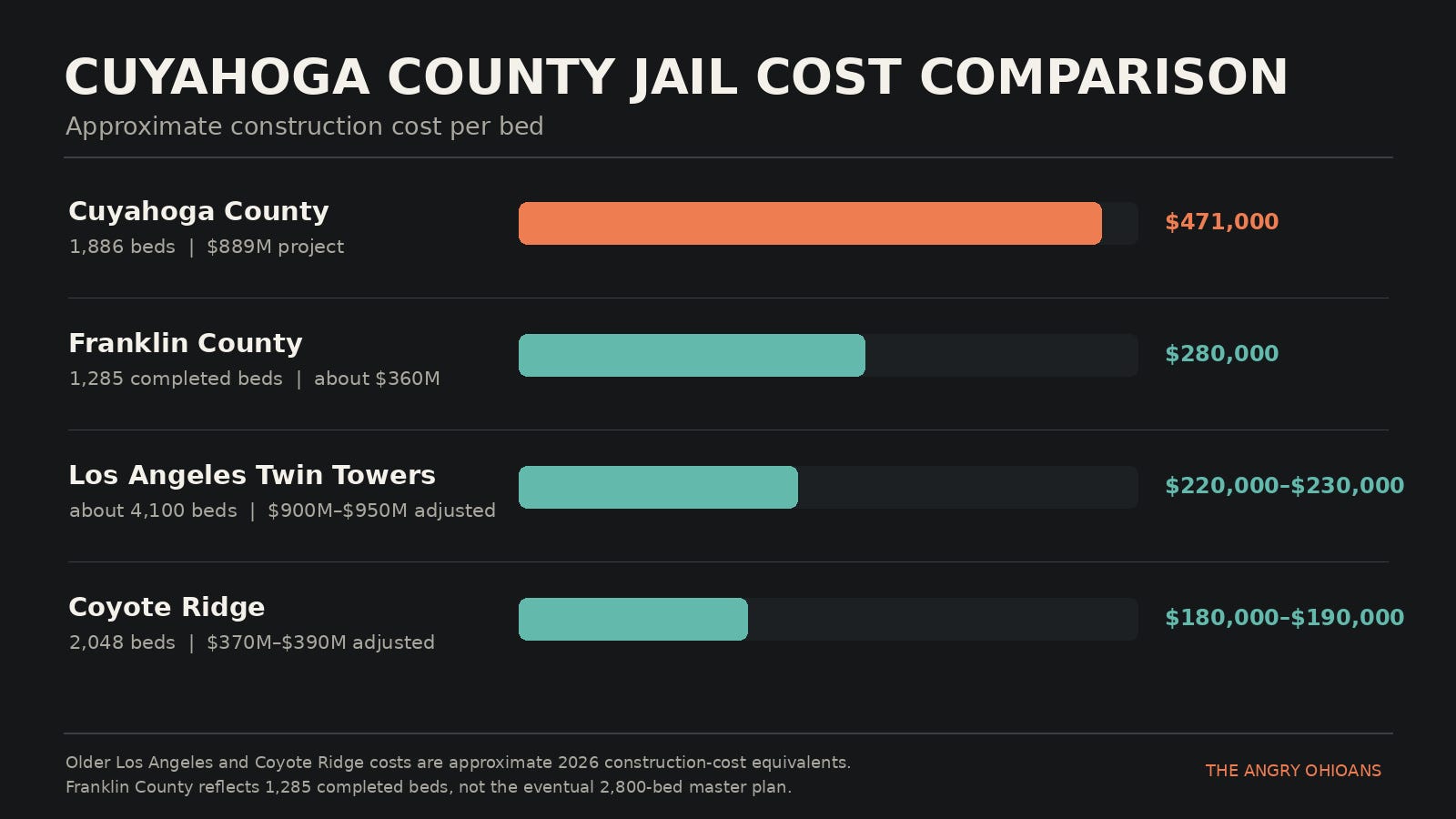
Franklin County’s completed corrections center contains approximately 1,285 rated beds and cost about $360 million, or roughly $280,000 per bed. It is a modern facility with medical care, mental-health treatment, addiction services, behavioral programming, direct supervision, reentry support and substantial natural light.
Cuyahoga County is proposing many of those same services while spending approximately $191,000 more per bed. That makes Cuyahoga’s project about 68 percent more expensive per bed than Franklin County’s.
The Los Angeles Twin Towers complex opened in 1997 with approximately 4,100 beds and originally cost $373 million. Adjusted to 2026 construction costs, the entire project would cost roughly $900 million to $950 million, or between $220,000 and $230,000 per bed.
That means Cuyahoga County is spending more than twice as much per bed as the inflation-adjusted cost of the Los Angeles Twin Towers complex.
Coyote Ridge in Washington provides another direct comparison. The 564,000-square-foot campus added 2,048 beds and included medical, dental, mental-health, educational, vocational, recreational and industrial facilities. Adjusted to 2026 construction costs, the project would cost approximately $370 million to $390 million, or between $180,000 and $190,000 per bed.
Cuyahoga County is spending approximately two and a half times as much per bed as Coyote Ridge.
The numbers are not close:
Cuyahoga County: $471,000 per bed
Franklin County: $280,000 per bed
Los Angeles Twin Towers: $220,000 to $230,000 per bed
Coyote Ridge: $180,000 to $190,000 per bed
Cuyahoga County’s nearly half-million-dollar cost per bed is not the unavoidable price of building a modern jail.
It is an extraordinarily expensive project that county officials have failed to justify.
How Does Cuyahoga Compare Internationally?
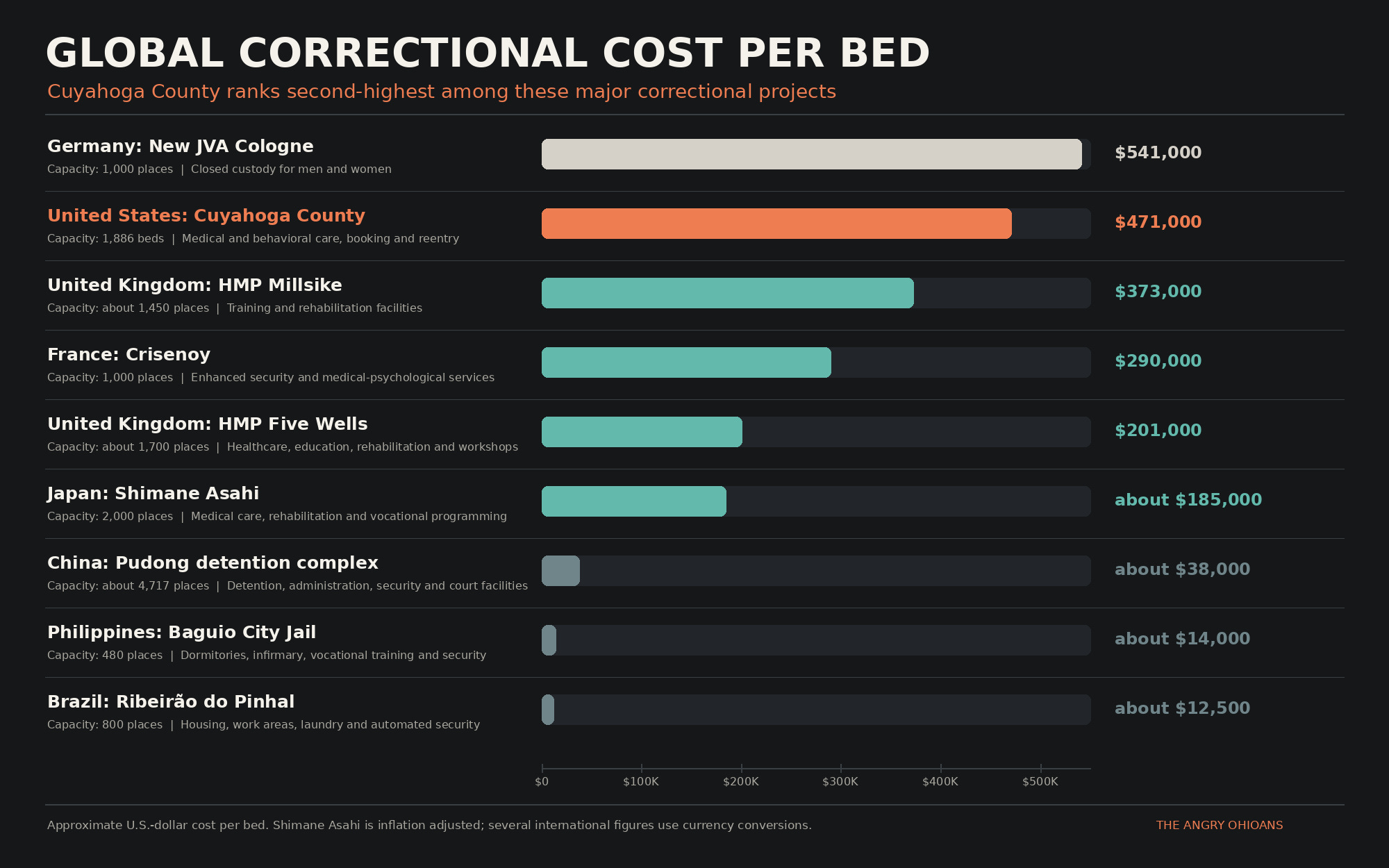
Germany’s planned JVA Cologne replacement is the only facility in this comparison that costs more per bed than Cuyahoga County. Every other major project costs substantially less.
Cuyahoga is approximately 26 percent more expensive per bed than HMP Millsike, 62 percent more expensive than France’s Crisenoy prison, 134 percent more expensive than HMP Five Wells and 155 percent more expensive than Japan’s Shimane Asahi Rehabilitation Program Center.
The comparison with HMP Five Wells is especially damning. Five Wells opened in the United Kingdom in 2022, so this is not an outdated facility built under completely different financial conditions. It contains housing blocks, healthcare, workshops, education, rehabilitation programs and modern security systems.
Five Wells provides approximately 41 square meters of space per prisoner. Cuyahoga County plans approximately 44 square meters per bed. The facilities provide nearly the same amount of physical space per person, but Five Wells cost approximately $201,000 per bed, compared with $471,000 in Cuyahoga County.
Cuyahoga is spending more than twice as much per bed without providing twice as much space.
France’s planned Crisenoy prison makes the cost even harder to defend. Crisenoy will contain approximately 1,000 places, multiple custody classifications, enhanced security and medical-psychological services. It is expected to cost approximately $290,000 per bed.
Crisenoy provides roughly 50 square meters per prisoner, compared with Cuyahoga’s 44 square meters. France is building a facility with more space per person, enhanced security and specialized medical services while spending approximately $181,000 less per bed.
Japan’s Shimane Asahi Rehabilitation Program Center holds 2,000 people and includes medical care, education, vocational training and extensive rehabilitation programming. After adjusting its construction cost for inflation, the facility comes to approximately $185,000 per bed.
Cuyahoga County is spending more than two and a half times as much per bed.
The projects in China, the Philippines and Brazil were built under different wage, regulatory, construction environments, human rights and dignity environments, but the size of the difference is still staggering.
Cuyahoga’s cost per bed is more than 12 times the Pudong detention complex, more than 33 times the Baguio City Jail and nearly 38 times the Ribeirão do Pinhal prison.
The international comparison is clear. Cuyahoga County is not paying an ordinary price for a modern jail. It is paying one of the highest prices per bed in the developed world.
The county cannot explain away those differences by listing medical care, mental-health treatment and rehabilitation services. The other facilities provide those services too.
Cuyahoga County is simply spending far more and county officials do not know exactly why.
What Are We Actually Buying?
The county will respond that this is more than a jail.
Fine. Let’s look at what is included.
The proposed campus contains jail housing, single cells, four-bed cells, dormitory housing, restrictive housing and specialized behavioral-care units. It also includes a 26-bed infirmary, dental care, dialysis, diagnostic services, laboratory testing, a pharmacy, physical therapy and telemedicine.
There will be mental-health and substance-abuse services, central booking, reentry assistance, visitation, programming, video courtrooms, recreation, sheriff’s administration, staff facilities and professional-development areas.
Those are substantial features. Many are necessary.
People being held in a county jail deserve dignity, medical care, mental-health treatment and protection from abuse. Many are awaiting trial and have not been convicted of a crime. Humane treatment is not the part I object to.
What I object to is county leaders acting as if listing those services automatically explains an $889 million budget.
It does not.
One estimate was approximately $85.8 million for HVAC work alone, or almost $100 per square foot across the planned campus. WTAF!~
For comparison:
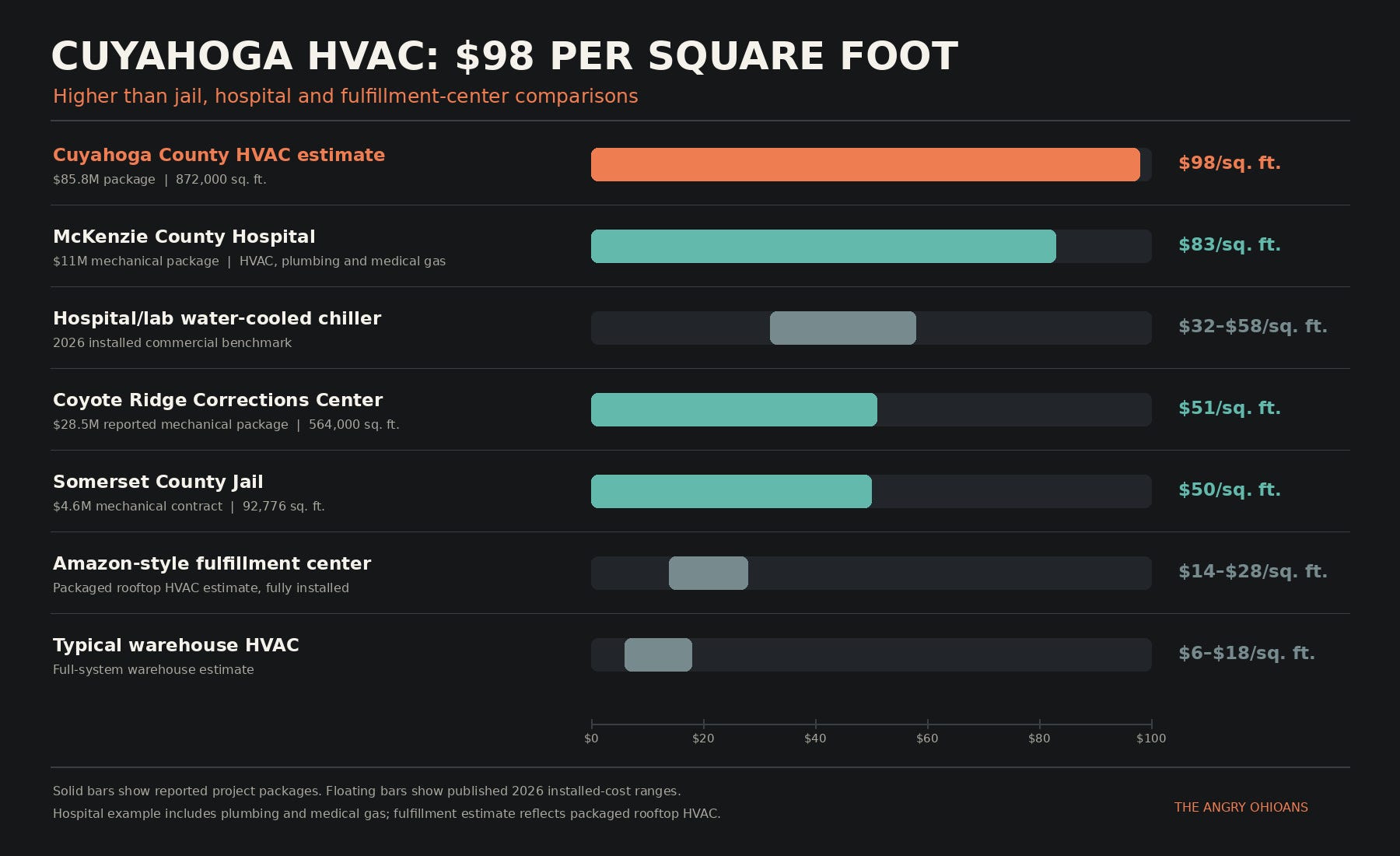
Cuyahoga County’s HVAC estimate is approximately $85.8 million for 872,000 square feet, or about $98 per square foot. The more facilities we compare it with, the harder that price becomes to explain.
Coyote Ridge’s reported mechanical package cost approximately $51 per square foot, while the Somerset County Jail mechanical contract cost about $50 per square foot. Cuyahoga’s estimate is nearly twice both correctional-facility comparisons.
The hospital comparison is even more revealing. The McKenzie County Hospital project had an $11 million mechanical contract for 132,380 square feet, or approximately $83 per square foot. That contract included HVAC, plumbing, medical gas and equipment. Cuyahoga’s HVAC estimate alone is approximately 18 percent higher per square foot than that broader hospital mechanical package.
Published 2026 commercial benchmarks put fully installed water-cooled chiller systems, commonly used in hospitals and laboratories, at approximately $32 to $58 per square foot. That range includes equipment, ductwork, piping, controls, startup and balancing. Cuyahoga’s $98 estimate is approximately 69 percent higher than the top of that range. Terrapin Construction Group
Large Amazon distribution and fulfillment facilities use commercial rooftop units, air-rotation systems and building-management controls. One documented Amazon distribution-center project used two 40,000-CFM air-rotation units, approximately 400 tons of cooling capacity and a comprehensive building-management system. A fully installed packaged rooftop HVAC system currently runs approximately $14 to $28 per square foot.
Even using the top of that range, Cuyahoga is spending approximately three and a half times as much per square foot as an Amazon-style fulfillment center. Compared with the lower end, Cuyahoga is spending about seven times as much.
A complete warehouse HVAC system generally costs approximately $6 to $18 per square foot, including equipment, ductwork, installation and basic controls. Cuyahoga’s estimate is between five and 16 times that warehouse range. AC Direct warehouse HVAC estimate
Cuyahoga County’s $98-per-square-foot estimate exceeds other jail projects, exceeds an actual hospital mechanical contract and towers over the cost of cooling a massive fulfillment center.
County officials need to explain exactly what taxpayers are receiving for $85.8 million.
This Is What Failed Oversight Looks Like
There has been no meaningful oversight of this project. Cuyahoga County allowed the estimated cost of its new jail to rise from around $500 million to nearly $900 million, and county leaders still cannot clearly explain why it costs approximately $471,000 per bed.
County Prosecutor Michael O’Malley asked the Ohio Auditor’s Public Integrity Unit to investigate whether county officials advanced the project and spent public money without obtaining approvals required under state law. When your own county prosecutor is asking the state auditor to investigate how money was spent and whether the project was legally approved, the oversight process has already failed.
County Council then extended a 0.25 percent sales tax for another 40 years to finance the project. The extension passed by a 6-5 vote without being placed before county voters.
Now taxpayers are expected to finance nearly $900 million for the jail while the county commits up to another $200 million to courthouse renovations. Together, these projects push the county’s justice-system construction commitments beyond $1 billion. I promise we will see them ballon to $1.5 - $2 billion.
This is fiscal irresponsibility and failed leadership. A project does not climb by hundreds of millions of dollars without people making decisions, approving contracts and spending public money. When those decisions produce one of the most expensive correctional facilities in the country, taxpayers have every right to ask whether this is incompetence, corruption or both.
County Council should stop authorizing money until an independent audit is completed.
The county must publish the guaranteed maximum price, every major contract and subcontract, the entire $85.8 million HVAC scope, every change order, every design revision and every bid comparison used to justify these costs.
“Modern jails are expensive” is not an answer. It is an excuse being used to avoid explaining where nearly $900 million is actually going.
This project is outrageously expensive, and the people approving it have failed to provide the oversight taxpayers deserve.
Not another dollar should be authorized until Cuyahoga County opens the books and shows the public exactly who is being paid, how much they are receiving and what taxpayers are getting in return.