

We all have been getting these weird-ass text messages and mailers from Max Miller’s Jobs and Prosperity PAC saying that Ed FitzGerald is “too liberal” to represent us. I’ve gotten three of these mailers myself, and then Fitzgerald turns around and sends two of his own trying to spin it to his advantage. And the whole thing just feels… a little too on the nose.
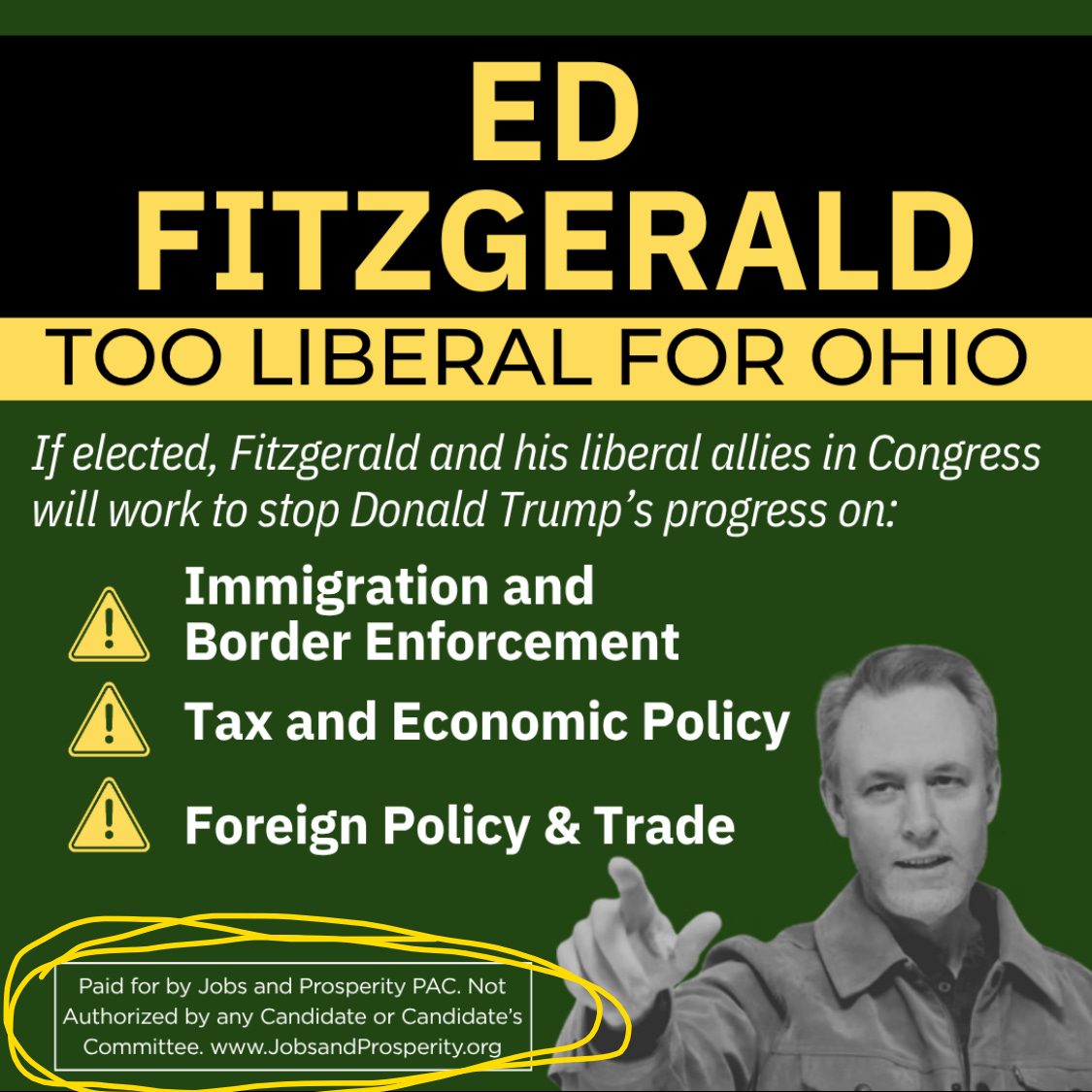
What really got me wasn’t even the mailers. It was the narrative around them. People kept saying, “Oh, Max is sending these to trick Democrats into voting for Fitzgerald.”
I put on Facebook, that’s the dumbest thing. Why would anyone fall for that? Why would Max think voters are that stupid? And more importantly, Max isn’t that dumb… Right?
So I started trying to over think it. Maybe there’s more to it? Maybe he’s trying to push Fitzgerald down so he can get to someone else. Maybe it’s about shaping the field, not just influencing voters. It had to be something more complex than this clumsy, obviously failure of a play… Right?
And to my chagrin, I was fucking wrong.
I reached out to a friend of mine, Aaron Fisher, Partner at Statecraft Media who does this for a living. He runs media strategy at Statecraft and does this exact thing for campaigns across the country. So, I asked him directly, what the hell is this?
He set me straight. I even tried to tell him my alternate theory… and he cut me off. Here is what he said.
According to Aaron, what we’re seeing here is a relatively standard political tactic. The goal is to influence the outcome of the opposing party’s primary by helping elevate what is perceived to be the weaker general election opponent.
In this case, the thinking from those backing Max Miller is that Ed Fitzgerald represents the more beatable candidate in a general election. That assessment likely stems from Fitzgerald’s past performance, particularly his unsuccessful 2014 gubernatorial run, which provides a record that can be used against him. And well all the scandal around that race. Still even over decade later we are asking, why didn’t he have a valid drivers license. Weird eh?
So instead of attacking him in a traditional way, the strategy flips the message. The mailers frame Fitzgerald as “too liberal,” with the expectation that Democratic primary voters will interpret that as a positive signal and rally behind him. It’s a form of “reverse psychology” designed to manipulate how voters perceive the candidate.
Aaron pointed out that this approach has worked before. He referenced the 2012 Missouri Senate race involving Claire McCaskill and Todd Akin. In that race, McCaskill’s campaign actively worked to boost Akin in the Republican primary by portraying him as “too conservative,” knowing that Republican voters might respond positively to that framing.
The strategy succeeded. Akin won the primary, and McCaskill went on to defeat him in the general election, in part because his controversial statements made him an easier target.
That said, Aaron doesn’t think this current execution is particularly strong. Actually it is just dumb.
He made two key points.
First, Democratic primary voters are generally more engaged and way smarter than the voter base that was targeted in the Missouri example (looking at you Republicans) :-). Democratic primary voters are more likely to recognize this kind of tactic for what it is, which reduces its effectiveness.
Second, the messaging itself is very out of touch with democratic primary voters. The word “liberal” does not necessarily resonate the way Republican consultants think it does.
Within parts of the Democratic electorate, especially on the left, “liberal” can carry associations with establishment or corporate-aligned politics. Aaron says that if the goal was to influence Democratic voters, framing Fitzgerald as “too progressive” would likely have been more effective.
So while the tactic is legitimate and has historical precedent, Aaron’s view is that this particular version is just poorly executed to the audience it’s trying to influence.
All in all just dumb.
The driver’s license thing…duly noted.
Okay, we can review Ed’s recent political career fairly easily in that he hasn’t had one. Twelve years ago is an eternity. And, for Christ’s sake, he hasn’t been a legislator in nearly twenty years and he is running to be one again. As I recall from my time in Lakewood, he was a very competent legislator.
Making a return to the political arena at this time makes perfect sense for Ed. Assuming he is elected to run off against Minimum Miller, the notorious lapdog of the Spray-tanned Sphincter, Ed would do well to dust off the effective political chops he showed while sitting on Lakewood council. Minimum needs to be careful what he wishes for. Ed Fitzgerald will likely give him everything he wants…and some of what he doesn’t, no doubt.
If only they would tell me what they are for—-instead of who they are better than. Ick. I’m saving the postcards…and counting the $ behind them.