

Hey everyone, Matt the Angry Ohioan here.
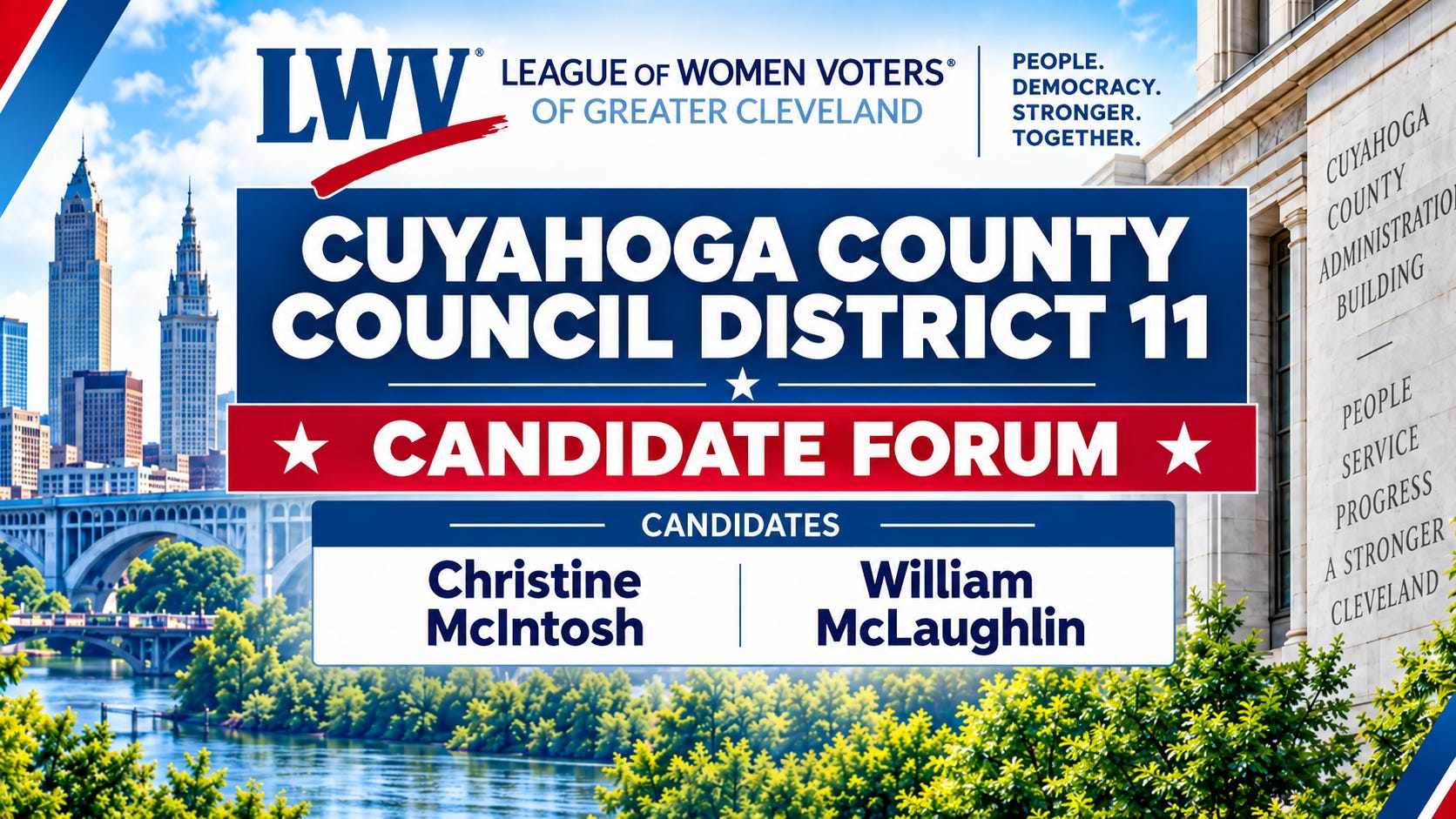
Today we are looking at The League of Women Voters forum for the Cuyahoga County Council District 11 race between Christine McIntosh and William McLaughlin. This was another really interesting forum, and I’m going to go through it.
First, I’m going to give you a TL;DR with my overall take on the forum, the central message from each candidate, and what stood out to me.
After that, I’m going to go question by question and give you my reaction to each answer.
Finally, I’ve cleaned up the transcript of the questions and answers so you can read exactly what the candidates said without having to sit through the entire forum and without my commentary mixed into their answers.
As always, I’m not changing what the candidates said in the full transcript. I’m just cleaning up the transcript for readability and separating everything out so it’s easier to follow.
You can watch the full forum here:
TL;DR
Before we start, I want to say that these were probably the best questions I’ve seen so far in a County Council race. I felt like the District 5 forum wasn’t nearly as straightforward in the way the questions.
This set of questions was efficient, clear, and covered a broad range of issues that are actually on people’s minds. I thought this was exactly the kind of questioning I was looking for in a County Council race. Let’s get into it.
I just listened to this entire conversation between Will and Christine.
I answered each question with my Matt’s Takes, like I always do, but to be perfectly honest, I’d rather summarize this one because I was getting a little frustrated. So I will not post my answers to each question because I do not think I was helpful. I hope my summary is.
I’ll explain why.
Will seems well-intentioned. They both seem well-intentioned.
But in my opinion, neither one demonstrated much innovation, creativity, or vision for the seat, just in two very different ways.
Will answers questions like we should already know what he’s talking about.
His answers are disjointed, a little all over the place, and he often mixes multiple thoughts into one response without really answering the question that was asked.
He also bases a lot of his policy thinking on personal experience.
That may be what is best for him personally, but that does not automatically mean it is what is best for the county.
That concerns me.
At the same time, Will shows up.
He does the work. He goes to meetings. He is involved. He has been working in and around government for decades.
And that actually makes me think a lot of his answers are coming from a wealth and depth of historical knowledge, meetings, projects, and conversations that he has sat through over the years.
The problem is that he seems to be coming from a place of knowing too much and not understanding that the people listening to him are not coming from the same place.
You have to explain more.
You have to tell us what you are actually thinking.
You cannot assume that everybody listening already understands the context behind whatever meeting, project, committee, or historical reference you are bringing up.
And even with all of that experience, it often sounds like he is simply repeating or regurgitating something he heard in a meeting rather than demonstrating that he heard the information, thought about it, digested it, and came up with actual solutions to the problems he is going to face on County Council.
That is what I wanted to hear.
Listening to Will answer these questions was frustrating.
Again, I genuinely think he is well-intentioned and coming from a good place.
But even though I can feel that, I did not hear a clear vision for what he wants his role to be.
Christine is completely different.
Over the course of an hour and 21 questions, I rarely heard an answer grounded in a clear vision, a specific idea, or a conviction that told me who she is, what she wants, and what she believes Cuyahoga County should look like.
Everything was a committee.
Everything was, “That’s what I do. I talk to people.”
Sit down with this bureaucracy.
Talk to this office.
Bring in this department.
Get these stakeholders together.
Get more feedback.
Get the data.
Get the research.
Yes, you need data.
Yes, you need research.
Yes, you need to talk to people.
We get that.
That could have been an opening statement. It could have been a closing statement.
But what do you envision?
What is your vision for the lakefront?
What is your vision for county services?
What is your vision for housing in Cuyahoga County?
What is your vision for the law department and checks and balances on the executive branch?
How do you envision your own job?
What does the Cuyahoga County you want to live in actually look like?
I did not get that.
What I got was, “I’ll talk to people in meetings, departments, committees, and bureaucracies.”
And at the end of that process, maybe we will find out what she believes.
That is expensive.
That is time-consuming.
And I guess voters are supposed to roll the dice and see what kind of County Council member they get depending on how those conversations go.
What makes that even more frustrating is that Christine repeatedly talks about having already been involved in these conversations because she is passionate about these projects and these issues.
Okay.
If you are that passionate and have already been involved in all of these discussions, where is the vision?
If I had to summarize the difference between the two, I would say Will at least seems to have clearer instincts about what he wants out of County Council and Cuyahoga County, even if he struggles badly to explain them.
Christine seems to be saying, “I’m going to talk, research, convene, and collaborate, and then we’ll figure out the solution.”
But I still do not know what her solution is supposed to look like.
This was super frustrating to listen to because nobody really stood on business.
Nobody created a clear identity.
Nobody gave me a compelling vision of where they want to take the county.
And I am left with more apathy than inspiration.
TLDR summary (or the summary’s summary):
Will often gives answers rooted in personal experience and accumulated institutional knowledge but does not always connect those details into a clear policy prescription.
Christine more consistently gives process-oriented answers centered on planning, collaboration, research, and stakeholder engagement, but often stops short of stating a sharply defined end-state or personal policy vision.
Full Transcript
Introduction
Alice Allen: Good evening and welcome to this forum sponsored by the League of Women Voters of Greater Cleveland. My name is Alice Allen. I’m the co-chair of the Rocky River chapter of the League of Women Voters and I will be moderating tonight’s forum.
The League of Women Voters is a nonpartisan organization devoted to defending democracy and empowering voters. As part of our efforts to defend democracy, the League of Women Voters is honored to be part of the nonpartisan Election Protection Coalition, which works year round to ensure that all voters have an equal opportunity to vote and have that vote count.
Election Protection provides Ohioans from Lake Erie to the Ohio River with nonpartisan information and assistance at all stages of voting from registration and voting and voting early absentee and on our and on election day to overcoming obstacles to to the ballot. Voters can text or call 866 our vote to get assistance in real time.
There are also hotlines available in Spanish, Arabic, and AAPI languages. We also need poll monitors to visit the Cuyahoga County Early Vote Center and area polling locations on election day to help voters by answering questions and reporting problems so that LWV and our partners can work with election officials to get them resolved.
Every poll monitor will be trained and provided with all the materials they need. Please join the League of Women Voters of Greater Cleveland and the Election Protection Coalition in helping every eligible Ohioan have their voices heard.
To volunteer or get more information about election protection, please visit our table after the event, visit our website at lwvgreatercleveland.org or email us at voterservice@lwvgreatercleveland.org.
Thank you to the Euclid Public Library for hosting our forum this evening.
Tonight we’ll be we will be hearing from candidates seeking election to the Cuyahoga County Council District 11 seat. Christine McIntosh and William McLaughlin.
The League of Women Voters is a nonpartisan political organization which means we do not support candidates or political parties. We work for informed and active participation in government and for good government policies.
Before we begin, a quick review of the rules.
We ask candidates and their supporters to refrain from wearing partisan items such as campaign buttons inside this room. Campaign materials may be placed on the literature table outside the room.
Candidates must appear in person and at the time slotted for the race. No stand-ins are permitted.
Each candidate will have equal time for opening statements and a final closing statement of 2 minutes. Responses to questions will be limited to one minute. Time limits will be strictly enforced.
Our timer will give candidates a 15-second warning, yellow, and a signal when their time has ended, red.
Candidates are asked to address the audience or the moderator, not each other. And we remind candidates that this is not a debate.
Our audience may submit questions on one of the cards handed to you when you arrived and are available from volunteers up front here. You can also email your questions to forums@lwvgreatercleveland.org.
The league reviews these questions to avoid duplication, to provide a diversity of questions, and to ensure clarity and appropriateness before handing them to our moderator. Questions must be addressed to both candidates.
Filming is not allowed in this room except for our official videographer. No one is permitted to post partial or edited clips of tonight’s forum.
We ask that everyone silence or turn off their mobile phones.
Finally, we ask the cooperation of the audience in avoiding expressions of support or opposition to any candidate during this evening’s program.
Please remember the purpose of this evening is to hear from the candidates so that each resident might make their own best informed decision regarding their vote and any vocal interruption takes time away from the candidates.
This is not a debate or campaign rally. Anyone creating a disruption disruption will be asked to leave.
County council members serve four-year terms and um they are not term limited. They must be registered to vote in Cuyahoga County for at least two years prior to declaring their candidacy. The annual salary for the position is $56,91.15.
We have asked each candidate to prepare an opening statement describing their training, how they view the job of county council member, and how their skills are relevant. They will each have two minutes.
Speaking order is determined alphabetically by last name, followed by roundroin responses. Closing statements will be given in reverse alphabetical order.
So now I turn it over to Ms. McIntosh for her opening statement.
Opening Statements
Christine McIntosh
Good evening and thank you to the League of Women Voters. uh the Euclid public library and everyone here this evening.
My name is Christine McIntosh and I’m running for Cuyahoga County Council here in District 11, which includes Euclid, South Euclid, Beachwood, Lyndhurst, Richmond Heights, and Highland Heights.
Because at this level of government, experience matters.
Since January, I’ve met with mayors, council members, and residents across our district. A clear theme emerges. People want accountability, accessible county programs, transparent communication, and seamless coordination between local and county government.
County Council sets the policies and budget that shape health and human services, public safety, housing stability, and regional economy.
Delivering real results requires someone who understands how policy moves from an idea to real world execution.
As a former Euclid city council member, I drafted legislation, navigated complex budgets, and built cross municipal coalitions.
As a professional city planner, I manage large-scale capital projects, oversee grant funding, and coordinate daily with our partners at the county, state, and federal levels.
I’ve been the legislator writing policy, the planner implementing it, and the resident impacted by it.
On county council, I will serve as a fiscal watchdog, a rigorous program evaluator, and an active technical resource for our communities.
My focus is on fiscal responsibility, responsive public safety, protecting vital human services, and sustainable regional infrastructure.
With a Bachelor of Public Administration from Cleveland State University, and advanced studies in city and regional planning, I am ready to serve on day one.
Thank you, and I look forward to your questions.
William McLaughlin
Yes, I’m William McLaughlin. My experience is quite different.
I have a BS in civil engineering from University of Maine and I worked for the city of Cleveland in the engineering department for 35 years. For 30 of those years, I was a licensed professional engineer in the state of Ohio.
We worked ma basically on roads and anything that goes on in the roadway. We coordinated projects with the city, the county, the state, the federal public and private work.
I’ve worked with ODOT as a coordinator for ODOT projects.
I also uh worked on the redevelopment of Public Square up until uh basically 2008 when I retired.
My other engineering experiences include the Wheeling Lake Erie Bikeway, which I think is now the Morgana Run Trail.
After I retired for a while, I worked as a temporary employee for the board of elections doing everything from poll worker rover uh doing the mail in the board of elections and working the absentee ballot nurses nursing home sections where I went from nursing homes, hospitals or people who home the people who needed to vote.
I traveled with my pair of the opposite political party.
I’m worried about the county budget, especially the jail.
I’m involved in the City Club of Cleveland. I also go to a Friday lunch discussion group at Case Western Reserve.
Thank you.
Question 1: Major Issues Facing District 11
Question: What are the top two or three major issues impacting this district? And how would your approach on council directly improve the lives of your constituents?
William McLaughlin
I think the greatest issue in this district and the entire county is the budgets of the county and the local cities.
Uh the other district or the other part is public safety. I I we need to make the population feel safe in the cities.
Thank you.
Christine McIntosh
Thank you. Um, I think the top two to three issues specific to District 11 are maintaining essential services and critical capital projects that require the county’s budget to be sustainable long term.
Um, as your representative, I’ll focus on rigorous oversight so vital human services and infrastructure dollars actually reach the neighborhoods and residents who need the most.
Equally essential is public safety that builds true security, ensuring that every district 11 neighborhood feels protected and supported.
Thank you.
Question 2: Transparency and Ethics
Question: How would you promote transparency and ethics in county government and how would you keep constituents informed about council decisions?
Christine McIntosh
Sure. Thank you.
So I think this is where my former elected experience comes into play. Um and as well as my current uh planning experience.
So I have held uh regular meetings for constituents um public engagement sessions, educational workshops. Um so very very uh versed in how to how to organize those and uh draw folks to them in order to bring resources to them.
I believe that we need to meet folks where they are um and doing that in their communities.
Um I apologize. What was the rest of the question?
Moderator: How how would you keep constituents informed?
Christine McIntosh: Informed. Thank you.
Uh so also while I was on city council, um I put together regular newsletters. So I would continue to do that, have um in-person forums and meet and greets and just stay visible.
Thank you.
William McLaughlin
Yeah. Well, we need to basically have smaller community meetings uh throughout the district because uh even though we’re all inner ring suburbs, the issues are different.
Uh I have no formal proposal for a newsletter, but I would like to hold meetings like this monthly in each of the cities.
What was the letter?
Moderator: Um, how would you promote transparency and ethics in county government?
William McLaughlin: No. Uh, basically we need an ethics organization and part of our job as councilman would be to inform the public and watch the county administrator to make sure that he is doing his job.
Thank you.
Question 3: Property Taxes and Budget Priorities
Question: The county has to balance rising costs against residents concerns about property taxes. How would you set budget priorities and what criteria would you use to decide what gets funded?
William McLaughlin
This is of this is of great importance to me. I have a son in a group home. He’s been there for several years.
I know that the health and human service levy is coming up and I support that.
We need to also watch the funding of the jail which I am seriously worried about not the location but the budget.
I do not think there’s enough transparency in the budget and uh we pro we should provide some help with the especially the inner ring cities towards maybe a grant or something like that something like what one south Euclid does.
Thank you.
Christine McIntosh
Do you mind repeating the question?
Moderator: I don’t mind. The county has to balance rising costs against residents concerns about property taxes. How would you set budget priorities and what criteria would you use to decide what gets funded?
Christine McIntosh: Sure.
I think uh you know rising costs, inflation and affordability is a very hot topic right now and and with good reason.
I think households are impacted by the decisions that are made by governments at every level including the county uh state and federal levels.
So managing increasing property taxes uh the county has done a great job in trying to get information out to property owners uh getting folks on payment plans and those types of resources need to continue and uh and be shared with those who may not understand that they’re available to them.
Um otherwise you know just affordability in general uh we need to ensure that development that’s occurring is not happening to the detriment of vulnerable populations and really we need to deliver direct tangible community returns and ensure that everybody has access to opportunities.
Thank you.
Question 4: Regional Issues
Question: How should the county approach regional issues that cross city lines such as transportation, water quality, and land use?
Christine McIntosh
Sure.
So, I think, you know, effective regionalism starts first with listening to local communities and respecting their unique priorities.
Um and that might mean that some services end up becoming more redundant and there’s an opportunity to share those to stretch municipal budgets and eliminate those redundancies.
But we have to ensure that high quality uh service delivery for residents is is maintained.
Um, I would leverage the county planning commission to, um, study, provide research and data on on those items that you mentioned, environmental concerns and and affordability.
Um, have them equip our local leaders and residents with clear planning, modeling, um, acting as a collaborative convenor who helps cities partner together when and where it makes sense.
Thank you.
William McLaughlin
I I worked for the city of Cleveland for basically 35 years. I lived in Cleveland Heights before I was married and after we got married I moved to South Euclid.
The main reason for this is for most the days I took an RTA bus to downtown and back.
We do need to coordinate public safety. I know the county deputy sheriff’s have helped out at local events coordination.
Uh housing is a big need and I know I know they cannot take care of the houses but put a plan together to help the local cities through planning and stuff like that for housing.
Al also I know most of cities have uh fire department uh sharing.
Thank you.
Question 5: Inter-municipality Cooperation
Question: What is your vision for intra-municipality cooperation in the future of the county?
William McLaughlin
Each city is an individual government.
I know we have uh what 57 separate cities. Uh the school district districts are one of the ways they cooperate and as I said the uh police and fire uh emergency uh coordination uh is that.
And one of the big things that I was involved in the in August of my 50-year high school reunion there was a there was a shooting standoff on Elwood in South Euclid.
I spent the night in the community center and I had a University Heights police woman at the end of my block.
Thank you.
Christine McIntosh
So I think this question also kind of goes back to the the just the last one about uh collaboration and regionalism and I would use my experience and skills as a convenor um as somebody who can bring folks together to discuss what pressing issues are facing communities and what resources are available um to to either take a deeper dive into what what issues might exist, what challenges and opportunities exist.
Um, I think the county planning commission could serve a role here as far as um being that umbrella organization to to lead a planning study in some way if that was something that governments wanted to explore.
Um, but I I would tap into my my collaborator and convenor uh self um and and use that role to to try to move forward.
Thank you.
Question 6: Avoiding Gridlock and Factionalism
Question: Council and the county executive don’t always agree. Can you give examples of how you would work to build a county government that avoids gridlock and factionalism?
Christine McIntosh
Yeah, I have been uh pretty dismayed at some of the public spats uh that have been ongoing over the course of this year and really believe that that’s not that’s not really a good resource of our taxpayer dollars.
So what we need to do is um get ourselves together. We need to have professional conversations.
Uh we need to be very open and honest and transparent about the challenges that we’re facing and come to some level of agreement as and listen uh to understand and not listen to respond.
Thank you.
William McLaughlin
We each elected councilman represents a a district.
What we need to do is get the councilman to talk about common problems.
And if the executive gets out of line or does not want to listen to the majority, we have to talk to him and convince him that uh it’s better.
The relocation of the jail took uh two three years.
And I know there is some questions about the Browns stadium, which the county has a minor role in, but we have to remember that we everybody lives in the same county and what benefits one of us benefits all of us.
Even though we vary by economic and political views, we basically have to trust and talk to each other.
Thank you.
Question 7: Public Financing of Large Projects
Question: How should the county weigh requests for public financing of large private or public private projects? What would you need to see before supporting or opposing such a project?
William McLaughlin
One of the jobs that I had with the city of Cleveland is preparing issue two applications, which I believe now is issue one.
They are federally funded, state funded, highway construction and they basically the different cities have different match ratios based on economics.
That money has to be shared on a regional basis on a regional amount.
Basically other programs. We need more coordination amongst the cities sort of like the partnership on aging which is the local community for South Euclid, Lyndhurst, Highland Heights, Mayfield Heights and Mayfield Village.
They run a project for the seniors.
Thank you.
Christine McIntosh
So this is another area where um my current government experience and former elected role would come into play.
I’ve sat in conference rooms and and offices where we’ve discussed potential development projects and have talked through you know the pros and cons of of any given um idea or concept.
And what always um sticks with me is what is the ultimate benefit for the community?
And that doesn’t mean that it would be necessarily a financial benefit, but are there quality of life improvements? Are there infrastructure improvements? Some challenge that can be addressed in that in that development project.
So, um I think also understanding what the county’s role would be in that development project.
Is there a level of financing involved? What is that mechanism?
And ultimately, what is the community benefits agreement uh that the developer would sign on to?
Thank you.
Question 8: Data Centers and Local Communities
Question: How much say should local communities have in approving data center projects?
Christine McIntosh
So that’s a hot topic right now I think across every municipality and every town and village and every state of this country and probably the world.
Um so this is something that has I think gotten away with from us and um we’re seeing a lot of municipalities put on moratoriums for data center development.
Um but I think the you know the honest reality is that these projects are going to continue. The proposals will be ongoing. AI is here to stay.
Um and we need to make sure that these developments are done responsibly.
Um, so understanding resident concerns and ensuring that wherever they’re developed, they are not causing some negative or detrimental harm to neighborhoods and to residents, whether it’s utilities, uh, energy costs, um, and infrastructure.
Um, we need to ensure that it’s fair and that the government and ultimately the taxpayers are not funding the negative effects from those.
Thank you.
William McLaughlin
I I’m worried about the uh electric grid.
If there is surplus grid, the data center is going to suck it up so no one else can use it.
I know some data centers are building gas turbines or they’re even looking at small nuclear power plants so they generate their own power.
If the data center needs a new connection, they should be responsible for paying the cost of connecting to the grid or modifying the grid.
There’s also the concern about water.
They basically would use fresh water for cooling. And what happens that water? Do they have a cooling pond and recycle it or they take city water and basically use it once and uh put it in a pond or return it to the storm sewer system.
And I do not believe there should be a data center on every corner.
The different cities need to get together and coordinate where they go.
Thank you.
Question 9: Data Center Requirements
Question: What requirements, if any, should be placed on data centers for water use, electricity use, noise, and construction traffic? Should companies be required to publicly report their water and energy use?
William McLaughlin
Yes, they should, but they will need they’ll need to prepare a preliminary estimate for how much electricity, whether it’s generated on-site or offsite, and what their water consumption is.
Construction noise is temporary and can be limited to reasonable hours, but nobody wants to put a data center in a uh site that’s already uh had buildings on it.
Everybody wants to build a data center in virgin ground which has not had any contamination in it.
Thank you.
Christine McIntosh
Thank you for that question.
Um I think that this is an area where through development agreements um some of these items can be addressed and governments can request that there is transparency with with energy and and water usage, utility usage.
Um, and that’s all well and good, but somebody needs to ensure that that’s being enforced from the local level.
So, and ensure that the private companies are are following the agreements.
Um, I think, you know, just in general, planning for these types of developments is something that we’re a little behind on.
And again, I’ll reference the county planning commission. They’re a tremendous resource and can help us um with with land use data and environmental impact modeling and and zoning codes to to limit those disruptions and negative impacts.
Thank you.
Question 10: New County Jail and Justice Center
Question: What is your position on the new county jail and renovations to the existing justice center? What factors would guide your decisions related to these?
Christine McIntosh
Well, the jail um as has been mentioned has been a long uh development planning project and implementation project and it is underway.
Um so while there was a lot of debate about the location, it’s now going to be in Garfield Heights.
Um, and it will have more of a holistic approach uh to to behavioral health and and a way to reduce recidivism and and try to get wraparound services to folks so we can try to reduce the jail population.
Um I am a bit concerned while you know the the construction budget is is exceeding um original projections.
Um costs continue to increase and so making sure that we are scrutinizing every line item in that capital project budget is going to be crucial as well as upcoming needs at the justice center which I’m I’m grateful that there is some movement on that.
But there is more to come just like with uh very a lot of uh county facilities.
Um, and local facilities maintenance continues to have needs and we need to properly budget for those.
Thank you.
William McLaughlin
I was at the public meeting when they uh were proposing the jail on the old research oil center that was down in the flats off Broadway.
That was stopped because of environmental concerns.
I think we need a jail that looks more like the county workhouse site out in Warrensville Heights.
It has to be human and it cannot be basically a big tower.
Uh and as as far as the budget, as I said, I’m very concerned.
I would like to see cost projections and more importantly the maintenance projections for the site and the staffing.
Those costs will be yearly.
Everything else is basically hard.
And uh I don’t know if I like the site in Garfield Heights, but they had at least they made a decision to move.
Thank you.
Question 11: Housing and Affordable Homeownership
Question: With a mix of aging housing stock, high rental rates, and vacant properties, what is your plan to stabilize neighborhoods and expand affordable home ownership opportunities?
William McLaughlin
Uh, basically we are in a built up community and the only way to get anything new is basically to tear it down.
uh the population loss all these buildings cannot be reconstructed.
There has to be something different, some type of different use.
What’s your last question?
Moderator: Um what is your plan to stabilize neighborhoods and expand affordable home ownership opportunities?
William McLaughlin: Unfortunately, new construction costs.
Everybody wants a McMansion.
The h my house in South Euclid is basically 90 years old, but everybody wants a brand new uh house like they’re building down in the Little Italy and everything.
And those are not affordable to the average person and there’s not much you can do to uh bring those costs down.
The city of Cleveland has a land has a tax abatement for 15 years, but I think it’s better that it be staged in every five years instead of 100% for all 15 years.
Thank you.
Christine McIntosh
Thank you.
Um, you know, we’ve been seeing a lot of uh development and redevelopment over the past few years, and um I thought maybe the pandemic would limit some of that, but it’s ongoing.
Um there’s a lot of adaptive reuse projects that are very exciting and we should be continuing to support those so that we do eliminate the need for new construction um you know where applicable.
Um we have a lot our our communities have a lot of aged infrastructure and buildings and along with development uh comes um some some renovations of those systems.
um you know for housing affordability and and supports you know we should be tracking data.
We understand that it’s difficult for younger individuals and families to purchase their first home.
It’s happening later in life.
Um and there are mechanisms out there through community development corporations or other low interest loans.
uh banking institutions can can offer programs and we should be um asking for those entities to step up.
We also need to limit investor activity that does drive up housing prices.
Thank you.
Question 12: Blight and Historic Preservation
Question: Blight is a growing problem in a number of areas in the county. At the same time, numerous historic buildings have been demolished amidst public opposition. With examples, how do you balance the needs of reducing blight while preserving the character of communities?
Christine McIntosh
This is actually a a a passion topic for me.
Um, I’ve always been interested in in historic preservation and grew up in a community that didn’t value that and and eliminated a lot of old historic buildings to build new ones that just ended up becoming vacant.
Um, but I think addressing blight requires, you know, property remediation with the preservation balance with the preservation of neighborhood character.
Uh, the county land bank serves a vital role in this, an essential partner for municipalities.
Um, but our toolbox needs to be expanded.
So um we also need to view these uh these situations through strict enforcement of codes of local codes um holding neglectful predatory property owners accountable but then offer you know low interest means uh rehab incentives for for developers um and residents who are struggling to maintain their homes.
So to protect neighborhoods um particularly across the east side and inner ring suburbs um we need to leverage data driven strategies and organizations who research uh to strengthen code enforcement and protect housing stability.
William McLaughlin
In South Euclid, there’s a community group called One South Euclid.
They talk to business owners and I don’t know where else they get their grants, but they help repair houses.
They’ve uh rebuilt one or two houses for occupancy, but this is only one or two houses.
There is not enough money to fix everything as far as historic preservation.
that is a private property owner’s right.
Uh do do they have the me the the money to restore it properly and then rent the building out at an affordable rate or will you have a building that is historically perfect and vacant?
Thank you.
Question 13: Developmental Disabilities Levy
Question: What is your position on the county levy for the board of developmental disabilities?
William McLaughlin
I I support it 100%.
As I said, I have a son in a group home and he’s been there for several years.
That’s about all I can say on the subject and I do support the levy and I wish there’s one way to increase services to people like my son.
Thank you.
Christine McIntosh
So I think yes, I support uh the the levy for the board of developmental disabilities um as well as the health and human services levy.
Um, I think in an era of shrinking state and federal support, local governments are facing unprecedented pressures to maintain these types of services.
Um, and they’re critical to maintaining a safety net for for some of our most vulnerable uh, populations.
Supporting that requires a commitment to proactive, realistic budgeting as well.
Um, and we need to pair levy revenues with program um, oversight and, you know, our nonprofit partners evaluating their performance, make sure we’re eliminating duplication or redundancies in programs um, and ensure that we have measurable outcomes and also that every dollar that’s delivered uh, is is giving meaningful benefits back to the community.
Question 14: Health and Human Services Levy
Question: What is your position on the county levy for health and human services?
William McLaughlin
I support it.
Christine McIntosh
Yes, I support it.
Question 15: County Charter Review
Question: The Cuyahoga County Charter Review Commission is scheduled to convene next year. What structural reforms or updates do you believe should be a top priority?
William McLaughlin
Once I ran for charter view commission at South Euclid and wasn’t elected.
They have to select a wide group of people.
I don’t think it’s possible to elect them that almost have to be appointed maybe two from each district.
Uh, one thing is eight years ago there was county redistricting.
I was at a meeting at Cleveland State and I asked about where’s the data? They said it’s out there.
I have look I I have been on the uh mailing list for Mr. Husted’s redistricting.
I got on that because I was also on Jennifer Bruner’s list for redistricting and we should basically look at the charter.
I prep I prefer individual items instead of a group and to look up and be voted down.
And I hope the charter commission can submit things directly to the voters if the county council doesn’t approve.
Christine McIntosh
So charter review um is another item that I tend to have a little bit of experience in.
We had to do some of that here in Euclid while I was serving um and working in government.
Um so structural reforms, you know, the the county forms of government is still fairly new um in the scheme of things.
Um, and so there’s items that are are subjects that are popping up that maybe those who drafted the charter didn’t necessarily foresee.
Um, and so we’re seeing some of that, I think, you know, with some of the infighting between the executive and the prosecutor, you know, and the sheriff.
Um, and so making sure that whatever those that root cause of the instability or fragility, um, is being addressed within the charter review.
um and maintaining that there’s transparency with what that charter review is looking at, what they’re proposing, and ultimately what county council will vote on.
Thank you.
Question 16: Downtown Lakefront Development
Question: With the Cleveland Browns moving to Brook Park, opening up several acres of downtown lakefront, the scope of development has changed. What specific funding, infrastructure investments, or regional partnerships would you support to ensure public access and enjoyment?
Christine McIntosh
This is another uh a passion subject that I’m passionate about is how we use Lake Erie as the resource that it is and that and the economic uh mobility that can come from capitalizing on that asset.
Um, here in Euclid, we had a transformative waterfront improvements plan that really opened the doors to what new development along the lakefront could look like, what public access can look like, and how that gets funded.
Um, and the the the stakeholder groups and, you know, nonprofits or quasi governmental groups like um like development corporations and what role do they play in these types of of projects?
So, uh, you know, between the Browns stadium and ongoing questions about Burke, um, I think there we’re going to have our hands full in the future and making sure that we have educated, knowledgeable, experienced folks at that table to discuss the options uh, that can bring some of that that prosperity and new development forward.
Ensuring that there’s community benefits involved with anything is going to be critical.
Thank you.
William McLaughlin
While I was at the division of engineering construction, I was one of the people that reviewed the plans for the new Browns stadium.
They had to make several changes, relocate a storm sewer outlet and basically what can you use a land for?
But you have to remember that the Browns stadium and Burke are both on filled land and there are utilities, sewers, outlets, storm sewer outlets that run under Burke and you’d basically have to review what you can build there.
It’s just like the parks along the uh Shoreway.
At one time that was all park and it’s still park.
Now, with Burke, if you close Burke, you have to pay back all your federal aviation grants that are, I think it’s less than 25 or 20 years old, and it’s also a reliever airport for downtown.
Thank you.
Question 17: Lake Erie and Cuyahoga River Protection
Question: How will you ensure any new development strengthens rather than weakens the protection of Lake Erie in the Cuyahoga River?
William McLaughlin
Well, basically, as I said, you’re dealing with filled land and a lot of that was a garbage dump before filled land.
you would have to control the water outlet and basically most of Burke is develop or most of the lakefront is developed uh be it park uh or other systems.
And there’s also the old Dike 14 site which they place dredging on and it’s now a wild habitat that you can walk through.
For a long time, you couldn’t get out there.
And that is all.
Thank you.
Christine McIntosh
This is another area that I work in um on a daily basis, not necessarily remediating uh maybe some some toxic environments, but understanding what the current conditions are, working with our partners to understand that, get the data, get the research, understand what we’re faced with.
Um, and this is where we would lean on on trusted partners and environmental monitoring and consultants um who who do who may excel at waterfront planning, especially in a site like uh like the Browns stadium and and by extension Burke Lakefront.
Um, you know, there are ways that there’s emerging methods of trying to remediate in a more natural way.
Um and so I would be interested in seeing if we could be leaders in that and work with universities and other organizations to find some suitable methods um you know wetlands and they they can they can clean water and ensure high water quality and so how can we build those types of systems into any development.
Thank you.
Question 18: Independent Legal Counsel for County Council
Question: Under the current structure, the county law department provides legal representation to both the county executive and county council. Given potential disagreements between them, do you believe county council should have its own separate independent legal counsel?
Christine McIntosh
I think this is an area where charter review might come into play and maybe look at this type of um dynamic.
and I have I have been a local council member who relied upon uh the city’s law department and um when you’re trying to be the check to an executive branch um that could prove a little complicated.
um so I am interested in researching what exists um in different areas, what models we can look to.
um I think that there there should be an unbiased nature to all of this um and ensuring that whatever outcome is being discussed and and options to move forward are are looking we’re looking at those from you know a neutral unbiased uh uh way.
Um, I see benefits, you know, cost-saving measure on one hand to have the law department working on both and there’s of course trusted and and dependable partners that that assist council currently.
Um, but how can that system be strengthened is um something I’d like to explore.
Thank you.
William McLaughlin
When I was working with the city of Cleveland, I had to go down the law department to get signatures on various things.
The the law department in Cleveland represents both the mayor and council.
I think they need to I’m sure the county has enough lower employees in the law department for both people that deal with council primarily and people deal with the executive and the management of that falls on the law director.
And I do not think we need two separate legal entities to represent the executive and the council.
Thank you.
Question 19: Immigration and Local Law Enforcement
Question: Cuyahoga County hosts large numbers of immigrants and refugees. With the continuing debate around immigration, what role do you feel the county government should play in serving these residents? And what role, if any, should our local police and sheriffs play in federal immigration enforcement?
William McLaughlin
The the enforcement is a tricky issue.
When my daughter was in DC, actually Fallers, Virginia, she had several friends who left because their visas had expired.
I believe if you a country has controlled borders, I really don’t know what to do about the people who come here illegally.
Some have humanitarian needs. Some are just looking for better economy.
I know on the near west side there are several farms that basically local residents work at and grow the vegetables of their nationality.
Unfortunately, this is a very tough question and someone is going to get hurt regardless of what we do.
But I support the residents or the immigrants to becoming citizens if they follow the laws.
Thank you.
Christine McIntosh
I think our region has experienced you know tremendous growth over the past century if not longer um thanks to immigrants and we wouldn’t be the community that we are uh without without them.
So, I remain welcoming to immigrants and when there’s a newcomer to any community, regardless of where you’re coming from, um you need to understand what exists here, what resources um are available, what programs you could take advantage of.
How do we get you acquainted with our transportation systems and um, get you positioned uh, to become, you know, have have a steady job, make a living wage, um, and contribute to your to to your community.
As far as a role in enforcement, I agree that’s a that’s a tricky conversation.
I do not support what what we’ve been seeing nationally and and some of this enforcement that’s become quite violent.
And so whatever the sheriff’s role, it cannot be a detriment uh to other critical services that is offered here in the county.
Question 20: Glick Recovery Campus
Question: The county is opening a new mental health center, the Glick Recovery Campus. What would you do to ensure continued support to this center?
Christine McIntosh
It well it’s a it’s a new uh center and that means that folks need to be aware of it and need to understand what’s being offered there.
So information sharing is number one.
You know in ensuring that our budget continues to um sustain that that center year after year will be important.
It’s one thing to build a new facility but you have to make sure that we’re maintaining it and that we have a long-term sustainable plan to operate these types of facilities.
I am grateful that the county values support wraparound services and behavioral uh health for our residents and our community members.
And I believe that investments in those are a proactive approach and without them uh we will see other issues that pop up uh that can become unwieldy and so proactive investment is always better than reactive.
Thank you.
William McLaughlin
As I said my son is in a group home.
I know he goes to the child and family services at 4,400 Euclid and he also goes to Circle Health which is the old free clinic building.
They both have been moved down to the parking lot of St. Vincent’s Hospital.
We need a good steady service center that can provide help to the people in need.
I don’t know much about the Glick Center, but if it’s for health and human services support and counseling in items like that, I support it totally.
Thank you.
Question 21: Gun Violence and Violence Prevention
Question: Gun violence remains a major concern in Northeast Ohio. We have an office of violence prevention. Do you support increased funding for this office? What actions would you support that actually reduce violence in communities?
William McLaughlin
First, the gun issue is ugly.
You basically have to public first you need a public education that if you uh commit a crime with a gun you do time.
It’s just like the old Betta saying don’t do the crime if you can’t do the time.
I would favor a separate mandatory jail sentence for everyone 14 and above 10 years absolute minimum.
Second gun offense is 20 years absolute minimum in addition until you the public safety is terrible.
That’s why most of the younger people carry guns.
They feel safer with a gun than without a gun.
And that will take a awful lot of public education and unfortunately people ending up in jail to change that.
Thank you.
Christine McIntosh
Thank you for this question.
It’s definitely something that’s critical in these times and and addressing gun violence requires combining proven, effective, and responsive safety models along with long-term community investments.
So, expanding career tech pathways for youth and and and adults, strengthening trauma-informed crisis care, expanding behavioral health resources.
These are things that can tackle the root causes of crime.
As well as uplifting families through opportunity and economic stability.
These are the most effective ways to prevent violence and keep our communities safe.
For you know the office of violence prevention I think it’s a tremendous addition to county government um but from my understanding it’s just about one person.
I know here in Euclid and in Euclid city hall our mayor and and others have reached out and it’s been it’s proven difficult to to get the attention of one individual on staff.
And so yes I would I would support investments in that office but it has to be combined combined with those proven models.
Thank you.
Closing Statements
William McLaughlin
Okay. So, it’s just 15 seconds. There’s no I I believe that this is the privilege of America to have your elected officials and candidates appear before you and question them that you will be able to make an educated vote on election day.
There are many problems in this area and we cannot solve all of them.
We have to pick and choose which problems we address and basically that is up to the community.
That is all.
Thank you.
Christine McIntosh
Well, thank you so much again to the League of Women Voters, uh the library here in Euclid, and all of you for joining us this evening.
Um it’s was a privilege uh to speak with you and share more about my qualifications and vision for the county.
Um, I am a former city council person here in Euclid.
I have five years of recent legislative, budget, and policy experience in municipal government within Cuyahoga County.
I am currently a city planner.
I oversee millions of dollars in capital projects and engage the community in meaningful ways and help to drive long-term success.
I’ve been a trusted partner in regional government, have earned the support of a broad coalition of District 11 mayors, council members, and community leaders.
I’m a valuesdriven public servant, and I’m committed to improving the lives and well-being of our residents and providing quality public services.
I strive to build coalitions.
I’m solutions oriented.
I’m a collaborator, and I’ve worked in public, private, and nonprofit sectors.
I understand what comes at the county government.
I care deeply about people and their futures.
And I have a sustained focus on fiscal responsibility, decreasing poverty, uplifting households, and improving public safety and justice.
I’m Christine McIntosh, and I will represent District 11 and the county with integrity, compassion, and care that it deserves.
Thank you.
Closing Remarks
Alice Allen: This concludes our time.
Candidates, thank you for participating this evening. Our community appreciates the perspectives and energy you contribute.
Thank you to our volunteers who made this evening possible and to the Euclid Public Library for hosting us.
Most of all, thank you for attending and viewing the forum from home.
Please remember election day is November 3rd. Early voting begins October 6th at the Board of Elections.
Don’t forget to look at the table outside for literature on the candidates in the League of Women Voters.
For more information on the other races that will be on your ballot in November, please visit vote411.org.
The league’s nonpartisan voter guide.
Vote411 is a one-stop shop for election related information. Provides nonpartisan information including local and statewide issues, candidates, polling locations, election dates and hours, early voting options, and ID requirements.
If you need to register to vote or apply to vote by mail, you can find materials at our table.
If you’re not already a league member and you found this event interesting and worthwhile, please consider joining the league.
We’re easy to find online at lwvgreatercleveland.org or see a volunteer here this evening.
Our forum is funded by our nonprofit education fund. So, if you find it valuable to have forums like this, please consider making a donation to the league on our website.
The video recording of tonight’s forum and all other forums for this year’s general election are currently available on our YouTube page at LWV Greater Cleveland.
Good night.