

Hey everyone, Matt Diemer here. One of my favorite things to do when I was running for Congress was participate in the candidate interviews put on by Medina TV and the Greater Medina Chamber of Commerce. It was a lot of fun, and it was the only time you really got to see Max Miller and me discuss similar issues in the same format.

Well, since we’re not having a debate and apparently getting two candidates on the same stage to answer questions for the people is too much to ask, this is the closest we have.
Below are the two interviews, followed by a comparison of the questions, their answers, and where their positions overlap or differ. You can watch them yourself or read through the topics that matter most to you.
Look, I know most of the people following this publication are Democrats. Max Miller was my opponent twice. I’m not making a case for him. But I do believe in democracy, and I believe giving people a chance to hear and compare the candidates is important.
These interviews were conducted separately. Some questions were nearly identical, while others covered similar subjects from different angles. I’ve grouped those answers together and noted where a topic wasn’t addressed in one of the interviews. These are summaries of what the candidates said, not independent verification of every claim they made.
Watch the Interviews
Brian Poindexter, Democratic challenger
Max Miller, Republican incumbent
At a Glance
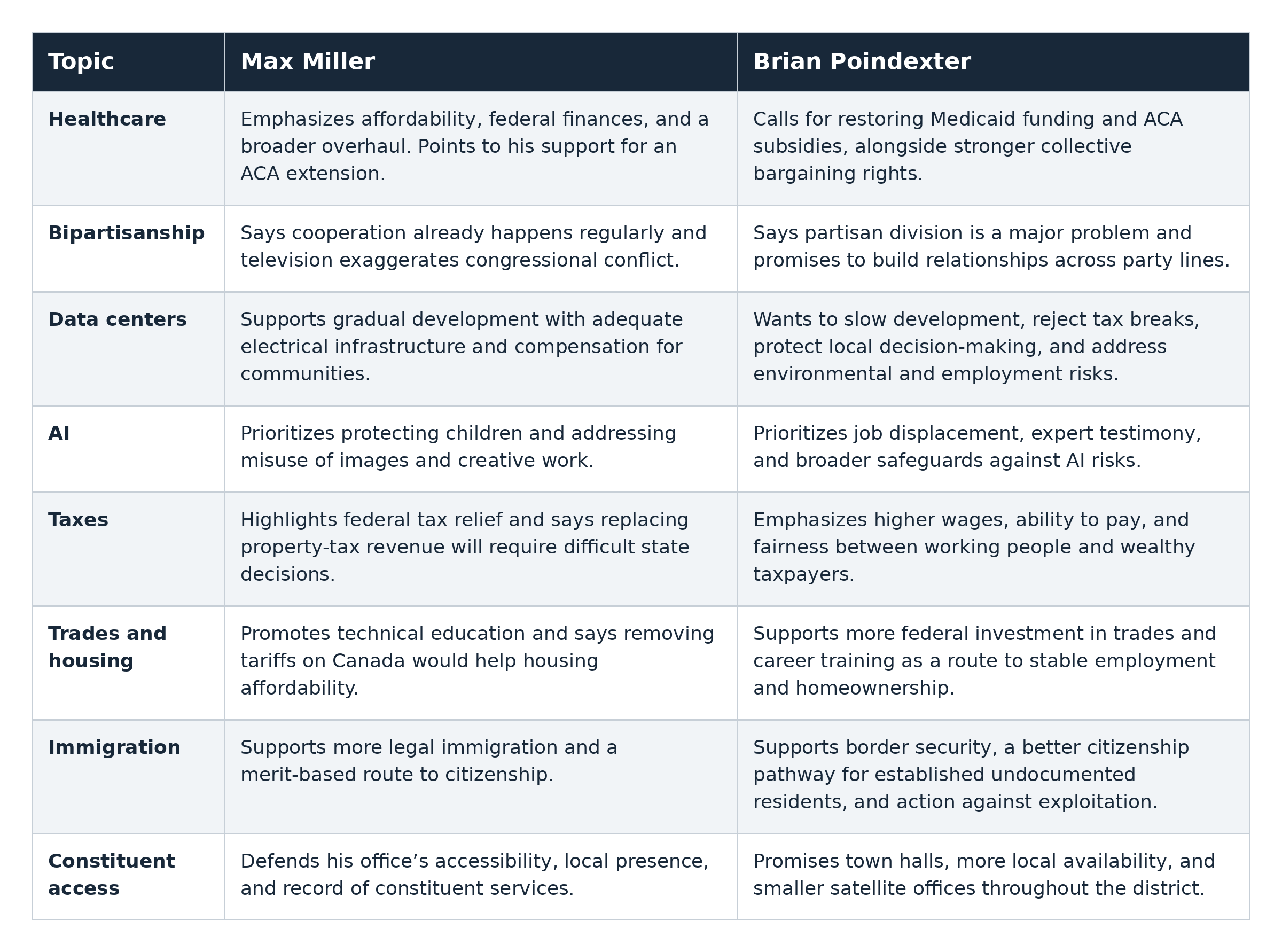
1. Why Are You Running, and What Experience Would You Bring?
Question being compared: What is your background, and why are you seeking this office?
Max Miller: Miller introduces himself as a Cleveland native, a Marine veteran, and a congressman approaching the end of his second term. He argues that his office has delivered for the district and that he wants to continue that work. He highlights infrastructure, police and fire funding, and his support for the Ukrainian community.
Brian Poindexter: Poindexter introduces himself as a father of three, a union ironworker, and a Brook Park City Council member. He describes working in machine shops, factories, kitchens, and trucking before becoming an ironworker. He says he is running because people who work hard and do what they’re supposed to do are still falling behind, and Washington needs someone who understands that experience.
The comparison: Miller’s case is based on his record in Congress and continuing the work of his office. Poindexter’s case is based on his experience as a worker and local elected official, and his argument that Washington needs different representation.
Interview references: Miller, 0:40–2:02; Poindexter, 0:42–2:29.
2. What Are the Biggest Problems Congress Needs to Address?
Question being compared: What are the biggest issues facing Congress and the people you represent?
Max Miller: Miller identifies healthcare as Congress’s biggest issue. He says both parties have failed to deliver the results Americans need and argues that healthcare reform must improve care while addressing federal spending and revenue.
Brian Poindexter: Poindexter identifies partisan division as a major problem in Congress. For district residents, he puts the cost of living first. He blames the war in Iran for higher gas prices, broad tariffs for increasing the cost of goods, and healthcare cuts for putting additional pressure on families.
The comparison: Both identify healthcare and household costs as important. Miller approaches the problem primarily through healthcare reform and federal finances. Poindexter emphasizes the immediate financial pressure on working families and the political division he believes prevents solutions.
Interview references: Miller, 4:40–5:27; Poindexter, 3:20–5:05.
3. How Would You Work Across Party Lines?
Question being compared: Can Congress work in a bipartisan way, and how would you help make that happen?
Max Miller: Miller says Congress is less combative behind the scenes than it appears on television. He describes good relationships with Democrats and says committee work involves negotiation over policies such as deductions and subsidies. He argues that being personable and working with members of the other party is how legislation gets enough votes to pass.
Brian Poindexter: Poindexter says Congress needs to make a more deliberate effort to work across the aisle. He points to his City Council experience as evidence that people can disagree while preserving relationships. He identifies border security and police support as areas of potential agreement. He also says he would work with Senator Bernie Moreno on lifting the Social Security taxable earnings cap, describing that as a position Moreno has expressed.
The comparison: Both say relationships matter and bipartisan cooperation is necessary. The difference is their diagnosis: Miller says cooperation already happens routinely, while Poindexter says Congress needs to do a much better job of it.
Interview references: Miller, 3:01–4:36; Poindexter, 3:36–4:24 and 5:09–6:39.
4. How Would You Stay Accessible to the District?
Question being compared: How do you balance work in Washington with the needs of constituents across the district?
Max Miller: Miller says listening to constituents guides his decisions, including his positions on Ukraine and an ACA extension. He describes making multiple community stops throughout the day and says his office is accessible. In his closing remarks, he points to offices in Medina and Parma.
He also highlights his staff’s help for constituents stranded overseas and says his office has brought more than $50 million back to the district for infrastructure, police, and fire services.
Brian Poindexter: Poindexter says he would be in Washington for votes and committee work, but otherwise would be back in the district. He argues that access to the congressional office is currently inadequate. He promises town halls and proposes smaller satellite offices so residents don’t have to travel as far for help with federal agencies and other concerns.
The comparison: Miller defends his existing accessibility and constituent-service record. Poindexter argues that access needs improvement and proposes a more geographically distributed office presence. These interviews present competing assessments of the current office, rather than resolving which assessment is correct.
Interview references: Miller, 2:02–2:52, 5:32–6:28, 7:31–8:12, and 21:45–22:57; Poindexter, 8:07–9:32.
5. What Should Happen With Data Centers?
Question being compared: What is your position on data-center development in Ohio?
Max Miller: Miller says data centers can be important, including for AI and competition with China, but development should proceed incrementally. His main concern is whether the electrical grid can support them without harming residents through higher utility costs.
He also argues that major companies moving into local communities should pay substantial amounts to those communities and do a better job explaining the projects. He raises concerns about farmland being converted to industrial use.
Brian Poindexter: Poindexter says it is time to “pump the brakes” on data centers. He supports construction and technological progress but argues that too many questions remain unanswered.
He explicitly opposes tax breaks for data centers and says communities should have a say in whether projects are built. He calls for environmental protections and safeguards for workers whose jobs could be displaced by the technology these facilities support.
The comparison: Neither gives data centers an unconditional endorsement. Both express concern about the effects on residents. Miller emphasizes grid capacity, utility costs, gradual development, and community compensation. Poindexter emphasizes local control, opposition to tax subsidies, environmental protections, and employment consequences.
Interview references: Miller, 9:46–11:27; Poindexter, 9:40–11:14.
6. How Should Congress Regulate AI?
Question being compared: What safeguards should Congress put in place as artificial intelligence develops?
Max Miller: Miller supports AI safeguards and explicitly distinguishes his position from what he describes as President Trump’s opposition to restrictions. His immediate priority is protecting children.
He discusses AI being used to remove watermarks and misuse images, as well as concerns involving copyrights and trademarks. He says his team has examined possible policies and that protection for vulnerable people should come first.
Brian Poindexter: Poindexter says Congress should bring in experts to help design safeguards. He emphasizes the possibility of large-scale job losses and says workers must be protected from displacement.
He also raises broader fears about AI systems and potentially catastrophic outcomes, citing reports he says he has read. He acknowledges that he is an ironworker, not an AI expert, and says he would rely on expert testimony.
The comparison: Both support federal safeguards. Miller’s answer centers on children, images, and misuse of creative material. Poindexter’s centers on workers, economic disruption, and broader technological risks. Neither lays out a complete regulatory framework in these interviews.
Interview references: Miller, 8:16–9:36; Poindexter, 9:58–10:38 and 11:20–12:37.
7. How Would You Help People Facing High Taxes?
Question being compared: What can be done about household tax burdens, and what happens if Ohio reduces property taxes?
Max Miller: Miller first notes that property taxes are a state issue. He then highlights federal tax provisions relating to tips, overtime, seniors, and car-loan interest as examples of relief Congress has pursued.
On Ohio property taxes, he says the state would need to replace lost revenue because it must balance its budget. He identifies sales taxes and taxes on products such as alcohol and nicotine as possible sources lawmakers would have to examine. He describes replacing that revenue as possible but difficult.
Brian Poindexter: Poindexter says people resent taxes when they don’t have enough left to pay their bills, disagree with how the money is spent, or believe wealthy people aren’t paying their share.
His main proposal in this answer is to raise wages so taxes become less burdensome. Drawing on City Council experience, he argues that higher earnings can also generate more revenue for public services without increasing an income-tax rate.
The comparison: Miller focuses on tax relief and the challenge of replacing revenue. Poindexter focuses on wages and tax fairness. Neither provides a detailed federal plan in these interviews to resolve Ohio’s property-tax problems.
Interview references: Miller, 18:39–21:24; Poindexter, 12:46–14:07.
8. What Is the Path to Better Jobs and Affordable Housing?
Question being compared: How would you help people enter the workforce, build a career, and afford a home?
Max Miller: Miller strongly supports technical education and skilled trades. He points to his financial support for local career centers and argues that trades can provide strong earnings without the debt associated with college. He also acknowledges that higher education remains necessary for professions such as medicine and teaching.
When asked about housing, Miller says removing tariffs on Canada would help lower costs. He identifies construction materials and manufacturing inputs as areas affected and argues that tariff relief would benefit housing and the broader economy.
Brian Poindexter: Poindexter also argues that college should not be the only route to a stable career. He describes his own union trade as the foundation that allowed him to buy a house and support a family.
He supports more federal funding for trades programs and alternative career pathways. He points to the Polaris career training available to his daughters as an example of preparation that can begin before high school graduation.
The comparison: There is substantial agreement on the value of trades and alternatives to college debt. Miller gives a more direct answer on housing costs by calling for tariff relief. Poindexter focuses on job training and earnings as the route to being able to afford a home.
Poindexter also criticizes broad tariffs elsewhere in his interview, so tariff concerns are not limited to Miller, even though their housing answers emphasize different things.
Interview references: Miller, 11:35–14:32; Poindexter, 4:33–4:50 and 15:50–17:09.
9. What Immigration Changes Would You Support?
Question being compared: Is there a legal immigration pathway that would help meet workforce needs?
Max Miller: Miller says the country needs more legal immigration and argues that people too often conflate legal and illegal immigration.
He supports a merit-based approach involving vetting, paying taxes, obeying the law, and assimilation. He describes a potential route to citizenship after three to five years for people meeting those conditions.
Brian Poindexter: Poindexter supports a strong border and says he would work with Republicans on border security. He also argues that immigration enforcement should not be cruel.
He focuses on people who have lived in the country for years, work, pay taxes, and contribute to their communities. He supports a better process and pathway to citizenship for those residents. He also calls for action against employers who exploit undocumented workers through low wages, lack of benefits, or threats involving immigration enforcement.
The comparison: Both support legal pathways and bipartisan reform. Miller emphasizes merit-based admission and conditions for citizenship. Poindexter emphasizes the treatment of established undocumented residents and protection against exploitation. Miller does not spell out in this answer how his proposal would apply to people already living here without legal status.
Interview references: Miller, 14:38–15:50; Poindexter, 17:17–18:40.
10. How Would You Make Healthcare More Affordable?
Question being compared: What healthcare changes would you pursue, and what would you want to accomplish during the next term?
Max Miller: Miller repeatedly identifies healthcare as a top priority. He argues that both parties have fallen short and that reform should improve care, increase revenue within the system, and make federal healthcare finances more sustainable.
He says he wants to introduce legislation that makes healthcare more affordable and produces better results than the current ACA system. Elsewhere, he points to his support for an ACA extension as an example of listening to constituents.
He does not describe a detailed replacement or overhaul plan in this interview.
Brian Poindexter: Poindexter calls for restoring Medicaid funding and ACA subsidies. He argues that public subsidies are part of what makes coverage affordable for working families.
He says those measures are not a complete long-term solution and supports a broader overhaul. He also links healthcare affordability to stronger collective bargaining rights, arguing that workers should have more power to negotiate employer-provided benefits.
The comparison: Both say the system needs substantial improvement. Poindexter identifies specific near-term steps involving Medicaid, ACA subsidies, and workplace bargaining. Miller emphasizes affordability and fiscal reform but does not explain the detailed mechanism for his proposed overhaul.
Their answers also need to be distinguished from their claims about Miller’s record: Poindexter criticizes Miller’s healthcare votes, while Miller highlights a vote supporting an ACA extension. The interviews alone do not reconcile those different references.
Interview references: Miller, 2:36–2:52, 4:40–5:27, and 15:56–17:22; Poindexter, 18:47–20:07.
11. What Would Make Your Next Term a Success?
Question being compared: Two years from now, what would you want to say you accomplished?
Max Miller: Miller says he would be proud to deliver healthcare legislation that improves affordability and results while strengthening the system’s finances. In an earlier answer about a third term, he also names better energy policy as a priority.
Brian Poindexter: Poindexter says success would mean relief for working families through higher wages, lower costs, better healthcare, and a secure retirement. He also wants constituents to say he worked across party lines, listened to them, and brought their concerns to Congress.
One of his first legislative priorities would be supporting the PRO Act to strengthen workers’ collective bargaining rights.
The comparison: Miller identifies healthcare reform as his central measure of success. Poindexter offers a broader set of household economic goals, with organized labor and constituent representation central to his approach.
Interview references: Miller, 6:35–7:24 and 15:56–17:22; Poindexter, 6:42–8:02 and 20:16–20:55.
Topics That Did Not Get Equivalent Questions
Not every topic received the same treatment. These answers are worth including, but they should not be presented as a direct exchange between the candidates.
Social Security and Medicare
Poindexter’s answer: Asked how to make Social Security and Medicare sustainable, Poindexter focuses on Social Security. He supports lifting the taxable earnings cap so higher earners continue contributing on income above the current limit. He argues that doing so would strengthen the program and help retirees. He describes moving his retired parents into his home because their benefits left them struggling financially.
What is missing from the comparison: Miller is not asked an equivalent Social Security solvency question. His comments about tax relief for seniors do not establish his position on lifting the payroll-tax cap. Poindexter also does not give a separate Medicare sustainability plan in his answer.
Interview reference: Poindexter, 14:15–15:45.
Energy Policy
Miller’s answer: Miller supports a mix of energy sources, including solar, wind, hydrogen, ethanol, nuclear, and carbon sequestration. He says some subsidies for private companies are too generous, while speaking positively about several energy incentives. He argues that opening up the energy sector could lower costs.
What is missing from the comparison: Poindexter discusses gas prices and the economic effects of the Iran war but does not receive an equivalent question about his preferred energy mix or subsidies.
Interview references: Miller, 6:35–7:24; Poindexter, 4:33–4:41.
Libraries and School Vouchers
Miller’s answer: Miller describes libraries as important places for education, research, reading, and community connection. He does not offer a specific library-funding proposal.
The interviewer also mentions public schools and vouchers in an education question, but Miller’s answer focuses on technical and higher education. He does not state a voucher position in that response.
What is missing from the comparison: Poindexter is not asked a comparable library or school-voucher question. Neither candidate’s voucher position can be established from these interviews.
Interview references: Miller, 11:35–13:14 and 17:25–18:29.