

The Q1 financial reports are out for Ohio’s 7th District, and if you actually take the time to go through them, they tell you a lot more than just who raised what.
They tell you how each campaign is thinking.
They tell you who is playing for the primary, who is thinking ahead to the general, and who realistically does not have a path. And when you line all of that up, you start to see where this race actually stands, not just in terms of messaging, but in terms of viability.
Max Miller: Sitting in Control
Starting with Max, this is about as straightforward as it gets.
He no longer has a Republican primary. Jonah Schulz dropped out mid last year, and now Max is effectively coasting into the general election without having to spend resources defending his position. That alone is a massive advantage.
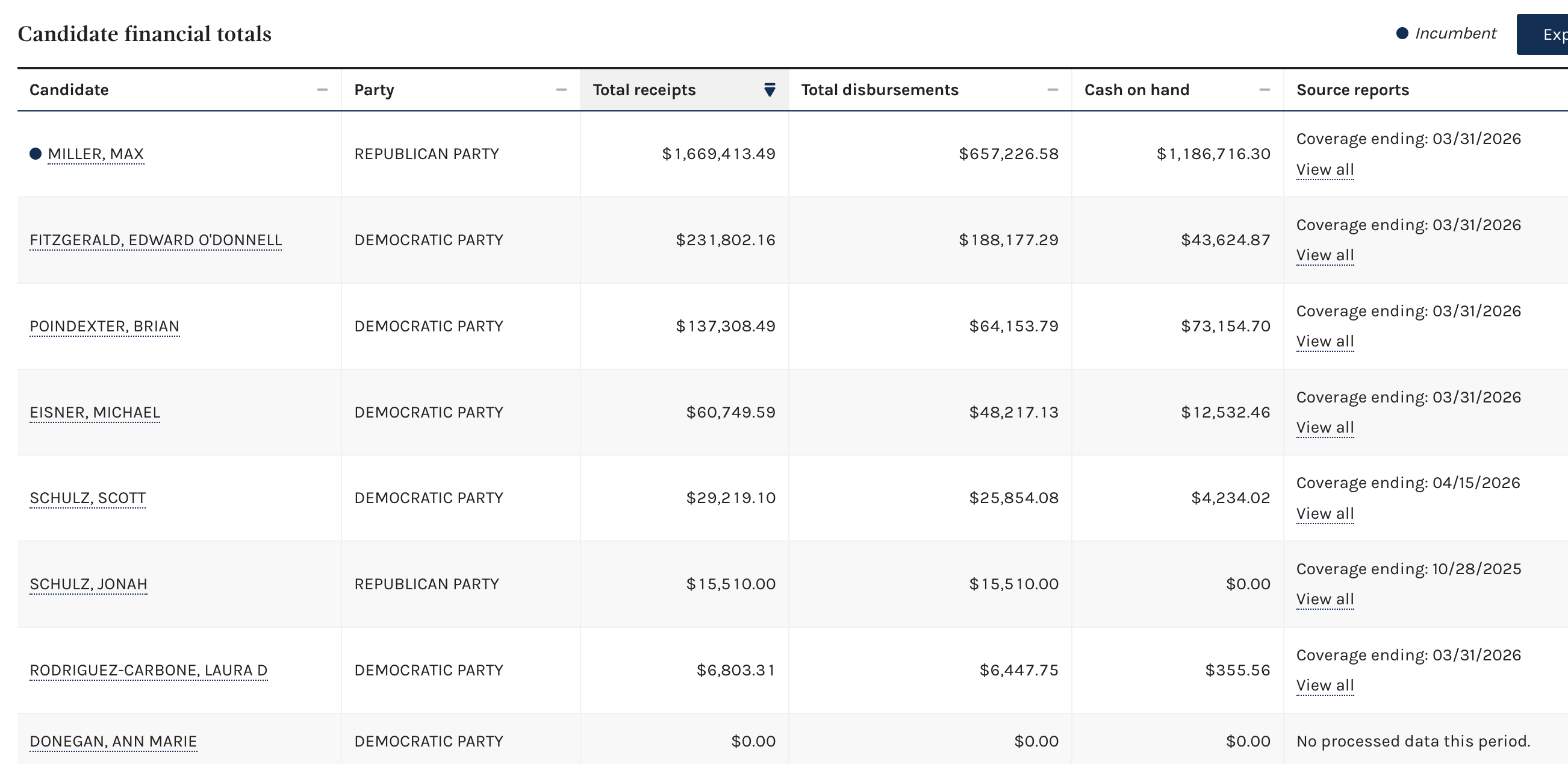
Financially, he brought in just under $1.7 million, spent around $657,000, and is sitting on roughly $1.2 million cash on hand before the primary even happens. That’s a strong position.
If you assume he raises even a modest amount between now and the general election, he’s easily sitting north of $2 million. And if for any reason the race tightens or becomes competitive, he has the network and backing to push that number closer to $3 million.
This is what incumbency looks like when it’s combined with no primary pressure. He’s not reacting to anything right now. He’s preparing.
Ed FitzGerald: $231k!
FitzGerald is the top Democratic fundraiser in this race, bringing in just over $231,000.
On the surface, that’s strong. In a district like this, that’s a serious number for a primary. But then you look at the rest of the report.
He spent just under $188,000 and has $43,624 cash on hand.
That changes the interpretation.
He’s still spent aggressively, but he didn’t completely drain the account, like we mentioned before. What it shows instead is a campaign that leaned heavily into early spending, likely to establish position, build name recognition, and try to shape the primary field early.
The remaining cash on hand is not insignificant.
Brian Poindexter: Holding Back for a Reason?
Poindexter’s report is one of the more interesting ones in the field.
He raised about $137,000, which is a strong number given the timing, especially since he didn’t raise in Q4 and only had a limited window to build momentum. But what stands out is how he used it.
He spent just over $64,000 and is holding onto roughly $73,000 cash on hand.
That’s a decision and purposeful.
In a seven-way primary, most candidates would be burning through cash to gain visibility and push for votes. He’s not doing that. He’s holding a meaningful portion back.
That suggests one of two things.
Either he believes he can win the primary without heavy spending, or he is intentionally positioning himself to enter the general election with a financial base already in place.
If he can raise another $25,000 to $50,000 before the primary, that puts him in a position where, if he wins, he’s not starting from zero against Max Miller.
When you factor in union support and potential ground operations, he may be betting more on turnout infrastructure than paid media.
That’s a different strategy than FitzGerald, and it’s worth watching.
Michael Eisner
Eisner raised just under $61,000, spent around $48,000, and is sitting on roughly $12,000 cash on hand. That puts him in a tight position.
Now, I’ve seen campaigns make money stretch, like mine, so it’s not impossible to compete at that level, but everything has to be efficient. Every dollar has to go toward something that directly impacts turnout or voter awareness.
If money is being wasted on anything that doesn’t move votes, then the campaign is in trouble.
That said, if he were to win the primary, the situation changes. Outside money would come in. Party attention would shift. There would be an opportunity to build toward a $500,000 general election effort, maybe more.
At this stage, he needs to maximize what he has.
Scott Schulz and Laura Rodriguez Carbone
Schulz raised around $30,000, spent most of it, and has very little left.
Carbone raised about $7,000 and spent nearly all of it.
There’s no way around it.
While Scott and Laura both have strong messages, but that is not enough to be financially competitive in a primary like this, and it certainly doesn’t translate confidence into viable general election campaign fundraising.
Yes, money isn’t everything, and there are many ways to get your message to voters. But money does help get your message out in front of voters. Without it, you’re relying entirely on organic reach and word of mouth, which is extremely difficult and uncontrollable.
Keith Mundy, Ann-Marie Donegan, and John Butchko: Not Running Real Campaigns
Then you have candidates who didn’t file with the FEC or show any real fundraising activity.
At this point, it’s hard to take the campaign seriously.
There may be ideas there. There may be perspectives worth hearing. But if you’re not even filing or attempting to raise money in a federal race, you’re not operating on the same level as the rest of the field.
At best, you’re siphoning off a small number of votes from candidates that are trying to compete.
The Breakdown
When you put all of this together, the field narrows quickly.
FitzGerald, Poindexter, and Eisner are the Democrats who have raised enough to be taken seriously in the primary, but they are doing it in very different ways.
FitzGerald and Poindexter are operating at a higher fundraising level, which naturally puts them in a stronger position on paper. Eisner is still in the conversation, not because of the raw dollar amount, but because of how that money could be used and what could happen after the primary.
If FitzGerald or Poindexter wins, you’re likely looking at a general election campaign that could easily approach $1 million, and maybe more depending on outside support and how aggressively they fundraise. But even then, they’re still going to be behind Max Miller, who is already sitting on a significant financial advantage and can scale up quickly if needed.
Eisner’s path is different. He doesn’t have the same financial base right now, and there is clearly a discrepancy compared to the top two fundraisers. But it’s not impossible. If he’s using his money efficiently, focusing on turnout and targeted messaging, and if he were to win the primary, there is a scenario where outside Democratic money, including attention from groups like the DCCC, starts to flow into his campaign. That could realistically push him toward a $500,000 range or more. The question isn’t whether he can raise money later, it’s whether he can bridge the gap now with his limited resources.
The rest of the field is not in a position, financially, to compete at the same level, and that creates a clear divide in terms of viability.
And that’s the reality of modern campaigns. And, I don’t like it. I don’t like how much money dictates visibility, viability, and perception. But it does.
And when you’re going up against an incumbent who already has the resources, the margin for fundraising discrepancy gets exacerbated.
Can’t disagree. Similar analysis here (except you didn’t factor in the “hotness” factor—-which I hand to Fitzgerald). I think I’ve decided to support Laura R-C just to message the primary winner what matters to me: a representative who gives an eff about social wellbeing and has experience as a government worker.
Ed has the most name recognition. Doesn’t surprise me.