

Hey everyone, Matt the Angry Ohioan here.
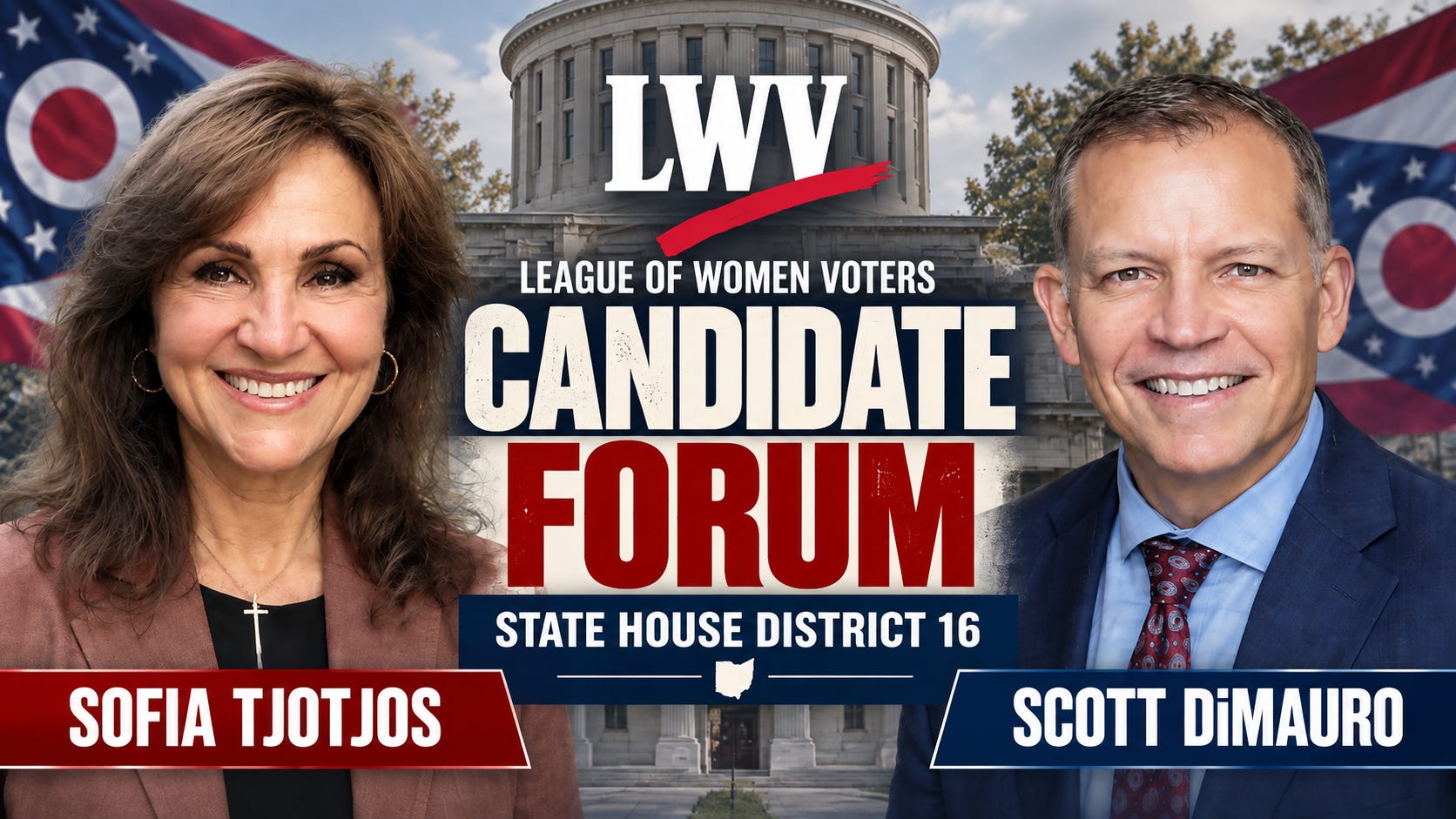
Yesterday was the League of Women Voters forum for the District 16 State House race between Democrat Scott DiMauro and Republican Sofia Tjotjos. This was a very interesting forum, and I’m going to go through it.
First, I’m going to give you my reaction to the candidates’ opening statements.
After that, I’m going to give you a TL;DR explaining the central message from each candidate, along with my comments on each question.
Finally, I’ve cleaned up the transcript of the questions and answers, with the help of ChatGPT, so you can read what the candidates actually said without having to sit through the entire forum and without my comments or paraphrasing of their answers.
You can watch the forum here:
My Initial Reaction
First, I want to say that it was a pleasure to watch both of these candidates in the League of Women Voters forum. Both were intelligent and prepared, with well-thought-out opening and closing statements. I also felt like their answers were not something they were simply slapping together on the spot.
It was clear that both candidates had been thinking about these questions and talking with friends, family, constituents, and others about the issues facing the district and the state. Both seemed to have a solid understanding of the questions being asked and the current issues at hand.
Their opening statements were also a good introduction to who they are and what they wanted to focus on during the forum. Both seemed prepared and ready to engage seriously with the questions.
TL;DR:
Scott DiMauro: Scott’s central message is that state government needs to take a more active role in solving problems. He repeatedly comes back to fully funding public schools, shifting more responsibility away from local property taxpayers, stronger state oversight and regulation, and protecting individual rights. He also frames his candidacy as a way to change the direction of Republican-controlled state government and bring more political balance to Columbus.
Sofia Tjotjos: Sofia’s central message is District 16 first. She emphasizes her nearly 40-year connection to the West Side, her experience as an attorney and small-business owner, local control, personal and parental responsibility, reducing unnecessary government spending and regulation, and having Columbus create a framework without automatically becoming the solution to every problem. Her argument is that she knows this community and should go to Columbus specifically to advocate for it.
My Take: My central takeaway is that there really isn’t as much daylight between these two candidates as you would expect. They agreed on a surprising number of issues. The biggest philosophical difference I saw was that Scott generally looked toward Columbus and state government for solutions, while Sofia leaned more toward local control, individual responsibility, and letting communities solve problems themselves.
But my bigger question is whether either one would actually break with their party when District 16 needs something different. I think Sofia will largely vote with the Republican caucus and Scott will largely vote with the Democratic caucus.
So after all of these questions, the choice may ultimately come down to something much simpler: Do you want a Republican or a Democrat representing District 16?
Opening Statements
Scott DiMauro: DiMauro is a retired social studies teacher and former president of the Ohio Education Association. He emphasized three main priorities: fully and fairly funding public education, creating a fairer tax system that reduces pressure on property taxpayers and local communities, and protecting individual freedoms. He also leaned heavily on his experience advocating for approximately 120,000 public school educators across Ohio as evidence that he knows how to represent people and advocate for their interests.
Sofia Tjotjos: Tjotjos emphasized her long connection to the West Side, her Greek-American family background, and her experience as an attorney and small-business owner. Her priorities included property tax reform while maintaining strong schools and public safety, reducing government waste and unnecessary regulation, supporting young families and small businesses, protecting the environment, and encouraging innovation. She framed her candidacy around her long-standing connection to the community and the idea of putting the interests of District 16 first.
Question 1 & 2: Two-Year Terms and the Role of a State Representative
Question: How would you balance long-term policy goals with the community’s immediate needs during a two-year term?
My Take
My opinion of their answers is that Sofia gave the answer I wanted to hear. She talked about the district and the constituents she would represent.
This is not a matter of saying, “Hey, let’s take the southern counties of Ohio, Cincinnati, and everybody else into consideration.” You are there as a representative of our district to go down to Columbus and advocate for us. Through that advocacy, you are going to fight for our goals. Representatives from other districts will advocate for their goals, and through that process, we will find what is best for the state.
I personally did not like Scott’s answer that a representative must balance the district’s immediate concerns with the concerns of the state as a whole and work across party lines. I don’t think that is the primary job of a state representative.
The job is to go down to Columbus with the concerns of your district and fight hard for your district. Other representatives should do the same for their districts. Through that fight, negotiation, and compromise among representatives, you ultimately determine what policies can achieve the goals of the individual districts while moving the state forward.
Question 3: Public School Funding and Vouchers
Question: How should Ohio fund public schools, and how should public school funding be weighed against state-funded private school vouchers?
My Take
I think it’s interesting that Scott did not say, “I want to repeal the school voucher system.” In fact, he acknowledged that there are people who, without a voucher, wouldn’t have that choice. To me, that suggests he sees some benefit to having a voucher system, even though he wants income limits, greater accountability, and public schools fully funded first.
Sofia supported the bipartisan Fair School Funding Plan, with adjustments to the student cost calculation and how local capacity is determined. Scott also supported implementing the Fair School Funding Plan, but criticized Republicans for moving away from it while expanding the voucher system.
That criticism of Republicans is going to become a theme throughout this forum. Personally, I felt that when Scott didn’t have a particularly strong answer to a question, he sometimes shifted the conversation toward criticizing Republicans or Trump rather than directly addressing the issue.
But on the substance of this particular question, there really wasn’t a major disagreement over the basic direction of school funding. Both essentially said they want Ohio to implement the bipartisan Fair School Funding Plan.
The Fair School Funding Plan is Ohio’s bipartisan school-funding framework designed to calculate the actual cost of educating a student and divide that cost between the state and local communities based on each community’s ability to pay, with the goal of reducing disparities caused by heavy reliance on local property taxes.
Question 4: Accountability for Private Schools Receiving Vouchers
Question: Should private schools receiving EdChoice vouchers face the same testing, reporting, and accountability requirements as public schools?
My Take
Sofia described vouchers as parental choice. I personally think we need to reevaluate all of this. The fact that we’re giving vouchers, or a portion of tax money, to private schools makes me uncomfortable with my tax dollars. I just don’t like it.
I think parents should have school choice, but I think that choice should go deeper than just public or private.

Both Sofia and Scott supported financial accountability for the schools. Where they differed was academic testing and reporting. Sofia didn’t say that private schools should have the same testing and reporting requirements, while Scott thinks they should.
I don’t have kids, nor do I really care that much about this issue. It’s just not something I think about often. But the idea that every kid has to take the exact same test is kind of weird to me.
If kids can take different tests and perform better, isn’t the important thing the performance? Should there be some understanding of whether the kids are doing a good job at reading, writing, and arithmetic? Sure. Do they have to take the exact same tests? I don’t know.
Does it hurt or help them when it comes to college admissions? Don’t they eventually have to take an SAT, or a GMAT, or an LSAT, or all kinds of different tests depending on what schools they want to attend and what they want to do? If they can take those tests, perform well, and get into good colleges or vocational programs, then maybe that should be the test of whether the education they received actually worked.
Question 5: Legislation They Would Introduce or Co-Sponsor
Question: What legislation would you prioritize upon entering the Ohio House?
My Take
This is such an interesting argument because they’re all talking about school funding and taxes and circuit breakers. And here’s a little bit of a tangent.
I’m a single person, non-married, with no kids. I pay the same property taxes as a married couple. No married tax deductions, no child tax credits, none of that. Nobody in my household goes to the schools. I’m well into my 40s, and I don’t plan on having kids. So I’m still paying for schools even though none of this really has anything to do with me as a taxpayer.
And when Sofia says they have to address the sharp increase in assessed home values, that’s kind of a weird double-edged sword. Yes, taxes went up because home values were reassessed. But they were reassessed for more. That also gives all of these people more equity in their houses. They (hopefully) can now sell their houses for more money or take out a HELOC or home equity loan in order to do different things.
So if those sharp increases get reassessed downward, did you just take away some of my equity?
And why are we freezing property taxes for older people? Older people worked their whole lives. They should have savings, and yes, they’re on a fixed income. To be perfectly honest, I’m on a fixed income. Aren’t we all on fixed incomes? That is what a salary is. And why should property taxes be lower for people with less income?
I think both of these answers were basically an acknowledgment that something has to happen. Something should happen. There have been sharp increases in property taxes. But neither of them really said the elephant in the room: we’re taxing too damn much on property taxes.
Instead, we’re trying to give tax breaks to different people, groups, and situations. We’re trying to cherry-pick who gets relief without addressing the elephant in the room.
Property taxes have doubled and tripled in some cases, and that’s too damn much.
Question 6: Property Taxes and Local Government Funding
Question: How should Ohio reduce rising property taxes without undermining funding for schools and other local services?
My Take
This was almost the same answer as the previous one about what legislation they would introduce or co-sponsor. Their answers covered much of the same ground, so my answer is above.
Question 7: Vaccines and Public Health
Question: What should Ohio’s vaccination policy be, including school requirements and exemptions, and who should have authority during future public health emergencies?
My Take
Scott focused on declining vaccination rates and misinformation. He also supported existing good-faith religious exemptions, and I don’t know how you can really separate the two. It’s a personal choice of: Do I want to do something, or do I not want to do something?
That goes along with Sofia’s answer. She warned against broad mandates and said vaccination decisions should generally remain between individuals or parents and their doctors. I think that’s how we feel about a lot of different individual health choices. It’s between an individual, their family, and their doctor. I don’t know why we would want to start getting into the middle of that.
If there is a role for the State of Ohio, I would say it should be providing public awareness and the different options available to people. But I also think we should give people more options of different ways of becoming vaccinated. That could give people more choice than just, say, a Big Pharma needle (which is a big part of the anti vaxx debate), and I think that would clear up a lot of the issues.
Questions 8, 9, and 10 Combined: Data Centers, Local Control, Transparency, and Obsolescence
Question: How much control should local governments have over data centers, what should data centers be required to publicly disclose about their water and electricity consumption, and who should be responsible for the infrastructure if these facilities eventually become obsolete?
My Take
They both supported local control. Sofia pointed to Westlake’s temporary pause, acknowledging that data centers offer some economic benefits but also pose risks to different sectors. Scott also supported local control and wanted to prohibit nondisclosure agreements.
I think both of them pretty much agree on what should happen here, and I do too. We cannot dismiss the economic benefits of data centers, but we also have to have communities in control and be transparent.
That goes into Question 9 as well, where public reporting of water and electricity consumption would be part of the disclosures and transparency for the community.
And then there’s data center obsolescence. If you remember my conversation with Jim Renacci, that was one of the things he was saying: technology moves really quickly.
Scott really hit the nail on the head here. A computer that used to be the size of a room can now fit in your pocket. Actually, what’s in your pocket would have been considered a supercomputer 10 or 20 years ago.
Data centers could become obsolete very quickly depending on where technology goes, how it evolves, and how AI evolves. That needs to be part of the conversation when communities are making long-term decisions about these facilities and the infrastructure being built around them.
Question 11: Ohio Environmental Standards
Question: Should Ohio establish and enforce its own environmental standards as federal protections change?
My Take
There seems to be no real daylight between the two here. Both of them understand that we should maintain environmental protections.
It seems like Scott went a little bit further than Sofia, acknowledging fracking on public lands and power plant regulations, while Sofia acknowledged Lake Erie, the Rocky River watershed, phosphorus runoff, and algae blooms, while also trying to balance those protections with economic benefits.
I personally think that Northeast Ohio, our nature, our Metroparks, and our lake are some of the gems of this country, and they have to be protected and kept clean at almost all costs.
Yet there is also some common sense that we have to have when it comes to onerous bureaucratic regulations that companies have to jump through.
The question is: Can we create a process that allows businesses to operate while respecting the environment we live in and acknowledging the specialness of this region?
Can we streamline the process of opening businesses, manufacturing facilities, power plants, and so on and so forth, without creating onerous bureaucratic nightmares, bottlenecks, or financial constraints that scare businesses away?
I think that’s the balance we have to find.
Question 12: AI and Job Displacement
Question: What should Ohio do for workers whose jobs are changed or eliminated by AI and automation?
My Take
You know what? I think Sofia gave the best answer here, although they both basically said the same thing: there should be some sort of cooperation, acknowledgment, or understanding of what jobs might be displaced sooner rather than later, and we should offer training and pathways for people to migrate into different jobs.
The problem is that government and the legislature are notoriously bad at acknowledging and planning for these kinds of changes.
What are you going to do for the truckers who are going to lose their jobs to self-driving trucks? What industries can you actually identify as being displaced? Are you going to be right or wrong? What skills can you train people for when we don’t even know what jobs will emerge in the future?
I’m personally not too sure that the legislature, or either candidate, will be able to effectively do that.
Sofia, in my opinion, made an important point when she said that AI will disrupt existing occupations but also create new jobs and wealth. This is absolutely true.
So, in my opinion, there shouldn’t necessarily be a survey trying to predict what jobs are going to emerge because there’s really no way to plan for that. But maybe there should be a survey of who is currently offering different services for AI training, particularly programs that bridge AI with existing professions, and then steer people who want to train now toward those people and organizations already offering those services.
Long story short, it’s very hard to foresee the future of this. But offering or educating people about trade schools, community colleges, retraining programs, and finding people who are already in the market training workers on AI, or teaching people how to do their current jobs more efficiently with AI, I think is the better plan.
Question 13: State-Level AI Regulation
Question: Should Ohio regulate AI itself, or should AI regulation primarily be left to the federal government?
My Take
When it comes to state-level AI regulation, we’re really starting to see, at least in my opinion, a pattern emerge between Scott and Sofia. Scott seems to feel that the legislature should take on every question and have some sort of answer or role in everybody’s life. Sofia seems to emphasize local control and personal responsibility more.
This is another area where I don’t really know what state action Ohio should take rather than waiting for the federal government. Like, what should we do?
However, I do think schools need to understand what should and should not be allowed in their classrooms.
Should kids have their cell phones in school? No. They should put them in a pouch when they walk into school and not be able to open them all day. If parents complain that they can’t reach their kids during the day, I’m sorry, but that’s how it worked throughout history. Call the school, have somebody go get the kid, and bring them the phone if it’s an emergency. Other than that, it’s not an emergency, and they should be in school.
The same thing goes for AI. What are they using AI for?
My solution with AI is that school boards should call other school boards, form a coalition, and then call Anthropic, OpenAI, and other AI companies to create specific programs and tools that students could use as AI tutors. Those tools could be integrated directly into school systems, with teachers able to assign them to students through their laptops, iPads, and so on and so forth.
You could create an AI tutor that is an extension of the teacher and the curriculum rather than just giving students access to the same AI that everybody else uses, which can literally help them do their homework for them.
Beyond something like that, I don’t know what other regulations the State of Ohio should be putting in place just for the sake of saying that we’re regulating AI.
Question 14: Automatic License Plate Readers and Flock Cameras
Question: Should Ohio require warrants for police searches of automatic license plate reader data, and what other restrictions should apply?
My Take
When it comes to automatic license plate readers, we should probably stop calling them that because it’s obvious that they’re doing much more than just reading license plates.
Calling these systems “license plate readers” was a complete Trojan horse for getting a surveillance system that tracks movements, identifies people, and collects data while calling it a license plate reader, which is complete bullshit.
There seems to be really no daylight between Sofia and Scott on this question. They both support regulation. They both support the police, and police say that these systems help them do their jobs.
So, in my opinion, again, it comes down to how the state regulates this technology and views our different constitutional rights and people’s right to privacy. Can the legislature uphold those constitutional rights?
And which one of these candidates will fight hardest to put data surveillance and the selling of that data, most importantly, not just access to that data, but selling that data, into some sort of state law and force these companies to comply?
That, to me, is the real question.
Question 15: Local Police and Federal Immigration Enforcement
Question: What role should Ohio police and sheriffs play in federal immigration enforcement, and should the state require, allow, or limit cooperation?
My Take
It was obvious to me that this question made Scott uncomfortable. He said words that his base would resonate with, talking about giving people dignity and so on and so forth. Fine, but you could tell that he was uncomfortable with the question.
I personally think Sofia handled this question extremely well, and I think hers was the appropriate answer.
Should police officers have an obligation to enforce the law, including immigration laws and all other laws? Yes. It’s not their job to decide which laws apply and at what times.
For a community to tell a police force or sheriff that they should not comply with or enforce certain laws is, in my opinion, disrespectful to their job and puts police officers in a compromised position. The people who decide how laws apply are the judges.
And I think Democrats, especially here, sometimes put police officers in that compromised position without acknowledging the compromises those officers themselves may have to make with their own personal views in order to do the job of being a police officer.
Questions 16 and 17 Combined: Mail-In Ballots and Election Security
Question: Should Ohio restore the grace period for mail-in ballots received after Election Day, and how confident are the candidates in the security and accuracy of Ohio’s elections?
My Take
Scott and Sofia both expressed confidence in Ohio’s election system, which is great.
Both also had to answer whether they would restore the grace period for mail-in ballots. Again, Scott seemed uncomfortable. He knows what the base wants to hear and said there might be unexpected circumstances that prevent voters from meeting the deadline.
Sofia basically said, “Bro, you get 28 days to go vote.”
I personally agree with Sofia. I don’t know why you need to have a grace period. Get your ballot in the mail or go to the polls. There are so many ways to vote that when Election Day ends, in my opinion, that’s the deadline.
I personally think Scott is trying to compromise some of his personal views here in order to appease the base.
Closing Statements and Final Take
My Take
Their closing statements were, I think, the cherry on top.
Throughout this whole conversation, they both came prepared. They both spoke well. They both expressed their opinions very clearly. To be perfectly honest, there isn’t as much daylight between these two candidates as one would think.
Maybe it was the way they were answering the questions, but the biggest difference I saw between Scott and Sofia was this: Scott seemed to approach issues from the perspective that Columbus can and should take on all of these problems, while Sofia seemed to focus more on local control, the individual, and people solving their own problems.
But again, that difference probably came up only 20% of the time. On a lot of these questions, they really weren’t that far apart.
Scott focused on Republicans and Trump when he got uncomfortable, while Sofia did not focus on Democrats. Maybe Sofia read the room, knew who was showing up, didn’t want to deal with any backlash, and tempered her communication to fit the environment.
I think we all know that each one of them will ultimately be locked up with their party. I don’t think Sofia is going to break with the majority Republicans in any significant way to create or fight for legislation outside of what her caucus wants. And I don’t think Scott would be much different with the Democrats.
Scott is coming in to provide more balance to a majority-Republican legislature and to hold the seat for Democrats so Republicans don’t have a supermajority.
With that said, Scott is a carpetbagger. He moved up from Columbus to run for this seat. From my perspective, it seemed like this was something that had been planned and thought about at different levels of the Democratic Party, and I got wind of his arrival in the district even before he got here. Sofia pointed that out in her closing statement.
She pointed out that she has lived in the area for almost 40 years, raised her kids here, has grandchildren here, and has worked in the community. I think that should mean something.
The question isn’t whether these are both thoughtful, smart, and caring people who want to represent the district.
The question really comes down to (sadly): Do you want a Republican or a Democrat?
Are they actually going to advocate and fight for the individual needs of District 16, or are they ultimately going to be another vote for whatever their caucus wants? I think both will just be a rubber stamp Democrat or a rubber stamp Republican.
And again, Scott’s answer earlier about having to consider the whole state and other places really concerned me. I personally don’t think that’s your job. Your job is to go to Columbus and fight tooth and nail for District 16. Everybody else should go there and fight for their own districts. Then you hash it out and figure out what works for the state.
So the question for voters basically comes down to: Do you want a Democrat or a Republican?
Because based on their answers in this forum, there really wasn’t that much daylight between them. And I didn’t hear enough from either candidate to convince me that they would break with their party when necessary and actually say or do something original for District 16.
Ohio House District 16 Candidate Forum: Complete Transcript.
League of Women Voters of Greater Cleveland
Candidates: Scott DiMauro and Sofia Tjotjos
Moderator: Pam Smith
Introduction/Closing: Alice Allen
INTRODUCTION
Alice Allen: Welcome, everyone. Good evening, and thank you for coming to this evening’s candidates forum. Does my mic sound enough? Yes.
Thank you for coming to this evening’s candidates forum presented by the Bay Village, Cleveland, Fairview Park, Rocky River, and Westlake/North Olmsted chapters of the League of Women Voters of Greater Cleveland. We’re pleased to welcome all of you here with us tonight. I’d also like to welcome those who are watching online via the livestream and any folks who are watching the recording, which will be made available on the League of Women Voters of Greater Cleveland YouTube channel.
My name is Alice Allen, and I’m co-chair of the Rocky River chapter of the League. I’d like to thank the candidates in the race for the 16th Ohio House District who are with us tonight. Thank you to the City of Rocky River for the use of this space, and thank you to all the League of Women Voters chapter volunteers who are staffing this event. I will share some information with you later about the Election Protection program after the forum.
In keeping with our longstanding forum tradition, questions for the candidates will be submitted in writing. Everyone should have received a card when you entered this evening to write your questions for our candidates. When you have a question ready, raise your hand and a runner will come and pick up your card. You can also raise your hand if you need another question.
We have a couple League members at the question-sorting table who will be reviewing questions to avoid duplication, to provide a diversity of questions, and to ensure clarity and appropriateness.
As I stated earlier, we are recording the program for future viewing on YouTube. I want to let you all know that personal recording during the program is forbidden by League policy. You are invited to view and share the forum in its entirety on YouTube, but we also have a prohibition on sharing segments of the forum on social media.
Finally, we ask for your cooperation in avoiding expressions of support or opposition to any candidate during this evening.
Please remember the purpose of this evening is to hear from the candidates so that each resident might make their own best-informed decision regarding their vote, and any vocal interruption takes time away from that.
Now I’d like to introduce you to Pam Smith. We are fortunate to have Ms. Smith as our moderator this evening.
Ms. Smith comes to us from Lakewood, where she’s been a longtime member of the League. She served three four-year terms on Lakewood City Council and continues to volunteer in many Lakewood civic organizations.
Ms. Smith is retired from her marketing manager job with Steve Master Carpet. She always enjoys moderating candidate forums and recommends them as the best way to learn about candidates.
Please welcome Ms. Smith.
OPENING STATEMENTS
Moderator Pam Smith: Thank you very much, Alice. Can you hear me in the back?
This is going to be good. We’re going to have a great time tonight. I’m so glad to be here.
We have two candidates running for the 16th Ohio House District seat: Scott DiMauro and Sofia Tjotjos.
We will begin with two-minute opening statements by the candidates in alphabetical order. Mr. DiMauro will go first, Ms. Tjotjos next. For the final closing statements, we’ll reverse that order.
After their two-minute statements, then we have time for questions. And that’s where the meat of a candidates’ night is, because the questions can vary from very broad to rather specific. Both candidates will answer each question for one minute.
At the end of the time period, and I’ve got a specific time to be at, we will have the closing statements, and then Ms. Allen will come back up to close out the whole event.
So let’s get started.
Mr. DiMauro, can you please give us your two-minute opening statement?
Scott DiMauro — Opening Statement
Scott DiMauro: Thank you very much, Pam, and thank you, Alice. Thank you to the League of Women Voters for graciously hosting this event. I know this is an important opportunity to get into the issues that are facing voters of this district.
I am a retired high school social studies teacher. I went into teaching over 35 years ago because I wanted my students to have the critical-thinking, problem-solving, and decision-making skills that they needed to be good citizens in our environment. And little did I know then just how important that would be.
I’m running because I want to provide a voice for the residents of this community, and I’m advocating for three important priorities.
Number one, as a high school social studies teacher, also as a former president of the Ohio Education Association, where I advocated for 120,000 public school educators across the state, ensuring that every single student, no matter where they live, has a high-quality public education.
We need fair and full funding of our public schools. The current legislature has failed to get that done. And I’ll talk a little bit more later about what that looks like, but we have to make sure that we’re investing in our communities.
The only way we’re going to do that, not just fairly funding our schools but also our local communities, is to have fairness in our taxes.
Residents across the state are frustrated about rising property taxes, as well many people should be. But the reason that exists is because the state has fundamentally failed in its responsibility to do its part in funding.
And finally, I want to stand up for freedom for all Ohioans. Get the state out of people’s—
Moderator Pam Smith: Thank you.
Sofia Tjotjos — Opening Statement
Sofia Tjotjos: Good evening, and thank you all for being here tonight and to our hosts. It’s wonderful to see a large group like you who are interested in our district and the issues that it faces.
My name is Sofia Tjotjos. I’m a longtime West Side resident, and I’m running for state representative in District 16 because I love this community and I want to see it thrive and grow.
My husband and I grew up in Greek-American families that taught us the values of faith, family first, and that with hard work and integrity, we can accomplish anything in this country. We carried that same message to our children when we started our family right here in Rocky River almost 40 years ago.
We have four grown children now, two grandchildren, and in my father’s footsteps, I was an attorney. First in private practice for many years, and then, in order to be closer to the kids, I chose a solo practice in our home and specialized in business and nonprofit advising.
That worked well because my husband and I actually were starting a small business of our own in IT networking. That business lasted for 21 years and had over 50 employees.
One thing I’ve learned from all my time and experience in our community is how special and rare it truly is. It’s why I believe it deserves the best for the West, and we can accomplish it.
I believe we can reform property taxes and still fund strong public schools and safety services. I believe we can and should have a state government that respects our hard-earned money and uses only what it needs without waste or fraud. I believe we can inspire young families and small businesses with fewer regulations and more incentives. And I believe we can be good stewards of our environment and still invite innovation.
My focus is always our community first, people, my neighbors, over party. And as your state representative, I will listen to you, research your concerns, and work to find solutions that I believe represent District 16 and the best for the West.
Thank you.
DISTRICT 16 AND CONNECTION TO THE COMMUNITY
Moderator Pam Smith: I suspect most people in this room are from the close area here, but actually District 16 has quite an amount of geography in it. I wonder if each of you would just take a minute to talk about the geography and your place within it. Starting with Scott.
Scott DiMauro: Yeah, sure. Thank you for the question.
So, the district includes Bay Village, Westlake, Rocky River, Fairview Park, and most of West Park in Cleveland. My wife, Lauren, and I live in Westlake.
Lauren is a middle school English language arts teacher in Bay Village. We have close ties to the community, and as I’ve been on this campaign journey over the last 11 months, I’ve had a chance to visit neighborhoods all across the district.
We have a very diverse district. A diverse district in terms of economics. We have a diverse district when it comes to religious affiliation, when it comes to politics, when it comes to ethnicity, when it comes to race. And I think that’s one of the things that makes this district so strong.
I am very excited to be a resident of the 16th District, and I hope to have the opportunity to represent this fantastic community.
Moderator Pam Smith: Thank you. Ms. Tjotjos.
Sofia Tjotjos: Well, as I began with, I’m a longtime resident in this community. Actually, I was born and raised in Cuyahoga County, but started out in my grade-school years on the East Side. My parents moved us here when I was in high school.
And I will tell you, for me, they go from the East to the West and fell in love. And for those of you who are from the West Side, you know the same. We all go from East to West without crossing through customs, right?
So I have spent my entire life, the rest of my life, here, and definitely in my adult life with the entire community, both as a church volunteer, a community volunteer, a school volunteer with my children, and also in my careers.
So I have a very, very deep and warm connection to this district and all the people who live in it.
ROLE OF A STATE REPRESENTATIVE
Moderator Pam Smith: Starting with Ms. Tjotjos, here’s a question on the role of the state representative.
With a two-year term, how will you balance long-term policy goals with our community’s immediate needs? One minute.
Sofia Tjotjos: Yes. Actually, the State of Ohio defines the role of a state representative very clearly. It says: one, listen to your constituents; two, speak for them; and three, turn their needs and concerns into legislative action.
I think that’s one of the most important aspects of being a state rep, is to represent this community. There are 99 state reps. Their role is each to represent the community that they come from.
It’s one of the reasons I feel I’m uniquely qualified for this position because of the years I’ve been here, the amount of experience I have in different facets as an attorney, as a small-business owner, as a mother, a grandmother, and a wife.
Moderator Pam Smith: Thank you. Mr. DiMauro.
Scott DiMauro: So your question is about planning when you have just a two-year term. And again, the framers of our state Constitution, just like the framers of the U.S. Constitution, believed two-year terms are important for representatives because it helps ensure accountability.
Going back to the voters every two years means that you have to listen to the voters, as Sofia said. But it is vitally important not just to think about the immediate needs of the district, but remembering that as one of 99 members of the House, your most important responsibility is to vote in ways that could be good for the State of Ohio, for all of its people.
And so I think it’s important to bring the voice of the community, to understand that perspective, but to work across the aisle to make sure that we’re making decisions that are looking ahead, looking to the future, to ensure that we are strengthening our communities and we’re building a strong Ohio.
SCHOOL FUNDING AND VOUCHERS
Moderator Pam Smith: This is a question about the State of Ohio and what the 99 representatives would be working on.
Starting with Mr. DiMauro, how should Ohio fund its schools? How do you weigh funding for public schools against state-funded vouchers for private schools?
Scott DiMauro: It’s a great question, and I’m sorry that we only have a minute to talk about that. I see Jim Best in the back of the room. Jim knows a lot about this issue. He and I have talked a lot about this issue.
We have what’s called a Fair School Funding Plan, a bipartisan plan that addressed our unconstitutional funding system, which has an overreliance on local property taxes, by ensuring that we are identifying the cost of providing quality education to every student and making sure that the resources are there and then that’s fairly distributed across the state.
Sadly, the current Republican supermajority has dismantled the Fair School Funding Plan. And part of that has been by prioritizing tax cuts for the wealthy, the billions of dollars in vouchers to subsidize private-school education.
And I think we really need to fix that. We need to go back to the bipartisan school funding plan to ensure that every student, no matter the ZIP code that they come from, has a high-quality public education.
Moderator Pam Smith: Thank you. Ms. Tjotjos, how should Ohio fund its schools?
Sofia Tjotjos: Yes, I agree with Scott. This is a question that requires more than a minute. But let me start with what I do agree with.
One is that the Fair School Funding Plan should be seen through its final phase. It began in 2022. Its final phase would occur in 2027.
I would like to see our legislature follow through with that formula with a couple of adjustments. One would be that we make sure the student cost calculation has a realistic cap so that it’s not just based on school spending.
And the other thing would be that local capacity for districts like 16 reflect what’s called phantom revenue as well.
As far as vouchers, I hope I get another opportunity to talk about that because it’s a separate issue.
Voucher Accountability
Moderator Pam Smith: As a matter of fact, I have a follow-up.
What accountability, if any, should private schools that accept EdChoice vouchers have to taxpayers? Should private schools give the same tests and publicly report achievement and graduation rates? Ms. Tjotjos.
Sofia Tjotjos: Okay, let’s first talk about the vouchers, which are really parent choice. It’s parents’ choice where they would like to educate their child, and I trust a parent to make that decision more than the state government.
There are two misnomers about the voucher program. One is that it’s taking money away from the public schools, and two, that it’s only benefiting the wealthy families who are sending their children to private schools.
First, the funding of both the public schools and the vouchers are separate. They are calculated separately. They are listed separately, and they do not cross over to each other. So they don’t affect one another.
Secondly, actually, it’s a sliding scale. Wealthier families get the least amount of the benefit, and the poor families get the most.
Finally, with regard to accountability, I agree. If there is a private school taking public money, I think they should be accountable to the state for the fiscal reporting, in other words, what they’re doing with that money, not the report cards and academic performance.
Scott DiMauro: I think this is an area where we disagree pretty starkly.
I will begin by saying the accountability should be the same. If private schools that are accepting billions of dollars of your taxpayer money are going to continue to do that, then they should have their students take the same tests. There should be both fiscal and academic oversight to make sure that taxpayers are getting what they deserve with that.
As far as who’s benefiting, I certainly understand there are a lot of people who, without the voucher, wouldn’t have that choice. But vouchers have been dramatically expanded in the last two budget cycles to the point where millionaires can now qualify for state money to send their kids to private schools when they were already paying out of pocket to do it.
That is just a flat giveaway from people at the bottom to people at the top. That needs to change.
I think we need to put some accountability standards. We need to put some income limits on that. And we need to make sure that we are first fully funding our public schools.
LEGISLATIVE PRIORITIES AND PROPERTY TAXES
Moderator Pam Smith: We’re very close on time here because of the Zoom and how it fits together. So please don’t clap within the program because that uses up time.
You will have time to talk to each candidate privately after the meeting.
I would like to ask you now, candidates: Do you have a piece of legislation that you would like to introduce or co-sponsor? Starting with Mr. DiMauro.
Scott DiMauro: Well, the first one is the state budget that prioritizes fully and fairly funding our schools, using the Fair School Funding Plan as the basis for that.
Along with that, I would proudly co-sponsor legislation that has been introduced by Republican Senator Bill Blessing in Cincinnati to provide a circuit breaker in order to provide targeted property-tax relief.
No one should ever be taxed out of their home. We do need to make sure that we have tax fairness. But that doesn’t mean eliminating property taxes. That would be absolutely devastating for the State of Ohio.
We could expand our Homestead Exemption, provide tax relief tied to income for people that need it. And if we fully and fairly fund our public schools, which right now the state is ranked 45th in the country in terms of state support for public education, that will go a long way to providing needed property-tax relief for homeowners.
Sofia Tjotjos: For me, the first bill would definitely be property taxes as well. Scott has mentioned a few options, but a lot of it is piecemeal.
I actually drafted a bill that I would love to put forward if I went into the state that really addresses all homeowners and the incredible increase that occurred across the board in this last appraisal. Thirty-two percent on average, but in our district as much as a 60% value increase.
I think that there has to be some address to those people whose values jumped up so high.
So I agree with the circuit breaker. That’s good for low income. I also definitely agree with a freeze for seniors who are over 70 so that they are not being priced out of their home.
Balancing Property-Tax Relief and Local Funding
Moderator Pam Smith: Continuing to discuss the property tax, starting with you, Ms. Tjotjos. What’s your proposal for addressing the property taxes that are going up, but we still need to have the funding come to our local communities?
Sofia Tjotjos: Yes. So, property taxes, they are generated by the local community. The state taxes come from our income taxes, our sales taxes, our fuel and sin taxes. They’re two different revenue sources.
And you’re right, property taxes are very important primarily to school funding, safety services, local parks, and libraries.
So even when we address that taxpayers are being very overburdened by the amount of property tax, we do also have to look at how to balance that with the needs.
I think there are numerous ways to do that. One is simply make sure that our spending at the state level is trimmed, is responsible, there’s no waste, there’s no fraud. We are experiencing a surplus right now at the state level already.
So I think we can accomplish both. I think what has happened is that a wild assessment in values has created an unfair burden on the taxpayer, but it would not necessarily cost that fallout on the more important services like school funding and safety services.
Moderator Pam Smith: Mr. DiMauro.
Scott DiMauro: Let’s not forget how we got into this situation right now.
Back in 2011, when Republicans took control, John Kasich cut 50% of the Local Government Fund, which devastated funding for the police and local communities from across the state.
At the same time, we’ve seen this steadily deteriorating state share of education. In this current year, the state is only providing 32% of school funding, which is the lowest in history.
And so until we rebalance that, until we stop prioritizing tax breaks for big corporations, until we stop prioritizing income-tax cuts for the people at the very top, we have the second-lowest income-tax rate in the nation, then we’re not going to be able to adequately address the property-tax issue.
But I do think that we can do it.
And by the way, that state surplus that Sofia just mentioned, given the changes that we’re seeing at the federal level with funding, I’m a little worried about that.
VACCINATIONS AND PUBLIC HEALTH
Moderator Pam Smith: We’re going to switch gears now and ask a question about health, specifically measles.
Starting with Mr. DiMauro, there’s a question which came from the audience. Please continue to hand your questions over to one of the ushers.
Measles cases have returned in the U.S., and another pandemic like COVID-19 is possible. What should Ohio’s approach be to vaccination, including school vaccine requirements and exceptions in future public-health emergencies? How should decisions be divided between the governor and health officials and the legislature?
Wow, big question. Mr. DiMauro.
Scott DiMauro: Well, let’s start by telling the truth.
The current administration is lying to the people, and that’s one of the reasons why we see, because of the craziness with the current Secretary of Health and Human Services and people that are spreading a lot of misinformation, vaccine rates are going down.
I think we have to do our job in educating the public.
There have always been good-faith exceptions for people that, for religious reasons, feel like they shouldn’t vaccinate their children. But so much of that declining vaccination rate is being driven by that misinformation.
And so one of the things that I think a lot of people don’t realize, Ohio is the only state in the country without comprehensive health education standards.
Let’s start by making sure that we are educating people so that they can make good decisions and protect their children.
Moderator Pam Smith: Thank you. Ms. Tjotjos, what’s your feeling about vaccination requirements for schools?
Sofia Tjotjos: Vaccination requirements for schools, but also I think you were talking about regulations that we saw in the pandemic era, and I think none of us ever want to see something like that occur again.
So I think we do have to be very cautious about making global mandates.
I think that the vaccination of individuals, children and adults, should be mostly within their own discretion unless it’s been determined by the state that there’s a statewide issue at hand.
I think medical questions should be private and determined by each individual and their doctor.
DATA CENTERS
Local Control and a Potential Pause
Moderator Pam Smith: I have three questions. They follow in order and will bounce back and forth between the candidates. These three questions are about a hot topic in the news, namely data centers.
The first question, starting with Ms. Tjotjos: How much say should local communities have in approving data-center projects? Do you think Ohio should pause new data centers while it studies the effects on water supplies and the electric grid?
Sofia Tjotjos: I think local cities should have a say, definitely, in whether data centers come to their community.
In fact, Westlake recently enacted something giving themselves a six-month pause so that they could determine how they would want to approach data centers in their service area. And I think that’s wise.
I also think that data centers present a very unusual situation. Both have tremendous amounts of benefit and also some risks. Risks to Ohioans in the nature of energy, water usage, air pollution, even farming.
So I would advocate definitely slowing down, making sure that we have the right precautions in place as a state, and assisting cities in making those decisions as well.
Moderator Pam Smith: Thank you. Mr. DiMauro, what do you say about local communities having a say in the approval?
Scott DiMauro: Yeah, I think it’s critically important that local communities have a say in this. In fact, that’s who’s making the decisions.
With the proliferation of data centers that we’ve seen over the last few years across the state, those decisions have all been made by township trustees, by city councils, by county commissions.
The number one thing that I would do, and actually maybe another bill that I would introduce right away, is we need to ban nondisclosure requirements or nondisclosure agreements. We need to require full transparency.
Because when a local community is making a decision on whether or not to allow a data center to be built in its jurisdiction, their driving decision should be: Is this going to create a community benefit?
The only way to answer that question is if all the cards are on the table. We need to end these secret agreements.
Water, Electricity, Noise and Transparency
Moderator Pam Smith: The follow-up question, number two, is: What requirements should Ohio place on the data centers for water use, electric use, noise, construction? Should companies be required to publicly report their water and energy use?
Scott DiMauro: Yes, to the last part. Companies absolutely should be required to report their energy use and their water use.
And in addition to transparency, I think it’s very important that we have clear regulations. And this is where deregulation isn’t always a good thing. Clear regulations in place to make sure that we are protecting water, that we’re not jacking up people’s electricity costs because of this increased demand on the grid.
So I think the state has a very important role to play there.
I think issues of noise, appropriate placement, people shouldn’t be dealing with the noise of a data center in their neighborhood. So those kinds of zoning requirements I think are also important too.
A lot of those decisions are local decisions, but the state can provide a regulatory framework to make sure that we’re protecting our citizens.
Moderator Pam Smith: Thank you. Ms. Tjotjos, what do you think about what Ohio law should collect regarding water use, electricity use, and asking companies to publicly report this?
Sofia Tjotjos: Well, I actually agree with Scott on a lot of these issues. I think transparency is critical.
And I would say that it’s even critical with regard to, for example, the tax abatements that we’re doing in order to induce the data centers to come into Ohio. It’s not only how much ended up going out the door on that, but what benefits we received in exchange.
So that’s a window that I think we need to close.
I also think that, with regard to energy, any place these data centers are located, there should be partnership between the city and that data center and the energy company in order to make sure they are helping and providing funds for the buildout of infrastructure that they need to meet their needs, and to make sure that the local ratepayers and Ohioans in general are not bearing the cost of the additional energy and/or water that’s needed.
And definitely transparency on water usage. And also in areas where they’re near urban areas, for those generators that are making noise all night long and for air pollution, they should be complying with the same kind of rules as any other industry.
Obsolescence and Infrastructure Costs
Moderator Pam Smith: The third question about data centers is, looking down the road, what if the data center is for some reason outdated compared to a new data center somewhere? Who should pay for infrastructure upgrades to support data centers? Ms. Tjotjos.
Sofia Tjotjos: Again, this to me goes back to the data centers themselves and who’s building them. This is a business for them. They should bear the cost of it, not us.
On the other side of data centers, there’s tremendous benefit to Ohio in revenue. In some cases, they have benefited the community tremendously by being one of the main taxpayers that help support the schools, for example.
But all of this has to be done somewhat on a case-by-case basis.
Yes, the state can be very involved in setting general frameworks, but as each data center comes into each community, those cities should be very involved in how that data center is built out, who’s paying for that buildout, what effect it has on that community, and they should be in a partnership that benefits both of them.
Moderator Pam Smith: Thank you. Mr. DiMauro.
Scott DiMauro: Yeah, that’s an excellent question.
And I think about the fact that 40 years ago, we think about mainframe computers, and they would take up this entire room or this entire building, and the computing power in them then can now be fit on this.
So it really does raise the question: How long will it take before data centers become obsolete?
And so therefore, part of the regulatory framework should be: What is the plan? What are the contingency plans for if and when this facility is not going to be needed anymore or times change?
Again, that should all be very clearly disclosed. And as local communities are making decisions on these projects, having an answer to that question has to be an important factor in those decisions.
ENVIRONMENTAL STANDARDS
Moderator Pam Smith: The next question is about environmental concerns.
We’ve seen some lessening from the federal level around environmental standards. I’d like to ask the candidates, starting with Mr. DiMauro: Do you think Ohio should play a role in setting its own environmental standards?
Scott DiMauro: Well, Ohio does have its own set of environmental laws. We have a state Environmental Protection Agency and the Department of Natural Resources, Department of Agriculture, that all have environmental protection responsibilities embedded in them.
And it’s not just the federal government that has been watering down environmental protection.
I think the most blatant example of that, just in the news this past week, was the Trump administration announcing that they are trying to get rid of environmental standards on power-plant emissions.
But we see it here in the State of Ohio, as this current legislature has just opened the door to fracking on public lands, on exploitation of state forests and state parks.
So, yeah, I think it’s very important that at the state level we take protecting our environment seriously, and that does require regulation.
Moderator Pam Smith: Thank you. Ms. Tjotjos, what about environmental standards?
Sofia Tjotjos: Yes, I think the state plays a very important role in our environmental protection.
And then on some of the issues, for example, that Scott raised, it’s always a balance between the benefits to the state and the balancing of the environmental needs.
One of my main platforms, especially for District 16, is the protection of Lake Erie. Our district is bordered by the lake, and I think it’s crucial not only to the economy but also our enjoyment of this district and our neighborhoods.
So I am very much in favor, for example, of H2Ohio, which actually in this last budgeting cycle saw a 40% reduction in its budgeted amounts.
I would very strongly support seeing that grow and be fully budgeted because it protects Lake Erie from algae blooms. And actually, it’s a wonderful program which has partnered with the farmers in our area to make sure that they minimize phosphorus runoff. It’s been tremendously successful.
ARTIFICIAL INTELLIGENCE AND JOBS
Moderator Pam Smith: Now we’re going to take another dive into another hot topic: artificial intelligence.
Starting with Ms. Tjotjos, what if a person loses their job to artificial intelligence? What role should the state play in helping workers whose jobs have been changed or eliminated by automation and AI?
Sofia Tjotjos: Well, AI is coming whether we like it or not, and it will have an impact on the workforce.
It’s one of the other, I think, technological revolutions in our time. What it does is usually also open up doors to all new possibilities for jobs and wealth.
So what I think we need to do, really, is examine where are the most impacted areas of AI to the standard, customary jobs, and look for programs that will enable people out of those positions to get certification or roles that would be very industry—
Moderator Pam Smith: Thank you. Mr. DiMauro, what about you? How can the state help workers whose jobs have changed?
Scott DiMauro: Yeah, it’s a very difficult question to answer because this is an area that is changing so rapidly.
And again, let’s look at the big picture. There are five-alarm warning bells going off everywhere about dangers of AI, losing control of AI in different ways.
And yet the person in the White House is saying, “Don’t look behind the curtain. There’s nothing to see here.”
That is so irresponsible. But the party that is enabling that has put us in this situation.
I think it’s important to really be serious about what are the things that we can control.
I think we need to make sure that we can use AI in an effective way in education, that we can take steps to protect children from misuse of AI. We can protect the integrity of our elections.
And to the extent that we can, let’s try to invest in education and job training at all levels to give workers the range of skills and the adaptability to adjust as the economy changes.
AI Regulation and Transparency
Moderator Pam Smith: Continuing on with this, some states, though not Ohio as of yet, have passed their own AI transparency laws. Others are concerned that AI regulation should be left to the federal government.
What’s your opinion on regulation, starting with Mr. DiMauro?
Scott DiMauro: Well, I don’t trust this federal government at all. And it’s very clear that this federal government doesn’t want to do it and is not going to do it, at least for the next two years.
And so we can either sit back and just claim that we’re powerless to address it, or we can roll up our sleeves, do the research that we need to do, engage in our community, and step up and lead in this area.
I think it’s important to learn from effective policies in other states.
I will be the first to admit that I still have a lot to learn about this, and this is probably one issue that I’ve spent more time on in the last year than any other issue.
But it’s one of those things, circle of knowledge, the more you know, the more you realize how much you don’t know.
But I don’t think that sitting back and saying that, sorry, we don’t have a role to play here, is an option.
Moderator Pam Smith: Ms. Tjotjos, what about regulation?
Sofia Tjotjos: Yes. Well, it’s, as Scott mentioned, such a rapidly evolving industry that I think meaningful regulation at this point at a federal level is going to take some analysis.
But I do think that at the state level there’s a role that we can play as well, and certainly in our schools.
I mean, we are seeing AI in the classrooms. We are seeing children use AI to complete their homework assignments.
Just like when cell phones first came into the classroom, or computers, there was a need to make sure that the children were not being negatively impacted by that new tool.
This tool can be very, very positive, and I think the schools have to step up and begin to train children properly on how it can be used to their benefit.
But policies about academic integrity and privacy also have to be put in place.
So I think we can make a difference at the local level and certainly at a state level while the global level is still trying to find its way.
AUTOMATIC LICENSE PLATE READERS
Moderator Pam Smith: Starting with Ms. Tjotjos, many Ohio communities use automatic license plate reader cameras.
What do you think? Should state law require police to get a warrant before searching the data that these cameras collect?
Sofia Tjotjos: Well, you’re discussing Flock cameras, and it’s definitely a hot issue right now for privacy reasons.
For the same fear people have about AI in general, that this data and this information is going to be much more invasive than ever anticipated.
So we have seen in Ohio numerous cities that thought it was going to be a good idea actually completely back away from Flock cameras.
And I do think they need some serious regulation.
For example, the data perhaps would have a timeline where it expires, so that after 30 days there would be no data available anymore.
What will there be for sharing data with other governmental agencies? And definitely there should be warrants in certain circumstances that I think would have to be examined by the state side.
Moderator Pam Smith: Thank you. Mr. DiMauro, what about these Flock cameras?
Scott DiMauro: It’s a great question.
And I would encourage people to check out, there’s a very interesting story in Cleveland.com about competing bills that are pending in the legislature on this issue, and I’m studying all of that.
But I very much agree with a lot of things that Sofia just said.
I think it is important to acknowledge, though, that if you talk to people in law enforcement, and I’m proud to have received the support of the FOP and the Cleveland Police Patrolmen’s Association, and police at the state level, it is clear that automated license plate readers are effective in helping to solve crimes.
And when you talk to people in the community, they want to feel safe.
But I do believe that the surveillance state is going too far. I do think that we need to put limitations on it.
And I am still trying to figure out exactly how to best balance the need for public safety and protecting people’s privacy and individual rights.
IMMIGRATION ENFORCEMENT
Moderator Pam Smith: We really are handling a variety of topics tonight. Thank you all for being here.
The next one is about immigration.
What role should Ohio’s local police and sheriffs play in federal immigration enforcement? Should the state require, allow, or limit that cooperation? Starting with Mr. DiMauro.
Scott DiMauro: Well, I mean, I think the starting point on all of this is to recognize that the federal immigration enforcement regime that we’ve seen in place for the last year and a half is largely inhumane.
And we have to begin at a place and treat every human being with the dignity and respect as children of God.
A lot of things that the Pope has said on this, and the Catholic bishops have said on this, being Catholic myself, I think are very instructive here.
I also believe that the state has an important role to play in providing some oversight and accountability.
We know from Minneapolis that when certain federal agents, particularly from ICE, go too far, there needs to be some accountability. Right now that is lacking.
That said, it is our job to make sure that everybody is safe. And we can’t live in a society with open borders. We do need safe and secure borders. We do need immigration enforcement, but it needs to be made—
Moderator Pam Smith: Thank you. Ms. Tjotjos, what role should Ohio’s local police and sheriffs play in federal immigration enforcement?
Sofia Tjotjos: Well, I am the granddaughter of Greek immigrants. My husband is the son of immigrants.
And I will tell you that I am a very, very proud daughter of immigrants, but of immigrants that came into this country wanting to be part of it and wanting to be here as legal citizens.
What I feel is that our police, they want to, yes, protect us and keep us safe, but their obligation is also to enforce the law.
And so if there are any people here who are in violation of those laws, it’s our obligation in this local area and in the state to enforce those laws.
They are not in a position to make a decision as to whether this, in this particular case, is the right to enforce it or to step away.
I do agree with Scott that these are very delicate issues. It’s going to involve families and people who very much want to be here.
But in the end, this is about enforcing our immigration laws, and I think that actually for the police, they should do that in a reasonable and straightforward manner.
MAIL-IN BALLOT GRACE PERIOD
Moderator Pam Smith: The last two questions that I’m going to ask tonight are about our elections.
Starting with Ms. Tjotjos, the state legislature recently eliminated the grace period for the return of mail-in ballots.
Would you support legislation to change this to allow for the grace period or not?
Sofia Tjotjos: No.
I feel that we have 28 days to do in-person voting, to do mail-in voting, maybe even time before that to request a ballot. This is plenty of time.
What I think is more important is that we make sure our voters know the rules, that they have those 28 days, that they can either vote in person, they can mail it in, but it must be received by that date.
They can drop it in the mailboxes that are available. And even if they show up to vote and don’t have their ID with them, for example, they can provisionally vote and provide that ID at a later time.
I think the laws right now are adequate. They just need to be clear and make sure that they’re properly communicated to all of our citizens.
Moderator Pam Smith: Thank you. Mr. DiMauro.
Scott DiMauro: I would support legislation to restore the grace period.
But to the credit of voters in the state, we’ve been through this new rule through one election cycle, and most people did get their ballots in on time. So I don’t know that it would have a significant impact.
But my problem with the elimination of the grace period was this was an unnecessary way of making it harder for people to vote.
We should make sure that everyone has an opportunity to vote. And if someone is in a situation where, with the week before the election, they suddenly realize they’ve got a family emergency and they’re going to be out of town and they’re not going to be able to vote on Election Day, I think that’s why you have that grace period.
And by the way, we do still have the extended time period for people who are military and overseas. So why are you not treating everybody the same?
OHIO ELECTION SECURITY
Moderator Pam Smith: And the last question that I will ask is about elections themselves.
Starting with Mr. DiMauro, how confident are you in the security and accuracy of Ohio elections? Would you have any change you would like to make?
Scott DiMauro: I am very confident in the security of Ohio’s elections, despite the very organized effort to try to undermine confidence in elections.
And in fact, I think one of the great strengths of our election system here in the State of Ohio is having multiple opportunities to vote, including voting by mail.
Yet there is a systematic, organized effort to try to undermine confidence in that.
But no, we clearly, and our current Secretary of State has said over and over and over again, that Ohio’s system of voting is safe and secure and continues to be.
Moderator Pam Smith: Ms. Tjotjos.
Sofia Tjotjos: Yes, I would agree that Ohio’s voting system is one of the most secure.
There are multiple layers of protecting your vote.
First is that your vote is a paper vote. It is not just a digital vote. So that if there’s any recount or audit, there is actually a piece of paper to back every single vote that’s been placed.
There’s also bipartisan poll workers. So there is always a Democrat and a Republican on the premises voting.
There is also a Republican and Democrat that must accompany the ballots as they leave the polling area to go be counted. And there’s a Republican and a Democrat that must be present at early voting.
There are multiple checks and balances because I think that our Secretary of State, our state in general, just truly believes that Ohioans are important and have an important voice in our government nationally and locally.
CLOSING STATEMENTS
Moderator Pam Smith: Thank you very much.
It’s now time for the closing statements by each candidate. Two minutes each, starting with Ms. Tjotjos.
Sofia Tjotjos — Closing Statement
Sofia Tjotjos: Thank you again to Pam, to the League, and to all of you for being here tonight.
You know, what I learned is that Scott and I agree on some things, schools, property tax, but we are very different candidates with different experiences and different connections to this district.
Scott moved into this district and registered to vote here last year. He filed to run for this seat just seven months later.
I’ve lived in this district for almost 40 years and voted in 35 elections here. I raised my family here. My children went to Rocky River public schools. I was PTA Council president, Sunday school teacher at the Greek Orthodox church.
Scott similarly spent 30 years in Columbus. He raised his family there, taught school there, then led the statewide teachers union there for 12 years.
His life and career have been in Columbus in one lane, public education and advocating for it. It’s a fight I respect. My mother was a public school teacher, and I love the public schools. I want to protect them.
And I’m sure Scott will come to love this community, but District 16 doesn’t need a Columbus-grown advocate for one cause. It needs somebody who will protect everything that matters here.
We also differ on how. On the League’s voter guide, for example, Scott said he supports bringing back higher income-tax brackets and repealing the small-business owners deduction. I’d find savings first.
My life on the West Side has been many things at once: trial lawyer, a small-business owner, a mother and a grandmother, church and school volunteer.
I know this community inside and out, and I love it. My loyalty is not to any one organization. It’s to you.
I’ve done a lot of homework on what I’d like to do for District 16. It’s on my website so you can see exactly who I am and what I plan to do.
I’ll bring my whole heart, my experience, and my fight to Columbus to make sure District 16 always gets the best for the West.
Thank you.
Scott DiMauro — Closing Statement
Scott DiMauro: Thank you.
And again, thank you very much for hosting this forum, for the opportunity to be here this evening.
Yes, it is true that I have not lived in this district for as long as you have. And I have no question about your commitment to this community, but I am no less committed to the success of every single person in this community.
Don’t ever doubt that for a second.
I was born in Cleveland. I was raised in Northeast Ohio. Yes, I spent most of my teaching career in Columbus, and then I advocated at the state level in every single county across the state to make sure that every single student, regardless of their ZIP code, had a high-quality public education.
Education is the foundation of our future.
Throughout this process, and I have been on the campaign trail for almost a year, I have learned so much, and I have earned the support of law enforcement, of the environmental activist community. I have earned the support of CPAs and the medical community, and I have solid support from organized labor.
But most importantly, as I’ve been going to the doors and I’ve been having conversations with voters, I’ve been hearing from people who are deeply dissatisfied about the direction of this state.
I think with Sofia, you will certainly have somebody who is committed to this community, but she’s associated with a party that has turned us in the complete wrong direction.
She’s going to be part of the Republican supermajority, or the Republican majority. Hopefully, it’s not going to be a supermajority, that has shortchanged our schools, that has shortchanged our communities.
And I’m going to change them.
I’ve talked to so many Republicans, independents, and Democrats who are ready for change. They’re sick and tired of what they’re seeing in D.C. They’re sick and tired of the corruption in Columbus.
They need a strong leader fighting for them.
I hope you will fight with me for the change that Ohio needs.
Thank you.
FORUM CLOSING
Moderator Pam Smith: This program has been recorded, and in fact it’s on Zoom as we have been speaking, and it will be posted on the YouTube website of the League of Women Voters of Greater Cleveland.
Our forum is funded by the nonprofit education fund of the League of Women Voters. And if you find it valuable to have forums like this, please consider making a donation to the League. There’s a box in the back and a QR code on the back table.
I’m now going to turn the meeting over to Alice Allen for some important information. Thank you.
Alice Allen: I want to share with you that the League of Women Voters is honored to be part of the nonpartisan Election Protection Coalition, which works year-round to ensure that all voters have an equal opportunity to vote and have that vote counted.
Election Protection provides Ohioans from Lake Erie to the Ohio River with nonpartisan information and assistance at all stages of voting, from registration and voting early, absentee, and on Election Day, to overcoming obstacles to ballots.
Voters can text or call 866-OUR-VOTE to get assistance in real time. There are also hotlines available in Spanish, Arabic, and AAPI languages.
We also need poll monitors to staff Cuyahoga County Early Vote Center and area polling locations on Election Day to help voters by answering questions and reporting problems so that LWV and our partners can work with election officials to get them resolved.
Every poll monitor will be trained and provided with all materials they need.
Please join the League of Women Voters of Greater Cleveland and the Election Protection Coalition in helping every eligible Ohioan have their voices heard.
To volunteer or get more information about Election Protection, please visit the table near the door.
Thank you again for coming.
I invite you to join us tomorrow at 7:00 p.m. here, same room. We will be holding a forum for the candidates of the 23rd District of the Ohio Senate. We invite you to join us.
Don’t forget to make a voting plan for November 3rd.
Thank you.