

Hey everyone, Matt the Angry Ohioan here.
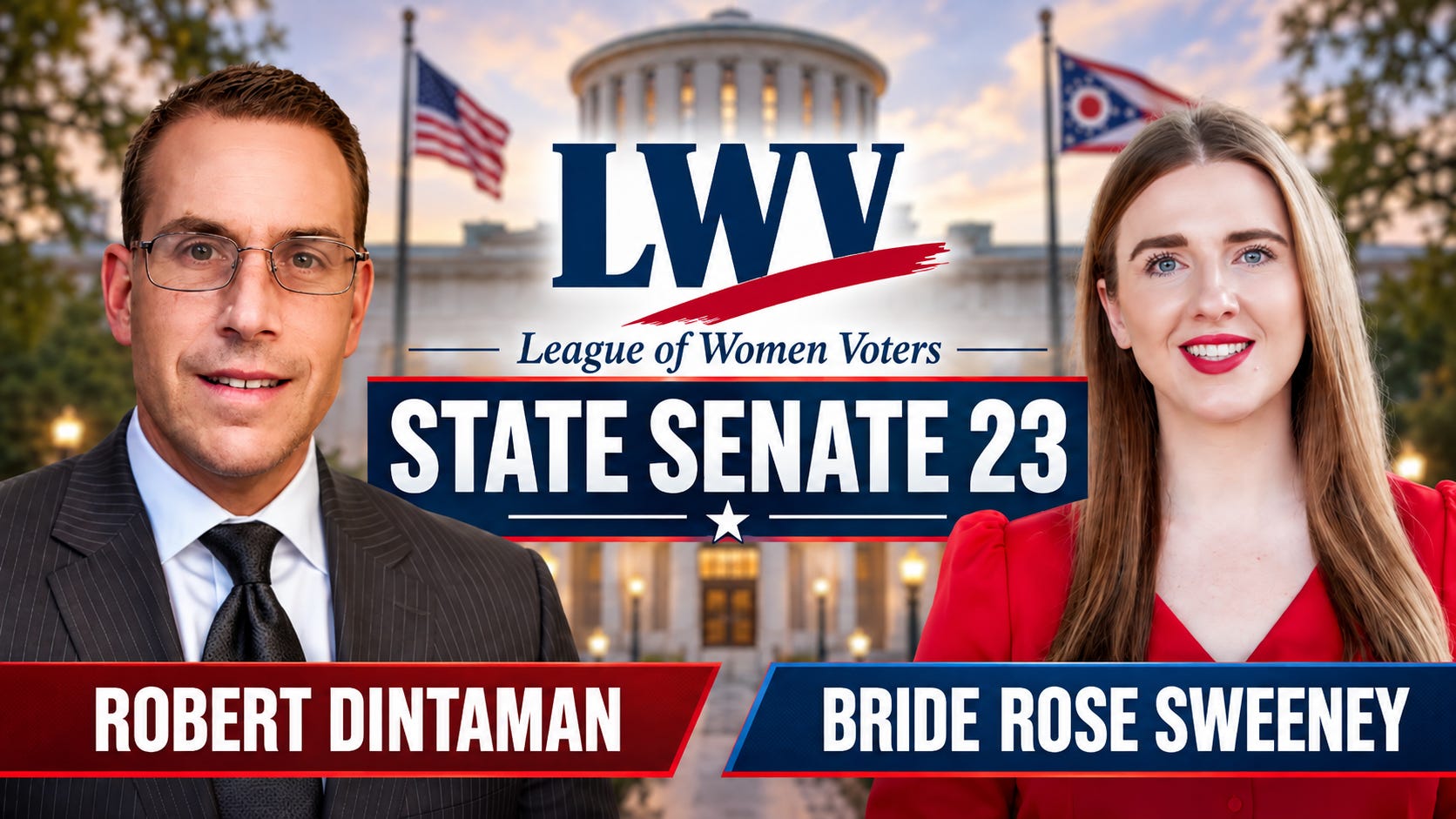
We are going to look at the League of Women Voters forum for the Ohio Senate District 23 race between Republican Robert Dintaman and Democrat Bride Rose Sweeney. This was another really interesting forum, and I’m going to go through it.
First, I’m going to give you my reaction to the candidates’ opening statements.
After that, I’m going to give you a TL;DR explaining the central message from each candidate, along with my comments on each question.
Finally, I’ve cleaned up the transcript of the questions and answers, with the help of ChatGPT, so you can read what the candidates actually said without having to sit through the entire forum and without my comments or paraphrasing of their answers.
You can watch the forum here:
TL;DR
First, I want to say that I think League of Women Voters forums are always the best. Whether it’s Cuyahoga County, Medina, Wayne, or wherever, they know how to run a tight ship, and they get candidates in front of constituents.
They’re tough forums because the questions come directly from constituents, and the candidates have to stay within strict time limits and boundaries.
The one thing I do wish they had was real-time fact-checking. In the future, I would love to see the League of Women Voters have two volunteers sitting off to the side fact-checking claims as the forum is happening.
With that said, Bride is, again, one of my favorite legislators.
She is somebody who can be a proud Democrat and pragmatic at the same time. She has original ideas and thoughts, doesn’t involve herself in a lot of drama, and gets the job done.
She already has a lot of accomplishments under her belt, and I think she will continue stacking bills in the legislature that are actually actionable and useful for the State of Ohio.
In this forum, she also showed discipline, poise, and a strong understanding of the different topics she was talking about.
She played the partisan game when it was actually relevant to the conversation, not as a distraction or a diversion because she didn’t know an answer, which I’ve seen in other forums.
She used partisanship as emphasis.
“I’m a proud Democrat because we did this.”
Or, “Even as a proud Democrat, I teamed up with Republican Governor Mike DeWine.”
That showed, in my opinion, the kind of temperament you actually need if you’re going to be a work-across-the-aisle legislator in Columbus.
Robert knows he has an uphill battle, and I don’t fault him for that.
Getting out there and running for office is super hard. And, to be perfectly honest with you, I fell into a lot of the same traps that he has.
He is Mr. Bipartisan. He is the “I’ll work across the aisle,” “I’ll work with everybody” candidate.
He knows he’s running in a Democratic district, and League of Women Voters forums, at least in Cuyahoga County, are usually going to have a Democratic-leaning audience, if not an audience made up mostly of Democrats.
With that said, I’ve seen this from a lot of first-time candidates.
They try to become the peacemaker. They think going out there and saying, “I’ll work with everybody,” is going to be the thing that gets a Democrat to vote for the Republican, or gets an independent who usually votes Democratic to cross over.
It isn’t.
In my opinion, it can come across as a lack of preparation and a lack of conviction.
I also think this can be difficult for lawyers, especially lawyers.
Lawyers train their brains to take emotion and bias out of their day-to-day work. They look at the law. They look at how to interpret it for their clients. They look at precedent and try to find the best outcome for the person they represent.
So when Robert says he works across the aisle, I actually believe him.
That has basically been his professional training. Suspend emotion, look at the facts, look at the law, look at precedent, and figure out the best outcome.
But electoral politics is different. Voters also want to know what you actually believe, where you draw lines, and what you are willing to fight for.
So, in my opinion, the TL;DR here is that this was another very educational forum, and it showed why Bride Rose Sweeney is a very experienced and effective legislator in Columbus.
Opening Statements
Matt’s Take
Initially, I think visuals matter, and that’s part of what these kinds of formats are about. We’ve known this since the first televised Nixon-Kennedy debate.
Bride Rose Sweeney is smiley, bubbly, and happy to be there. She thanked her opponent for being there and also thanked everybody for showing up and agreeing to do this. She clearly understands the importance of this kind of forum.
Robert looks a little gruff, a little grumpy. He looks like he knows he’s behind the eight ball and also probably not the favorite to win this race. Being the Republican in a room that was probably full of Democrats, in a very Democratic-leaning district, probably puts him a little off-guard.
His opening statement, though, was very focused and well laid out. You understood where he stood.
But I also saw the same thing here that I saw with Republican Sofia Tjotjos in the Ohio House District 16 forum. It seems like Robert may be masking some of his actual ideas because they might come across as a little too Republican for the audience in the room.
Bride Rose Sweeney, again, is one of my favorite legislators in the State House. She was very transparent, very forthright about what she’s done, who she is, and the bills that she’s passed.
This is going to be a fun one to watch.
Question 1: Representing a Large and Diverse District
Question: How would you balance the competing economic, infrastructure, and community needs across a district that stretches from Bay Village through Cleveland and into the eastern suburbs?
Matt’s Take
This is where I think we’re going to start seeing the difference between someone who is a policy wonk, an experienced legislator, and someone who can also build on that experience with charisma and really answer these questions.
I don’t want to sound biased here, but I am a Bride Rose Sweeney fan, if you will.
Her answer to Question 1 was pretty straightforward. She talked about the holes in the budget, the realities that come with that, and the need to build a bridge between the city and the suburbs and between very different suburbs, from Lakewood to Bay Village to Rocky River. Her point was that there is no one-size-fits-all solution.
That’s a very good answer.
Robert, on the other hand, talked about talking to folks, finding common ground, and getting out into the community.
This is where, to me, it starts to sound like first-time candidate talk from someone who hasn’t quite figured out how he’s going to position himself within the policy conversation.
I would call this, unfortunately, rookie talking points and a rookie error.
Question 2: Legislative Priority
Question: If elected, what is one piece of legislation you would most want to introduce or co-sponsor?
Matt’s Take
I appreciate Robert’s response and his concern about property taxes. They have, in my opinion, become onerous on a lot of homeowners, and I do think you have to work with Democrats and Republicans.
Again, I always think that’s kind of a weird middle-of-the-road cop-out, this idea of, “Look, I love everybody, I’ll work with everybody,” as a talking point. But in this case, it’s also true. You are going to have to work with everybody to figure this out.
That said, if Republicans continue to control as much of the legislature as they do right now, you’re really not going to have to work with Democrats nearly as much as you’re going to have to work within the Republican caucus itself.
Bride understands that property taxes and school funding are synonymous, and she isn’t going to dance around that. That is the real question. If somebody is talking about getting rid of property taxes, they are also talking about fundamentally changing how we fund kids’ education. Those two things are tied together.
But I did not hear a real solution from either one of them.
And, to be perfectly honest, I think this (property taxes) is something Democrats have notoriously been very poor at talking about, even though it is a massive elephant-in-the-room issue.
Question 3: Most Challenging Aspect of Serving in the Senate
Question: What do you anticipate will be the most challenging aspect of serving as an Ohio State Senator?
Matt’s Take
I feel like Bride Rose Sweeney actually gives the definition of a state legislator’s job almost exactly right. It’s a weird concept when you really think about it, but it is what it is: their job as lawmakers is to figure out how to spend all of the money the state collects and decide where it goes.
That really is the job.
But on this question, I’m going to have to be with Robert.
It’s a $100 billion budget, and they’re still having shortfalls. That is absolutely unacceptable, in my opinion.
He brings up Medicaid fraud. Again, I would need much more evidence to show that Medicaid fraud represents a substantial loss of revenue or spending power in the overall state budget.
But I generally lean toward a pretty simple principle: if you have a budget, you stay within your budget.
You can’t keep having shortfalls.
Question 4: Long-Term Budget Stability, Tax Reform, and Economic Development
Question: With a four-year term in the Senate, how would you approach long-term state budget stability, tax reform, and statewide economic development?
Matt’s Take
Robert really didn’t have an answer beyond getting spending under control and working across the aisle.
To me, that’s another rookie mistake from someone who maybe hasn’t thought through this issue deeply enough yet.
Bride, on the other hand, brings receipts.
She says that, over the past 15 years, Ohio has given away exemptions to the tune of $17 billion. Her argument is basically this: Ohio can be a great place to do business, but if you’re allowing major companies and high-net-worth individuals, some of your biggest potential revenue sources, to avoid paying into the system while you’re also running shortfalls, then you don’t necessarily have a spending problem. You have a special-interest problem.
She also points out that people in the lower tax brackets actually saw an increase of $32.
I mean, that was an amazing answer. Really strong.
That said, I also feel like there is always a spending problem somewhere. I don’t think those two things are mutually exclusive.
Question 5: H2Ohio and Lake Erie
Question: Should Ohio keep, change, or expand H2Ohio, and what should the state do to protect Lake Erie?
Matt’s Take
Bride comes out swinging, saying she’s a proud Democrat and that she’s proud to say she’s working with Republican Governor Mike DeWine.
She explains what has happened, why H2Ohio is important, why she voted against a budget that cut money from the program, and why she will continue to defend it.
I feel like her answer just had everything in it. She’s a proud Democrat, but she’s also willing to say, “Hey, this Republican governor did something right, and I support it.”
We still haven’t really heard Robert say, “I’m a Republican,” yet. He seems to be trying to create this middle-of-the-road, work-with-everybody sort of thing.
He’s running in a district that is overwhelmingly Democratic, so I understand why he’s doing that. But at the same time, this was a point where he could have said, “I really respect Mike DeWine and what he was doing,” kind of like Bride did.
Other than that, it’s good to hear that Robert acknowledges protecting Lake Erie is a very important part of government stewardship.
Question 6: State Environmental Standards
Question: As federal air and water regulations change, what role should Ohio play in setting and enforcing its own environmental standards?
Matt’s Take
I won’t belabor this one too much.
It seems like they’re pretty much on the same page when it comes to understanding the importance of protecting the environment.
Bride added a little more color to the issue by explaining how the federal government, depending on who is in the administration, can move the goalposts, change standards, or shift resources available to the state. When that happens, Ohio has to scramble to figure out how to respond.
That was actually pretty insightful, and I appreciated that she added that context.
Question 7: Gas Tax Suspension
Question: Should Ohio suspend the gas tax, and if so, how should the state account for the resulting loss of transportation revenue?
Matt’s Take
Finally, we have a real difference of opinion here. A pretty major one.
I’m actually somewhere in the middle on this. I’m generally a lower-tax, lower-spending kind of person, but Bride is right on the basic budgeting principle: if you already have taxes and spending commitments in place, you can’t just willy-nilly stop collecting revenue and pretend those obligations disappear.
You can’t cut a tax and create a $700 million hole in the budget without a plan to replace that money. That is not responsible budgeting.
Yes, gas prices are high. And yes, that is not necessarily the fault of the state. A lot of that comes from federal policy choices and broader economic conditions.
But I think there are better ways to provide relief to families than cutting a tax that is directly tied to funding the Ohio Department of Transportation.
On this one, I think Bride had the more responsible budgeting argument.
Question 8: Mail-In Ballot Grace Period
Question: Should Ohio restore a grace period for mail-in ballots that are postmarked by Election Day but arrive afterward?
Matt’s Take
I love how, when you watch these forums, you can see when candidates get genuinely heated about certain topics, and Bride was pissed about this one. It’s obvious she’s passionate about the issue.
I think they both have a point.
Personally, I like having a voter cutoff. Ballots should be received by a certain date, voting should be finished when the polls close on Election Day, all ballots should be counted, and we should have a timely result. I like that. It’s clean, it’s comfortable, and we already have a long early-voting period.
But Bride does have a real point.
If you have a federal government that has been messing with the Postal Service, and your ballot is postmarked before Election Day but doesn’t arrive until afterward because of cuts, reorganizations, or whatever other finagling is happening at the federal level, then that is absolutely an issue. We can’t pretend it isn’t.
On a personal note, this has nothing to do with elections, but I traded in my Apple Watch and mailed it to Apple’s return center during the last election. It was delayed by probably more than a month. Because it arrived so late, Apple offered me less for the watch than they had previously.
Obviously, that’s nowhere near as important as a ballot, but the point is that I thought the watch was lost. It wasn’t lost. It was just massively delayed in the mail.
So I think they both have a legitimate point.
The postmark has to matter. But at the same time, if you put something in snail mail on Election Day and it takes two weeks to arrive, there also has to be some level of personal responsibility.
Question 9: AI-Generated Election Deception
Question: Does Ohio have sufficient safeguards against AI-generated deception in elections, and should AI-generated political content be labeled or otherwise regulated?
Matt’s Take
I’m not even sure anybody fully answered this question, although there were pieces of an answer from both of them.
The fact that you can legally lie in Ohio political advertising is absolutely crazy. And again, Cleveland.com and The Plain Dealer have said they were going to create a website to fact-check political ads in Ohio. I think that’s a great idea. Hopefully they’re looking at mailers and everything else too. Honestly, maybe that’s something I should be doing as well.
There should be some kind of operation that fact-checks this stuff.
Robert says he wants to work in a bipartisan way and create “reasonable guardrails,” but guardrails around what, exactly? What are you actually proposing?
Again, I don’t know if Robert has really thought through a lot of these issues beyond saying, “I’m going to work bipartisanly.”
The one thing neither candidate really addressed, and I think absolutely has to be part of this conversation, is the First Amendment.
Political speech is core protected speech. If someone is making an AI-generated ad, a political parody, or political content about a candidate or elected official, that speech deserves very strong protection.
I don’t know whether AI-generated political content should always be labeled as AI. I don’t even know if requiring a label in every circumstance is the right answer.
But when you start creating deepfakes or extremely realistic representations of candidates and elected officials that make it appear they said or did something they never actually said or did, then you have a real problem of deception and authentication.
So I think there has to be some way to distinguish authentic material from manipulated material and to create checks around deceptive AI content.
But we also have to walk very carefully here, because whatever rules we create have to protect political speech and the First Amendment.
Question 10: Ranked-Choice Voting
Question: Should Ohio allow ranked-choice voting, particularly at the local level?
Matt’s Take
In terms of ranked-choice voting, I think local communities should be able to decide how they run their own local elections.
I do think it could become confusing if you have two different systems on the same ballot, especially in a November election where the state operates one way, the county elections operate another way, and then your municipality might operate under a completely different system. That could absolutely become problematic.
I am for ranked-choice voting.
But I also think Democrats in Ohio may support it because they assume it is going to help them win more seats or give them more control in areas where they already have an advantage. The problem is that ranked-choice voting does not inherently benefit Democrats.
It could go exactly the opposite way.
Remember, under ranked-choice voting, you could end up with two Republicans effectively competing against each other in a way that starts carving Democrats out of the process entirely.
So I am for it. I’m also in favor of more of a jungle-primary system, like California.
But I think Democrats in Ohio who support ranked-choice voting because they assume it will benefit them electorally might not like all of the consequences once the system is actually in place.
Question 11: Business Tax Incentives and Accountability
Question: How should Ohio balance tax breaks and other incentives for businesses against the cost to taxpayers, and what accountability measures should be required?
Matt’s Take
Both had very good points here, and honestly, if you combined both of their arguments, I think you would have a win for the people of Ohio.
Bride points out that 75% of the businesses that received taxpayer money did not actually meet the job-creation targets they signed up for. In my opinion, that is a problem.
The entire reason you are incentivizing a business to come to Ohio is so that it creates jobs for people in Ohio. You are competing with 49 other states. You are trying to provide resources and make Ohio attractive. Yes, you absolutely have to incentivize businesses to come here.
But if a company comes here and says it is going to create 1,000 jobs and it creates 600, then it did not meet the requirements that justified those tax breaks.
So there has to be accountability. There has to be transparency.
At the same time, Robert also makes a very good point about NDAs. You cannot have everything happening under the cover of darkness when you are talking about community projects, especially when taxpayer money is involved.
You do want to incentivize businesses. So how does all of this fit together?
In my opinion, if another state wants to offer companies the cover of darkness, NDAs, and no real accountability, then they can keep those jobs.
But I also think that with the right incentives, the right programs, and real transparency, this can be a win-win for businesses, workers, and taxpayers.
Question 12: Small Businesses and the Business Income Tax Deduction
Question: What should Ohio do to support small businesses, and should the state change its small-business income-tax deduction?
Matt’s Take
Again, they both can be right and wrong at the same time.
The fact is, Bride is 100% correct that there is a loophole. At the same time, you need to incentivize people to start their own small businesses.
There is a real catch-22 right now when it comes to small businesses.
Real estate is very expensive. There is not enough mixed-use real estate where you can live upstairs from your small business if you have a shop. So retail is really getting hit.
A lot of people are also working from home, which means your small business is now taking over part of your home space. You might have to expand, build out an office, or dedicate part of your house to running that business.
You don’t pay income taxes on up to $250,000, which can absolutely become a loophole. But at the same time, the whole point is to allow people to use their own capital, take the risk, grow their business, and hopefully hire people.
I can absolutely see the abuse of that loophole.
If you have a “small business,” in air quotes, but one household has five different small businesses that are really just five different pieces of the same basic company structure, then yeah, that might be a problem.
But at the same time, the risk is real.
People who are willing to put their own money on the line, start a business, and take that risk should be incentivized to do so.
And with that said, I think you also have to recognize just how difficult the environment has become for actual small businesses.
You have private equity coming in and buying up HVAC companies, mom-and-pop shops, dry cleaners, and all kinds of local businesses. Now you have big business effectively buying out small business and creating a market where it becomes much harder for independent operators to find margins and compete.
That matters.
When I’m talking about small businesses, I’m not talking about some multimillion-dollar company that still technically qualifies under a broad definition of “small business.” I’m talking about actual small businesses.
At that level, $250,000 a year is not some massive amount of money. In the context of running a business, paying expenses, reinvesting, taking risk, and trying to grow, it can be pretty minor.
So I think that has to be part of the conversation too.
There has to be a balance between closing abuse of the loophole and protecting the kind of genuinely small businesses that we actually want people to start, grow, and keep independent.
Question 13: Data Centers and Local Control
Question: How much say should local communities have in approving data-center projects, and should Ohio pause new approvals while studying their effects?
Matt’s Take
On data centers, they’re basically saying the same thing.
Yes, there should be transparency. Local individuals should have a say, and it shouldn’t just be local governments signing NDAs and making decisions for everybody behind closed doors.
I think this should be a citywide democratic process. If something this large is going to affect water, electricity, land use, traffic, taxes, and the surrounding community, then the people who actually live there should know what’s happening and have a meaningful voice in the decision.
With that said, just saying no all the time probably isn’t the best solution either.
You’re also talking about union jobs and skilled-trade jobs for pipefitters, ironworkers, electricians, and a whole range of other workers who would be involved in building these facilities. There are real employment and economic-development benefits that come with them.
So I agree with both candidates here.
The answer is transparency, local input, and accountability, but not automatically treating every data-center proposal as something that should be stopped.
Question 14: State-Level AI Regulation
Question: What role, if any, should Ohio play in regulating AI, especially when a 50-state patchwork could create conflicting rules?
Matt’s Take
It seemed like Robert didn’t really understand the question because his answer was basically gibberish.
Bride, on the other hand, said two things at the same time, and again, complex issues sometimes require nuanced, complex answers.
A 50-state patchwork for AI regulation is not ideal.
To be perfectly honest, when you have 50 different regulatory systems, the companies best positioned to navigate all of that are the biggest companies. Google, Apple, Microsoft, Meta, and the other giants can afford compliance teams, lawyers, engineers, and systems that manage 50 different regulatory environments.
A startup with two developers cannot.
That kind of patchwork can actually benefit the largest companies while squeezing out smaller competitors before they ever have a chance to grow.
That is a real issue.
At the same time, I do think states’ rights are imperative. That is part of what the United States is built around. Different states have different ideas, different regulations, different business environments, different tax structures, different infrastructure, different cultures, different populations, different climates, and different priorities.
That is part of how states compete with each other.
So why shouldn’t Ohio be able to make its own rules for AI? I don’t see anything inherently wrong with that.
The problem is timing.
If enough states begin regulating AI differently, that may eventually force the federal government to step in and create one national framework. But by the time that happens, some of the smaller startups may already have been squeezed out because of the logistical, operational, and financial burden of complying with dozens of different systems.
Then you’re left with the Googles, Microsofts, and Metas of the world because they were the only companies large enough to survive the patchwork.
So Bride’s answer gets at the real tension here: states should absolutely have the ability to act, but fragmented regulation can also unintentionally strengthen the biggest companies at the expense of startups.
Question 15: AI and Job Displacement
Question: What role should the state play in helping workers whose jobs are changed or eliminated by automation and AI?
Matt’s Take
By Question 15, Robert finally gives the answer that I thought was the best.
Sorry, Robert, if you ever read this. Don’t know you, but this is where we are.
I have said this multiple times: school districts and the state should be calling OpenAI and Anthropic and saying, “Build us specific AI applications for education.”
Not apps that just give students the answers. Not apps that do everything for them, look everything up, and write the essay.
I’m talking about AI that works as an extension of the teacher. A tutor in the classroom. Something that helps explain concepts, gives additional examples, works through problems with students, and helps teachers scale what they are already doing.
And we should be thinking about this same model across the workforce.
AI is here to stay. So the question is not how do we stop it. The question is how do we extend jobs with it, retrain people around it, and teach people how to work alongside it.
That means partnerships between universities, companies, the state, schools, employers, and other stakeholders who are going to shape the future of Ohio and, honestly, society.
The goal should be to create something that is beneficial, educational, and actually useful as a tool for everyone.
Question 16: Automatic License Plate Readers / Flock Cameras
Question: Should police be required to get a warrant before accessing data collected by automatic license plate reader systems?
Matt’s Take
This is an absolutely fascinating issue.
First things first, can we cut the bullshit and stop calling these things “automated license plate readers”?
It feels a little bit like we’re being gaslit by the terminology.
Remember years ago when people said our iPhones were listening to us, and everybody said, “Oh no, they’re not listening to you”? Now everybody basically accepts that our technology is constantly collecting information about us.
These systems are not just reading license plates.
They can capture information about your vehicle, including the color, markings, bumper stickers, and other identifying characteristics. Depending on the system and how it is integrated with other technology, these networks can also be used to track where vehicles go and build patterns of movement.
So please, let’s stop pretending these are just license plate readers, because they are much more than that.
With that said, there are cities that have rolled this technology out extensively, and law enforcement agencies argue that it helps solve crimes and recover stolen vehicles. We have also seen auto theft fall significantly in some places over the past few years.
Does surveillance technology help prevent or solve crime? A lot of police officers will tell you yes.
But now we get to the much bigger moral and constitutional question.
Do we turn the United States into a surveillance state and sacrifice liberty for security?
This is the part that matters.
The fact that we are even asking whether police should need a warrant to access this data shows how complicated this gets and how much we are willing to sacrifice for safety.
You need a warrant in many circumstances to search somebody’s phone. So what about data collected by a camera?
Is it public information? Is it private information? Who owns the data? How long is it stored? Who can access it? Can different agencies access the same database? Can private companies aggregate it? Can that information be shared or sold… by the company or data brokers?
Those questions matter a hell of a lot more than simply asking, “Did this camera help solve a crime?”
Because once you start aggregating massive amounts of location and vehicle data into centralized databases that can potentially be accessed by multiple institutions and agencies, you are talking about something much bigger than crime prevention.
You’re talking about surveillance infrastructure.
Then we get into the Fourth Amendment, privacy protections, warrants, data retention, oversight, and the checks and balances surrounding all of it.
So, again, the real question is not whether a camera can help solve a crime.
The real question is how much liberty we are willing to sacrifice for security, and what protections have to exist before we cross the line into becoming a surveillance state.
Question 17: Local Police and Federal Immigration Enforcement
Question: What role should Ohio’s local police and sheriffs play in federal immigration enforcement, and should state law require, allow, or limit that cooperation?
Matt’s Take
I think it was the League of Women Voters forum for the 16th State House race where I heard what I thought was the best answer to this question:
Why are we putting our law enforcement officers in the position where they have to decide which laws they are going to enforce and which agencies they are going to work with to enforce those laws?
We don’t tell police officers that they shouldn’t work with the FBI if they need help. We don’t tell them not to work with the National Guard, FEMA, or other government agencies when cooperation is necessary.
So, in my opinion, this is an interesting situation where we are putting the responsibility on individual law enforcement agencies and asking them, in some form, “Could you enforce this?” or “Should you enforce this?”
Their job is not to interpret the law. Their job is to enforce the law.
Interpretation belongs to the courts.
If the State of Ohio wants to push back against a federal requirement or a federal enforcement policy, then the state should make that decision at the state level. That means the governor and the state legislature should take a unified position that applies across the state.
But putting that burden individually on the Cleveland Police Department, the Cuyahoga County Sheriff, the Bay Village Police Department, the Berea Police Department, or any other local agency complicates their jobs in a way that I think is unfair.
If the state wants to draw that line, then the state should draw it. Local police officers should not be left to decide where that line is.
Question 18: Fair School Funding Plan
Question: Is Ohio’s current school-funding system sustainable, and how should the state fund public schools without continuing to lean so heavily on property taxes?
Matt’s Take
This is where an incumbent always has the high ground in these kinds of discussions.
When you ask a policy question and the sitting representative can come back and say, “Hey, by the way, I sponsored that law,” that’s a real big flex.
Bride gets to do that here with the Fair School Funding Plan.
It immediately changes the dynamic because she isn’t just talking about what she would like to do. She can point to something she actually worked on, sponsored, and helped get into law.
That’s the advantage of being an incumbent in a forum like this. You get to answer with a record instead of just a proposal.
Closing Statements
Matt’s Take
In her closing statement, I really appreciated what Bride said about how this is how we truly take our democracy back: by doing these kinds of forums and actually getting candidates in front of voters.
Bride knows she is heavily favored in this race. But the fact that she still shows up and participates says a lot.
It shows that she cares about the democratic process. It shows that she understands these conversations matter. It gives her more input from the community, and it gives everybody else a better understanding of what is actually happening in the State House.
I respect when somebody doesn’t have to show up, and they do.
You don’t see that nearly as often anymore, on either side of the aisle.
So, much respect for that.
In terms of Robert’s closing statement, he said he’s a problem solver, and I appreciate that.
He talked about fraud issues, lowering costs, lowering taxes, and getting money back to citizens. I like that he wants to get money back to the citizens.
I do think people are being overtaxed, and we’re reaching a point of real strain. If somebody doesn’t seriously address that, I think eventually something is going to break.
So I appreciate him talking about lowering costs, lowering taxes, and putting money back in people’s pockets.
The fraud discussion, though, makes me a little more cautious.
I don’t know how much evidence he has for some of those claims or how large those losses actually are in the context of the overall budget.
And again, I think when it comes to this stuff, direct fraud is probably a much smaller problem than legalized corruption.
That, to me, is the bigger issue.
Complete Transcript
Introduction
Alice Allen: Good evening, everyone.
Welcome to this evening’s candidate forum presented by the Bay Village, Cleveland, Fairview Park, Lakewood, Rocky River, and Westlake/North Olmsted chapters of the League of Women Voters of Greater Cleveland. We’re pleased to welcome all of you here with us tonight.
I’d also like to welcome those who are watching online via the livestream and any folks who are watching the recording, which will be made available on the League of Women Voters of Greater Cleveland YouTube channel.
My name is Alice Allen, and I’m co-chair of the Rocky River chapter of the League. I’d like to thank the candidates in the race for the 23rd Ohio Senate District who are with us tonight. Thank you to the City of Rocky River for the use of this space, and thank you to all the League of Women Voters chapter volunteers who are staffing this event.
In keeping with our longstanding forum tradition, questions for the candidates will be submitted in writing. Everyone should have received a card as you entered this evening to write down your questions for our candidates. When you have a question ready, raise your hand and a runner will come and pick up your card. You can also raise your hand if you need another question card.
We have two League members at the question-sorting table who will be reviewing questions to avoid duplication, to provide a diversity of questions, and to ensure clarity and appropriateness of the questions.
I did want to do a visual demonstration. We had a forum here last night. These were all the questions that we received. We only had time for 17. We expect to get through 13, 14, or 15 tonight. We get a lot of questions and we aren’t able to get through them all.
I do remember that we had several on property tax last night, which got condensed into one question. So, just to give you an idea how that works.
As I stated earlier, we are recording the program for future viewing on YouTube, and I want to let you all know that personal recording during the program is forbidden by League policy. You are invited to view and share the forum in its entirety on YouTube, but we also have a prohibition on sharing segments of the forum on social media.
Finally, we ask for the cooperation of the audience in avoiding expressions of support or opposition to any candidate during today’s program.
Please remember, the purpose of this evening is to hear from the candidates so that each resident might make their own best-informed decision regarding their vote, and any vocal interruption takes time away from the candidates.
Thank you for being here and agreeing to our policies. If you are being disruptive this evening, we will ask you to leave.
I’d like to introduce you to Kathy Hexter. We’re fortunate to have Ms. Hexter as our moderator this evening.
Ms. Hexter serves as the program director for the League of Women Voters of Greater Cleveland and is a member of the Shaker Heights chapter. A public policy analyst with over 35 years of experience, she retired in 2017 from Cleveland State University’s Levin College of Urban Affairs, where she directed research on affordable housing, energy, and community development policy.
In addition to her work with the League, she is a board member of a number of community nonprofits.
Please join me in welcoming Ms. Hexter. Pasted text
Forum Format
Moderator Kathy Hexter: Good evening. Thank you.
Before we begin tonight’s program, I’d like to explain our format. We have two candidates running for the 23rd Ohio Senate District seat: Robert Dintaman and Bride Rose Sweeney.
We will begin our forum with two-minute opening statements by the candidates. The candidates will go in alphabetical order, Mr. Dintaman going first.
We will then continue with questions for each candidate. Each candidate will have one minute to answer each question. We will rotate which candidate answers first. Whoever answered last will answer the next question first.
We have people keeping time here in the front. They will let the candidates know when they have 30 seconds and when they have 15 seconds left. Then they’ll let you know when you’re done.
At the end of the question period, each candidate will give a two-minute closing statement in reverse order, beginning with Ms. Sweeney.
We will take, as Alice said, written questions from the audience. You need to write them on the cards that are on your seat, and people will be around in the audience to collect them.
Opening Statements
Robert Dintaman
Robert Dintaman: Thank you very much. Thank you, everybody, for having me here this evening. I look forward to engaging you in a very thorough discussion. It’s going to be a lot of fun. Hopefully, we get to learn a little bit about each other.
I’m Rob Dintaman. I’m a resident. I’ve lived in Lakewood now about 14 years. I’m originally from Mansfield, Ohio, so I came from down south of this way. I went to law school at Akron. I’ve been a practicing lawyer now for about 30 years. Time is flying.
That’s kind of where I’ve got my experience. I deal with folks. I solve problems on a day-to-day basis. They come into my office, and I talk to folks just like you come in and ask questions. They have issues. I try to resolve them.
I think that’s how I classify my candidacy. I’m going to be an individual who hits the ground running, rolls my sleeves up, goes and talks to you, and tries to figure out what I can do to help and respond in the best way possible.
That’s how I’ve grown my practice and dealt with many folks in this community. It’s been my pleasure to do so for the last 30 years as a practicing lawyer.
I really kind of break my candidacy down into a three-pillar process. Again, I’m nontraditional. I’ve never really run for office. I guess it would be my second time, but I’m not a traditional politician. I’m a business guy. I’m your neighbor. I live in the district.
Obviously, I care about homeownership. Citizens talk to me all the time. I care about property tax reform. That’s my biggest issue.
I’m down there to try to tighten the belt with regard to the budget. I was concerned to see the Medicaid situation, the fraud that happened. That’s healthcare for our citizens in this community. We have to be able to solve that problem.
And really, it’s the data centers that are coming in. I’m fighting that right now. In several areas in Columbus, I’m working with communities with regard to transparency and making that work within our community.
My goal is to work with you. I want to talk to the citizens and be part of this community and represent this community in Columbus.
Bride Rose Sweeney
Bride Rose Sweeney: Good evening, everyone.
I first want to thank the League for hosting this and Robert for agreeing to do this, and most importantly, the people watching, because it really wouldn’t matter if we didn’t have an audience that cared about making sure they knew both of their candidates.
I’m State Representative Bride Rose Sweeney. It has been the honor of my life to be a state representative, in some capacity, for the West Side of Cuyahoga County, because I’ve had about three different districts in my tenure. That’s not how that should work.
I was born and raised in the West Park area and had the crazy idea that, at 25 years old, a young woman could run for office, be the youngest member of the General Assembly and the first woman to represent her community at the Statehouse. Not just that, but actually do something different, actually get things done, and put the people first.
I believe I have done that. I’m a Democrat. It is not the most fun thing working in a state controlled by the party that’s opposite of yours, but I’ve focused on getting things done.
I was told by plenty of people in my own party that it wasn’t possible, and I’ve passed over 14 bills, all of them meaningful, all of them with Republicans.
One of them was the largest change to our public schools in the history of Ohio that set us on a pathway to constitutional funding for them. I have passed bills to end police quotas, to stop police officers from being forced into being revenue generators to fill budget holes, and to help disabled kids ensure that they’re getting lifetime supports regardless of the county that they live in.
That is what’s possible when you have candidates who are willing to focus on other people.
There are so many more things that we can do to make our state better when we are actually focusing on people rather than Twitter likes and our differences.
So I hope to continue to do that in the Senate.
Question 1: Representing a Large and Diverse District
Moderator Kathy Hexter: You will be representing a very large district, running basically from Bay Village all the way across the City of Cleveland to Euclid. How would you balance the competing economic, infrastructure, and diverse community needs within your district?
Bride Rose Sweeney
Bride Rose Sweeney: It’s an excellent question, and it becomes even harder when you are looking at the realities of our upcoming budget.
I do not believe that our current budget has been funded responsibly, and we are going to have massive holes in multiple budgets that we face next year. That means it’s even more difficult when you have such a diverse district that has different needs.
But it’s about figuring out the things that uniquely tie those districts together and finding different solutions to help the inner-city core without leaving your surrounding suburbs behind.
We also can’t look at communities like Rocky River or Bay Village and say, “Oh, therefore, they don’t need anything.”
It’s about fairness. There is no such thing as a one-size-fits-all solution, and you need the resources to do so.
Robert Dintaman
Robert Dintaman: It is a big district, and obviously there are going to be differences of opinion about how things should be done. I think that makes the district great.
So, get out in the field. Let’s talk to these folks. That’s how I approach my practice. I try to talk to everybody. I try to understand what they need, and sometimes those needs are going to clash.
The idea is to try to find common ground. That would be going down and figuring out, hey, how do we fix the budget?
I have problems with my own party right now and how they’re doing things. I’m not going to go down there and make friends. I’m going to go down there and work.
I’m going to get out in the community. I’ll talk to folks. I’ll find out how we can get common ground. I think that’s the main thing. How do we work together as a community? How do we work together to address different needs of different communities?
I think it can be accomplished. Just talk to people. I like talking to folks. I’m a lawyer. I like to talk all the time.
Getting out in the field, talking to my neighbors, talking to everybody, I look forward to the challenge. I think it’s something I could bring to the table.
I’m going to engage the community. I’m going to figure out what they need. I’m going to work together to bring us together.
Question 2: Legislative Priority
Moderator Kathy Hexter: If elected, what is one piece of legislation you would most want to introduce or co-sponsor?
Robert Dintaman
Robert Dintaman: I think my number one issue is to protect the family home.
Citizens are concerned about property taxes. I think Columbus has done some things, but they’ve not done enough. I think we need to get down there and solve the problem.
We understand that property taxes fund certain things, and we need that to be done, but how do we protect our seniors? How do we protect our citizens?
That home is the bedrock of family life. We need to protect it.
My goal is to work with Democrats, Republicans, whoever, to get that done and go further. Let’s reform the property tax code. Let’s protect the family home.
I think that’s going to be one of my biggest pillars when I roll up my sleeves. That’s what I’m going to promise to this community and to this district.
I’m going to go down there and get that done and make sure it works the right way for the folks in the community.
Bride Rose Sweeney
Bride Rose Sweeney: It’s a hard answer because there’s no shortage of problems that still need to be fixed.
But I would say, undoubtedly, the biggest issue that is most important to me and, I think, this community is continuing the work of making sure the State of Ohio is paying its fair share to our public schools.
As I mentioned, I was the lead sponsor of the biggest change that actually gave us a formula that was connected to what it actually costs to educate students.
It’s my biggest accomplishment. I’ll be proud of it the day I die, but I’ll be the first one to tell you it doesn’t mean a single thing if it’s not funded.
In the next budget, it is not just about making sure kids have a quality education regardless of where they’re living. That’s a great goal, but it’s also about making sure that this is connected to our property taxes.
[The next sentence is unclear in the source transcript.]
Funding our schools is helping students, and it is also helping lower property taxes.
Question 3: Most Challenging Aspect of Serving in the Senate
Moderator Kathy Hexter: What do you anticipate will be the most challenging aspect of serving as an Ohio State Senator?
Bride Rose Sweeney
Bride Rose Sweeney: One of the most challenging aspects, especially in my role for at least the past five years, has been being the lead person for my party on the Finance Committee, which is responsible for, I think, the most serious job a lawmaker can do, which is spend all of your money and decide where it goes.
In the state budget, we don’t have the same luxury as the federal government. We have to pass a balanced budget. So when money is not there, you either have to raise revenues or make cuts.
I don’t care what party you’re in. Both of those things are tough.
We are having a lot of discussions about a gas holiday. It is undoubtable that people need relief because of the issues of the Iran war.
But I haven’t heard one lawmaker talk about how this upcoming transportation budget is going to be a fiscal cliff. We will not have revenues to meet the current demand, to the tune of, over the next 10 years, a $13 billion backlog.
These are real problems, and there are tough decisions regardless of who’s in the legislature.
Robert Dintaman
Robert Dintaman: To me, the most challenging part is trying to get our state budget under control.
It’s $100 billion, and we’re still having shortfalls. Why are we not getting this under control? Why did we watch $50 million get lost in the Medicaid system? That’s funding for our patients. Those are our people in our community.
We’ve got to get control of this stuff. We can’t be having shortfalls. We can’t have things going by the wayside.
We’ve got to figure out how to rein in spending but also support the things that need to be supported.
There’s got to be a way to do it a little bit better without wasting the money that our citizens need, and not just growing the budget because it needs to be grown or raising taxes or whatever it is to fill a shortfall.
It’s finding the right balance, making adjustments, reprioritizing where the money is spent, and reining in spending.
Question 4: Long-Term Budget Stability, Tax Reform, and Economic Development
Moderator Kathy Hexter: You both mentioned the budget. Let’s dive into that a little bit more.
With a four-year term in the Senate, how would you approach long-term state budget stability, tax reform, and statewide economic development that go beyond the short term?
Robert Dintaman
Robert Dintaman: I think it’s getting control of our long-term planning, sitting down and saying, okay, how are we going to do this? Map it out.
We all run our households that way. Start figuring out what’s going to happen the next year. Commit to planning how we’re going to spend, what needs to be adjusted, reduce spending if we have to, but again, fund the things that are important.
I think it’s just projecting better, sitting down, and working with both Democrats and Republicans.
That’s my goal. Let’s get this done. Get the future figured out together and figure out how we’re going to do that.
Again, just write it down. A piece of paper. That’s how I look at it. That’s how I run my office. I think that’s how we run our households.
Keep it simple. Let’s just figure out what the priorities are, get it worked out, work together to do that, and keep Ohio moving forward.
Bride Rose Sweeney
Bride Rose Sweeney: The State of Ohio does not have a spending problem. It has a problem with paying attention only to special interests and the wealthiest people in the state.
In the past 15 years, the State of Ohio has decided to give exemptions to the tune of $17 billion.
I’m a big believer that if we can cut taxes, we should do so. But I believe in cutting taxes to make sure seniors can stay in their homes. I believe in cutting taxes for individuals who don’t get paid family leave or have to care for a senior or an aging loved one.
If you look at that $17 billion, the average person in our top brackets got $70,000 back, while the lower brackets got a tax increase of $32.
The issue is who we’re paying attention to, and because of that, that is why we don’t have enough revenue. It is not that we are spending too much, because we are in the bottom half of the majority of indicators for the health of our people.
Question 5: H2Ohio and Lake Erie
Moderator Kathy Hexter: H2Ohio, the state’s water-quality program, is funded through the state budget, and Governor DeWine leaves office in January.
Should the legislature keep, change, or expand H2Ohio? How do you think Ohio should work to protect Lake Erie’s water from being moved outside the Great Lakes region?
Bride Rose Sweeney
Bride Rose Sweeney: This is one of the areas where, as a proud Democrat, I’m proud to say that our Republican Governor Mike DeWine has led on an issue.
It was a crisis when he came into office, where you had cities in the Maumee Basin that went without clean drinking water because of the neglect of government not protecting the most basic and most important resource we have in the State of Ohio, our Great Lake.
This was a massive effort, H2Ohio, that the budget I voted against cut by over $270 million, when we just didn’t meet our own benchmark that we agreed to with Canada, Michigan, and the other Great Lakes.
We are the state that’s falling behind. I support Governor DeWine’s funding and continue to push my Republican colleagues to make sure that we are not falling behind and reversing all of the efforts that were made in a bipartisan way to protect our drinking water.
Robert Dintaman
Robert Dintaman: The Great Lakes area is an important resource. It’s an important part of our community. I think it needs to be protected.
We need to do whatever we can to keep it as a resource. We need to develop, but we need to protect.
I think using H2Ohio is a good piece of legislation to do that. Let’s keep it reasonable and above board. Let’s keep the lake safe. Let’s protect our water.
I think it kind of goes along with how the data-center stuff is going right now, too. That’s all about water and its use in these communities. Are they damaging the water in those little communities? Is it staying clean?
I would be for that. I want to protect Lake Erie. I think it’s an important resource in our community.
Again, it’s being reasonable, just like anything else we’re developing, but it’s an important part of our community, and we need support in Columbus to protect Lake Erie.
Question 6: State Environmental Standards
Moderator Kathy Hexter: As federal air and water regulations change, what role, if any, should or can Ohio play in setting its own environmental standards?
Robert Dintaman
Robert Dintaman: I think it goes hand in hand with what we just talked about with the Lake Erie region.
We’re going to try to protect our own environment. We want our air and our communities to be safe. I think keeping air quality clean is important.
That’s sensible regulation. Again, it goes to noise pollution. It’s all kinds of pollution.
You’re dealing with the data-center problem that I’m dealing with right now. I think it’s the same thing.
We’ve got communities dealing with these big monstrosities coming in. They’re causing noise and other types of pollution. I think that’s just a small scale where we’re regulating the environment in that community.
I think it’s important.
Again, we’re talking about being reasonable to the community, not hamstringing the community, protecting the community, working together as a partnership and as a community.
It’s everybody working on the same page, coming to common ground as it needs to be to make sure that we protect the most important resources in Ohio.
Bride Rose Sweeney
Bride Rose Sweeney: I think that with a lot of issues such as this, obviously the federal government and the state have a role.
The federal government standards should be the bare minimum, and we should ensure that the State of Ohio and local communities, who have the most incentive to make sure that the air we are individually breathing is safe for us and safe for our children, have a role.
We have seen some back and forth from the federal government depending on who’s in the administration.
Under the Biden administration, it emboldened local communities and gave resources and grants for local communities to actually get testing of their own that they could use to hold polluters accountable.
In the past state budget that I was proud to vote against, they actually tried to take that ability away from our own local governments to be able to test our own air.
Thankfully, some of the EPA groups are suing, and I hope they’re successful because it needs to be in local hands.
Question 7: Gas Tax Suspension
Moderator Kathy Hexter: Ms. Sweeney, I think you alluded to the gas-tax suspension earlier. If the gas tax is suspended, what effect will that have on what the state has?
Bride Rose Sweeney
Bride Rose Sweeney: It is undoubtable, because of decisions in Washington, that our gas prices are skyrocketing. It is also undoubtable that people need relief.
I will not support a gas-tax holiday that is not replenished in the ODOT budget because it would be fiscally and morally irresponsible to put a $700 million hole in it when we know a billion dollars is coming in a few months.
I do believe there is the possibility that some of the proposals that have been put out, that we’ve learned about and have not seen, are asking to dip into the rainy-day fund.
We have not done that since the Great Recession, where we barely kept the state government and schools’ lights on.
It should not be a willy-nilly campaign promise.
Because we are likely to vote on this in a few days and no one will have seen this legislation, I don’t think anyone who votes on that will have any guarantee that it will lower gas prices.
I unfortunately don’t get to set the agenda, but I will be making sure that our ODOT budget is saved to the best of my ability and that those funds actually go to the people who need them the most, and not just a handout to gas companies.
Robert Dintaman
Robert Dintaman: Obviously, gas prices are a problem.
I like the idea of a gas holiday. Obviously, you don’t want to jeopardize the highway funds that would be part of that.
I think there are ways to plan the budget. There’s got to be a way to do it.
This is how I would go down and try to find a way to do that. Find people who can get smart about it. We can make these types of things work to help average, everyday citizens get to work.
I think lowering gas prices is helpful, and doing it in a responsible, reasonable way.
I’m not for just doing everything immediately. But again, being responsible and looking for ways to do it.
There’s got to be a way in that budget to replace the funds if we decide to do the gas holiday without jeopardizing our highways and replacing our roads in the community.
Question 8: Mail-In Ballot Grace Period
Moderator Kathy Hexter: The state legislature recently eliminated the grace period for the return of mail-in ballots.
Would you support legislation to change this? Why or why not?
Robert Dintaman
Robert Dintaman: I think one of the basic promises of our democracy is free and fair elections. I want that to be done in the most transparent and free way possible.
I think you have to have guardrails on it. You can’t just have unlimited elections in terms of every day, 30 days, 40 days, 50 days. I understand that there has to be some kind of limit on it. That’s part of the process.
I think you want to make sure it’s the most reasonable outcome, that we understand the outcome, and just make sure we have the right guardrails on it and that we protect the vote.
We don’t want to disenfranchise, but we do want to protect it and make it fair. We want to make sure it’s understandable and that we know what the outcome is without undermining our elections.
Bride Rose Sweeney
Bride Rose Sweeney: I opposed that bill in the legislature and have opposed every single anti-voter bill that has come before us.
We have a Secretary of State who continuously says, time and time again, that voter fraud is 0.00008%. It is basically nonexistent.
Yet the policies that come out of Columbus are all under the guise of protecting an election that, by our own Republican measures, doesn’t need protecting.
To me, the only explanation and the only real outcome of these policies is that eligible voters with eligible ballots are thrown out.
That is the exact outcome.
Because if you postmark your vote-by-mail ballot and, because the federal government decided to cut the post office, it gets there a few days later, why should you be punished for something you couldn’t control, on something that has been working and has proven to have never been abused and to have never swayed elections?
That should stop.
Question 9: AI-Generated Election Deception
Moderator Kathy Hexter: We recently sponsored a forum on citizenship in the AI era.
Do you think Ohio has sufficient safeguards in place to protect elections from AI-generated deception?
What steps, if any, should Ohio take to protect elections? And what is your opinion on requiring labels on AI-generated campaign ads or penalizing deepfakes meant to mislead users?
Bride Rose Sweeney
Bride Rose Sweeney: We currently have absolutely no laws that address that, so the answer is definitely no.
However, I have been encouraged that this issue has at least appeared in a bipartisan sense. I have not been able to look at the bills, but there does seem to be a real concern that there is not a handle on this.
However, what gives me little confidence is that over the past 15 years, this legislature has gutted the Ohio Elections Commission and has essentially legalized lying in elections.
You can legally lie in Ohio [unclear], and we specifically won’t pass my anti-corruption act that would mandate disclosure on every campaign ad that’s going to your house.
I believe everyone in Ohio deserves to know who is sending their mail and who is funding them, regardless of whether it’s AI or not, and I cannot get that.
But given the intensity of the issue, I’m hopeful that maybe we can make some progress specifically on the AI issues.
Robert Dintaman
Robert Dintaman: AI is everywhere. It surrounds us, and everything that we do is becoming more and more prevalent. I think we’re all trying to get a grasp on it.
I would agree that we need to start coming up with reasonable guardrails. Protect ourselves, protect our vote, protect what we receive in the mail.
Obviously, we’re inundated with a lot of ads. Look at Facebook. We’re going to see a lot of this stuff that’s AI-generated.
I would work in a bipartisan way. I would want to have safeguards that identify these things.
I think it’s important to know where you’re getting the mail and where you’re getting these ads.
AI is going so fast, and keeping up with it is hard enough as it is. So, to create guardrails and reasonable and responsible controls, I would be in favor of that.
I will work with everyone in a bipartisan way down in Columbus to make sure that we protect our communities as AI grows and not let it get out of control.
Question 10: Ranked-Choice Voting
Moderator Kathy Hexter: What do you think about ranked-choice voting?
Robert Dintaman
Robert Dintaman: I grew up in Ohio. We’ve run elections a certain way for a long time.
To me, I don’t think ranked-choice voting is a sensible way to do it. I would just stick with what we have.
I think the way we handle elections is fine. We’re working on making it better and making it fairer. I would not be in favor of it.
I’ll always listen to anything that’s brought to my attention, but I wouldn’t see a reason to change something that we’ve been doing for a while in that kind of way.
It seems like that would be a substantial change in how people vote and how we conduct our elections, and we want to make sure that’s done correctly.
Bride Rose Sweeney
Bride Rose Sweeney: I believe that we shouldn’t make our policies based on being afraid of change and being afraid of new ideas.
When the legislature decided, I believe last year, to pass a bill banning local municipalities from allowing them to decide how they conduct their elections, at that time there wasn’t one city in the state that had actually fully implemented it.
That attitude of being so afraid of something that you don’t understand won’t even allow the experiment to happen.
I’m a big believer in local control and that not everything is one-size-fits-all.
If one community wanted to have their elections run that way, or have a certain issue run that way to see if it actually does what it’s promised, which is to have more voices in the system and more people feeling that they have more options, let’s see if it can actually work.
How can we know if it works if we’re never able to utilize it at the local-government level?
At the end of the day, if that community wants it, they should have it.
I voted against that prohibition.
Question 11: Business Tax Incentives and Accountability
Moderator Kathy Hexter: Ohio offers businesses tax breaks and other incentives to relocate or expand here.
How would you weigh the benefits of these incentives against their costs to taxpayers, and what accountability measures, if any, would you support?
Bride Rose Sweeney
Bride Rose Sweeney: There was a recent audit by our Republican auditor of one of the largest tax credits that we give to businesses under the Department of Development. It’s called the Job Creation Tax Credit.
The nature of that credit is important, and it’s important to have those tools, but I would require the same level of scrutiny that we do with our public-assistance programs for programs benefiting people who should have the best ability to align with the rules and regulations.
That audit found that 75% of those who got your taxpayer money in some way or form did not actually meet the jobs that they signed up to create, and the majority of them got zero clawbacks.
State funding is serious.
Development doesn’t just happen. Government can be a tool to allow it to happen. It shouldn’t be the thing that is creating it, but it should have accountability and transparency just like any other government program.
And it has the least.
Robert Dintaman
Robert Dintaman: I’m in favor. I want development to come to the state, and I think taxes and other tax breaks do that.
Again, I think it goes back to being reasonable about anything that we do to develop.
You do have to have some kind of accountability regarding how it is being used, where it is being used, and whether it is doing the things that it says it is supposed to do.
I go back to what I’m dealing with now on data centers. A lot of that stuff involved tax breaks that turned out to be a big problem for communities because you bring these things in and you don’t regulate them.
A lot of that was done under the cover of darkness with these NDAs.
I think that’s just a microcosm of not paying attention to how business development on the tax-break side is brought into a community. The community was kind of left out in certain situations.
You want safe development. You want to incentivize people, but you do want to be reasonable about how we’re paying attention to how it’s being used.
Are they doing what they say they’re doing? Are they working with the community? Are they making it beneficial?
Question 12: Small Businesses and the Business Income Tax Deduction
Moderator Kathy Hexter: What would you do to help small businesses in our district, and would you change the state’s small-business income-tax deduction?
Robert Dintaman
Robert Dintaman: Small business is the backbone, I believe, of our economy, our state, and our local communities.
I consider myself a small business in the sense that I work for myself.
I think that’s the way the community grows. That’s how the community itself becomes more interactive. It gets people more engaged with the community and helps the community develop and grow.
I would foster that. I would want more incentives to do that.
I would create greater opportunities to allow businesses to develop in smaller communities, maybe communities that don’t have the opportunity, and maybe offer grants and more money to do that.
My goal would be to enrich the small-business community. I want those folks to thrive.
I think it makes communities better. I think it engages with the community. I think it makes the community grow.
Again, it goes back to being a partnership that allows everyone to work together, benefit, and grow, and not just keep it to the big outsiders.
It’s the folks here who can do it and grow it.
Bride Rose Sweeney
Bride Rose Sweeney: I think it’s important. Sometimes we use the word “business” as a monolith.
Especially in my time in the legislature, I don’t think the State of Ohio has done enough for true small businesses that really can be the lifeblood of our communities.
There are small businesses that are under real strain, mostly because of state policies that hold them back at the expense of what we’re doing for the big guys and gals.
But there is something called the Business Income Tax Deduction.
This is something that, if it was actually structured for what it was said it was for, was supposed to help businesses grow their companies and hire new employees.
Yet the vast majority of people who take advantage of this were not who it was intended for. We call it the [unclear] loophole.
You basically just restructure your business so everyone is their own company, and you don’t pay any income taxes up to $250,000.
It costs $2 billion, and it is the first area I would rein in.
So it goes to the rights of all businesses.
Question 13: Data Centers and Local Control
Moderator Kathy Hexter: We’ve already touched a lot on data centers, but I want to ask a specific data-center question.
How much say should local communities have in approving data-center projects?
Could Ohio pause new data-center approvals while it studies the effects on groundwater and the electric grid? Why or why not?
Bride Rose Sweeney
Bride Rose Sweeney: Absolutely. Local individuals should have a say in what goes on in their community.
There are only a few times you’ll get me to believe that local governments shouldn’t necessarily have control. Sometimes, if you just had local governments dealing with energy policy, it would never move forward.
But when you’re talking about an area that has real concerns about the impacts to that community, the health of that community, and the taxes of that community, it is not just a nice thing to do. It should be an essential part of the process.
As the state government that does have the expertise and the tools, I don’t think it’s just something we should allow.
We should be helping our local governments be able to go toe-to-toe and make sure that they’re not taking a bad deal.
You’re leveling the playing field when they’re negotiating with some of the biggest companies in the world.
Robert Dintaman
Robert Dintaman: I think it’s been a big problem with the whole data-center movement. I think we’ve left a lot of our local communities out.
That’s what I’m dealing with now. I’ve got several cases in Columbus I’m dealing with in that area.
The local communities were kind of left in the dark, finding out that there are NDAs involved where they’re not disclosing all the plans and what they’re going to do.
They’re rushing these things through with emergency legislation, where folks in town halls sitting here like this don’t get their voice and they’re finding out later what’s going to happen.
They’re building these big things without any community input.
I think you’ve got to develop these things by talking to the folks who are actually going to live by these things or interact with these things on a daily basis.
It’s a concern. I think it’s gone the wrong way.
That’s why this has been one of the biggest issues I’ve been dealing with over the last year, and it’s going to be a priority, a pillar of what I’m going to be looking for: data-center transparency.
These guys have got to work with the folks in the community when they’re going to build these things.
They’ve got to get the input. They’ve got to make sure it’s safe. If folks get the information and work together, then it works.
Question 14: State-Level AI Regulation
Moderator Kathy Hexter: Of course, the reason we have data centers is because of the proliferation of AI.
Some states have passed their own AI safety and transparency laws. Others argue AI regulation should be left to the federal government.
What role, if any, should Ohio play?
Robert Dintaman
Robert Dintaman: I think we have to participate in the regulation.
We’re talking about local communities that are going to live with it. I think it’s important that the folks who are going to have these things around them have their voices heard.
If all the information comes out and they discuss all of the topics and understand what’s going to happen, then, by having community input, we build something that they can live with, that fits within the community, and that works well with the state.
I’m not saying, “Hey, we can’t have development.” We don’t want to end progress.
But I think it has to be developed reasonably. It’s working with the folks who are going to interact with it on a daily basis.
When they’re putting it near farmland or housing developments out in the middle of nowhere, they’re not putting it in big cities, per se. They’re putting it next to folks who live in these rural communities.
If we’re going to do that, when folks want it and they’ve given their input, then so be it.
But let’s make sure the development is almost like a partnership, that the community is getting its say and folks understand what they’re doing.
Bride Rose Sweeney
Bride Rose Sweeney: In a perfect system, it is the federal government’s job to deal exactly with these types of issues.
When you’re dealing with technology like the internet or AI that is hard to control within one state, and you have a 50-state patchwork, it can make it impractical to actually enforce.
However, the federal government has not done it.
It is probably my biggest pet peeve when somebody comes into my office and tells me, “You guys shouldn’t do anything about this emerging issue.”
I had an individual tell me that one time while the federal government was currently in the longest shutdown they had been in, and I said, “That is absurd.”
There’s actually a statistic that once a certain number of states regulate something, it triggers the feds to act.
So even if it doesn’t fully make sense, taking that step, challenging, and pushing that issue forward is actually what makes the federal government truly get its hands on an issue such as controlling these sorts of technologies.
Question 15: AI and Job Displacement
Moderator Kathy Hexter: Sticking with AI, what role, if any, should the state play in helping workers whose jobs are changed or eliminated by automation and AI?
Bride Rose Sweeney
Bride Rose Sweeney: I think it should be the role of the state.
When you think about what the purpose of a state government is, it is to be the arbiter of these emerging issues.
As much as some people might not like it, AI is here, just like the iPhone and the internet.
Instead of hiding from it, it is possible to have these types of technologies not disrupt our lives.
The only entities capable of addressing that are entities like state and federal governments.
I think it’s such a serious responsibility, from how it’s being implemented into our classrooms to how it’s being implemented into the workforce.
If not, it could have undue harm, not just to the workers, but to our entire communities, if that is not the state’s job.
Robert Dintaman
Robert Dintaman: Clearly, AI is here to stay.
It’s going to continue to enter every sector of the workforce. It’s going to continue to automate many jobs.
A lot of different sectors are going to be impacted. The legal profession is impacted by it. It’s everywhere.
So what do we do?
Is it job retraining? Is it trying to come up with a way to figure out how people can find a niche in what they do? Learn the AI, work with it, maybe repurpose the job in that sense?
Maybe it’s working with our colleges and universities to try to come up with programs and developments that teach us to work with AI, become a partner with it, and then come up with our own ideas that may work.
It’s a tough situation. It’s going to be here to stay, and we’re going to have to work with it.
My job is to try to help folks figure that out together, and then some of the legislation can work together to get that done.
Question 16: Automatic License Plate Readers / Flock Cameras
Moderator Kathy Hexter: Many Ohio communities now use automatic license plate reader cameras.
Should state law require police to get a warrant before searching the data these cameras collect? Why or why not?
Robert Dintaman
Robert Dintaman: This is a tough issue. I deal with this. This is something I deal with on a daily basis on the legal team.
You’ve got these cameras out here that collect a lot of data. Everything is on camera nowadays.
I don’t know if I would go as far as to say a warrant. I want things reasonably protected.
I think there are some uses and benefits to communities, but again, we just have to have reasonable guardrails so it’s not being abused.
It would be just like license plates or anything else with different types of cameras. You have to make sure it’s being protected and not being abused.
Again, I don’t want to hamstring our law enforcement in our communities.
There are benefits to it. There are benefits for lost family members, cases, and solving crimes.
But I guess I just don’t want to go as far as requiring a warrant. I want reasonable safeguards, pictures not being misused, and the people who use it being properly trained in the technology.
Bride Rose Sweeney
Bride Rose Sweeney: The Flock-camera issue is one of these issues that I think is just so fascinating because, as more and more people learn about it, you see such a unique demographic on the political spectrum.
People who usually can be completely opposed are together fighting the same thing, and you can see that in the legislature.
Yet we’ve had absolutely no hearings, even though there are about six or seven different versions of how we could actually do this.
To the specific question of whether it should require a warrant, I just don’t have enough information.
But the thing I have had no one disagree with is that there should be a standard.
Maybe the standard should be a warrant. But in the case of a child abduction, I don’t know how quickly that works.
So we have to make sure we meet the most immediate needs for these cameras, but we have seen that, without regulations, they have been abused.
We know about it. The majority of people in Ohio and lawmakers agree with [unclear], yet for some reason we can’t get a hearing.
Question 17: Local Police and Federal Immigration Enforcement
Moderator Kathy Hexter: What role, if any, should Ohio’s local police and sheriffs play in federal immigration enforcement?
Should state law require, allow, or limit that cooperation?
Bride Rose Sweeney
Bride Rose Sweeney: This is a great question.
I think you could answer this in the pure political sense that if there is a time for rightful and lawful immigration duties and fulfillment, then the answer is yes.
But what we have seen has not been lawful, and it’s not something that you should be proud of.
I challenge the notion that, especially with the entities that we control, such as the police forces from your local cities, the taxes that you pay to pay their salaries should go toward something that a lot of us believe is not following our laws.
So I think saying yes or no on that is really indicative of exactly what policies we’re putting forward.
But I do believe it’s the state’s job to push back when they believe that something is being pushed by the federal government, because that’s kind of the checks and balances that we have.
Robert Dintaman
Robert Dintaman: This is a tough issue. It’s at the forefront most of the time.
How do you balance community safety with the rights of individuals? It’s something that we have to deal with on a regular basis.
The way I look at it, we go back to reasonable safeguards.
We want to make sure we protect our communities. We want to make sure that we support law enforcement and make sure that they’re working with us to do that.
We don’t want abuses. That’s not what anybody wants.
With regard to the immigration question, it kind of goes the same way.
How do we interact with our community? How is it reasonable? How is it safe?
Again, protect our communities and make sure we work with all of our law enforcement and the state to make sure that we do this in the most reasonable way possible and don’t do things that harm individual rights, but also make sure that our communities are protected and safe.
Question 18: Fair School Funding Plan
Moderator Kathy Hexter: This is my last question before I turn it over to you for closing remarks.
I want to talk about education and school funding.
The bipartisan Fair School Funding Plan that passed in 2021 has never been fully funded, leaving local districts to rely ever more heavily on property taxes to fund schools.
Is this sustainable? And how should the state fund its public schools?
Robert Dintaman
Robert Dintaman: Obviously, the big issue for me is I don’t want our citizens to lose their homes and be burdened with property taxes.
I like the idea of the Fair School Funding Plan. I like that.
The problem is we’ve got to figure out ways in our budget to fund our schools.
I don’t want property taxes to be leaned on. I don’t want people to bear that burden.
My job is to go down and work with the folks in Columbus and get the teeth of the Fair School Funding Plan together, get it working again, and look for reasonable ways to fund schools.
Make the state step up and do its job. Don’t rely on our local citizens. Don’t rely on the overuse of property taxes so people don’t lose their homes.
That’s what I do not want to see.
Again, that’s my issue. I’m at the forefront of that.
That’s what I’m going to go do: get down there, make sure that we get this issue tackled, and again, not lean on our citizens’ homes.
Bride Rose Sweeney
Bride Rose Sweeney: Whoever asked that, thank you. This is my favorite topic.
This is the plan I’ve been talking about that I was proud to be the sponsor of that became law in 2021.
Whoever asked that is paying attention, because the question of state sustainability was something that the Speaker of the House said as to why he wasn’t going to fund the plan. He said it was unsustainable.
I reject the notion that it could even be unsustainable when the entire basis of that plan was not what Bride Sweeney thinks it should be funded at.
It is what the Republican Department of Education funded based on third-party studies of objective measures of what it actually costs to teach kids in Ohio.
It is the most comprehensive study that’s ever been done in the state.
So when you say it’s unsustainable, what they’re really saying is they do not want to pay the cost of education, and they haven’t proven that.
The cost in order to fully fund the plan last year could have been paid for by the flat tax that they gave away of $1.6 billion, not mentioning the billion dollars that they gave to sports teams.
The problem is priorities, not that we don’t have enough funding.
And it should never be unsustainable when that is the measure.
Closing Statements
Bride Rose Sweeney
Bride Rose Sweeney: Again, I just want to thank all of you for, one, the very insightful questions, and for having this.
I think this is truly how we take our democracy back: continuing to do these types of forums.
Maybe I’m delusional, but I’ve genuinely never been more hopeful for the future of our state.
Obviously, there’s a certain person I want to be governor, but I still have hope even if my non-preferred candidate gets in there, because in my time over the past eight years, I have even evolved myself on what is possible when you send people to actually get things done.
No one thought that, in a Republican supermajority, in the last budget under the DeWine era, we would give the most amount of money in the history of Ohio to public transportation.
That often doesn’t get the news.
But it is possible for really bad things to be happening and, at the same time, really good things can also happen.
To me, the difference is who you send to represent you: people who are focusing on people over politics, party, and Twitter likes.
That is what I’ve been doing, and I hope to continue to do it.
I don’t want to be Pollyanna about, “Oh, you can just fix the world by just working on the things you agree with.”
I think it’s just as important, especially as a member of the opposition party down in Columbus, to hold the powerful accountable, as I believe in states where it’s the reverse.
Our democracy does not function if you do not have accountability.
Having real accountability means more than just giving a floor speech about how unfair things are.
In my very first year in office, as a 26-year-old, the youngest lawmaker in the State of Ohio, I decided to challenge a Republican Secretary of State.
I challenged him on public records and found that he wrongfully removed eligible voters from the rolls, and he had to restore them.
To be honest, it was really an accident.
But I have found that sometimes incompetency can be that much more devastating than conspiracy.
That work is just as important.
And that is also what I want to continue to do representing you in the Ohio Senate.
Robert Dintaman
Robert Dintaman: I want to thank everyone for having me tonight and having this discussion.
I think it’s important. I’ve enjoyed the time. I’ve enjoyed the questions.
I think it’s what kind of drives democracy. It provides a discussion, gets us involved in how we can make the state better, and keeps us moving forward.
That’s my goal.
As your state senator, if I’m elected, I want to be down there. I want to be a change candidate.
I’m not an average politician. I’m just somebody who does business in the community, like a lot of you folks who live in this community.
You’re my neighbors. I work amongst you.
I want to go down there, roll up my sleeves, and get things done.
I want to work with both sides of the aisle. I’m not beholden to any party.
The job I’ve built, my practice, my life, I’m a problem solver.
I like to listen to folks. I deal with folks on a daily basis, and my job is to listen and hopefully get things done.
It’s my job to talk to all of the folks here in this district, go down, work with you, get your input, and let’s solve these problems together.
Let’s make Ohio better. Let’s keep moving Ohio forward.
There are a lot of serious issues to tackle, budgetary issues, legislative issues, and I want to do that.
I bring a different perspective. I bring an outsider’s perspective.
I’m somebody who is going to be reachable. That’s how I pride my practice.
I like to talk to folks. I like to listen to them. I like to have the engagement, and I try to look for what’s the reasonable solution and work with everybody on an issue.
I’m down there to try to solve their problems.
The pillars of my campaign are very simple.
I want to reform property taxes.
I want to go down there and have projects like data centers be very transparent, working with our local communities and our local partners, and try to make sure things are developed the right way.
I want to close budgetary fraud issues.
I want to get the money back to the citizens and make the state work.
That’s my goal.
I want to work with you, be a partner, be the person who goes down there and gets the job done in a nontraditional way, and be your advocate as your state senator. Pasted text
League of Women Voters Closing
Moderator Kathy Hexter: Thank you again to our candidates for participating in tonight’s forum and to our audience for their close attention and thoughtful questions.
If you’re able, would you stay and speak with the community members who may have additional questions?
This program has been recorded and will be posted on the League of Women Voters of Greater Cleveland YouTube site in the coming days.
For more information on countywide issues and other races that will be on your ballot in November, please visit Vote411.org, the League’s nonpartisan voter guide.
Vote411 is a one-stop shop for election-related information. It provides nonpartisan information including local and statewide issues, candidates, polling locations, election dates and hours, early-voting options, and ID requirements.
If you are not already a League member and you found this event interesting and worthwhile, please consider joining the League.
Thank you. I’ll now turn it back over to Alice.
Alice Allen: Thank you so much.
Again, this program has been recorded and will be posted on YouTube.
Our forum is funded by our nonprofit education fund. So, if you find it valuable to have forums like this, please consider making a donation to the League. We have a donation box and a QR code at the back table.
The League of Women Voters is honored to be part of the nonpartisan Election Protection Coalition, which works year-round to ensure that all voters have an equal opportunity to vote and have that vote count.
Election Protection provides Ohioans from Lake Erie to the Ohio River with nonpartisan information and assistance at all stages of voting, from registration and voting early, absentee, and on Election Day, to overcoming obstacles to the ballot.
Voters can text or call 866-OUR-VOTE to get assistance in real time. There are also hotlines available in Spanish, Arabic, and AAPI languages.
We also need poll monitors to visit the Cuyahoga County Early Vote Center and area polling locations on Election Day to help voters by answering questions and reporting problems so that LWV and our partners can work with election officials to get them resolved.
Every poll monitor will be trained and provided with all the materials they need.
Please join the League of Women Voters of Greater Cleveland and the Election Protection Coalition in helping every eligible Ohioan have their voices heard.
To volunteer or get more information about Election Protection, please visit the table near the door.
Thank you again for coming, and don’t forget to make a voting plan for November 3rd.
Thank you all.