

Ambassador (retired) Jennifer Brush is a 30 year national and international diplomat with specialities in nuclear non-proliferation, the Balkans, Central Asia and Mongolia. She was born in Solon, where she currently resides, and is President of the Solon Democratic Club.
The war in Iran threatens Ohioans’ well-being, starting with our day-to-day lives and leading to a serious deterioration of our national security. Here, working from the innermost circle outward, is how this war makes us unsafe and why your vote is so important on November 3.
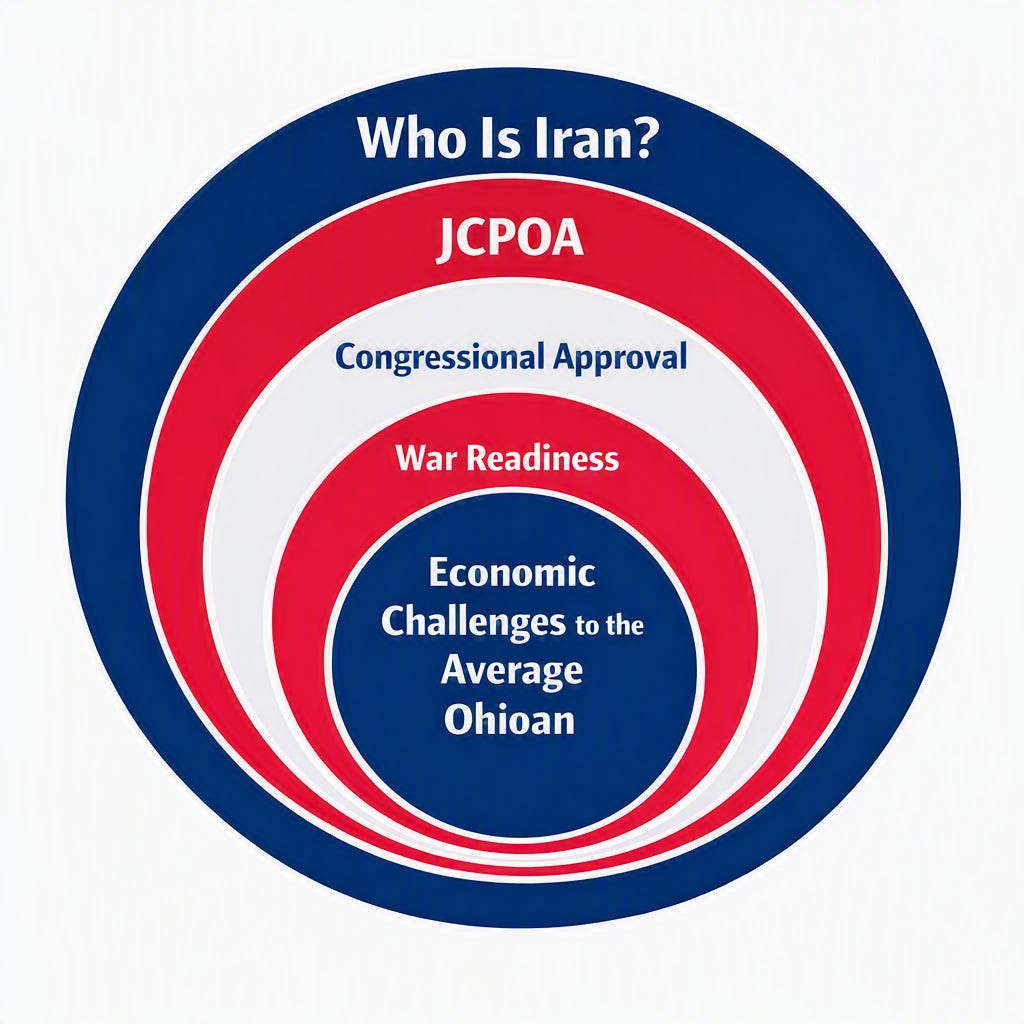
Economic Challenges to the Average Ohioan
Increased diesel prices will raise farmers’ fuel costs by as much as $20,000/year. Fertilizer is up 40–70%. “It will cost us twice as much to plant corn.” ¹ The added expense, combined with the toll taken by tariffs and the loss of USAID revenue, is contributing to farm closures and bankruptcies. The number of Ohio farms was down over 2% from 2023–2024. ²
Of course, it is not just farmers; manufacturers and average consumers suffer too. According to the Cleveland Federal Reserve, “…because of escalating energy costs related to the conflict in the Middle East, fuel costs are ‘skyrocketing,’ further exacerbating already-high freight costs. Materials costs continued to rise, particularly for metals like copper, steel, and aluminum, with manufacturers citing tariffs as drivers, as well as the Strait of Hormuz closure.” ³
Ohio families have paid approximately $2,175 more per year for gas, utilities, and groceries, and thousands of dollars more in health insurance premiums for those on the ACA marketplace since January 2025 due to federal policies enacted during President Donald Trump’s second term, according to a report released Wednesday by the Center for American Progress Action Fund. The report attributes the cost increases to four key policy decisions: the war with Iran that drove up gas prices, cuts to clean-energy investments that led to higher utility bills, blanket tariffs that increased prices on imported goods, and the expiration of enhanced Affordable Care Act (ACA) premium tax credits. ⁴
Though Ohio’s suffering exceeds the national average, we also reflect the entire nation. And we also reflect the world, which is attempting to manage higher utility and fuel costs in record heat.
War Readiness
As the arms stockpiler to the world, it is shocking to hear our munitions are seriously depleted because of the six-month-long bombing campaign. It is even more demoralizing that our huge, sophisticated stockpile is being defeated by a primitive, cheap, nimble Iranian war machine. Military experts also tell us our tactics and strategy are doomed to failure. Not once has a conflict been won from the air. You may fly over a nation forever, you may bomb it, atomize it, pulverize it, and wipe it clean of life. But if you desire to defend it, if you desire to protect it, if you desire to keep it for civilization, you must do this on the ground, the way the Roman legions did . . . in the mud.” ⁵
Even more wasteful, then, is that we shot all our munitions into Iran for no gains. And in spite of these failures, Trump wants to keep bombing. The very useful Military Spend tracker keeps kinetic tracking of our spending, now upwards of $38 billion. ⁶
Here are just a few examples of the asymmetric use of sophisticated, expensive weaponry we have wasted on cheap, primitive Iranian drones.
Status of Key Munitions
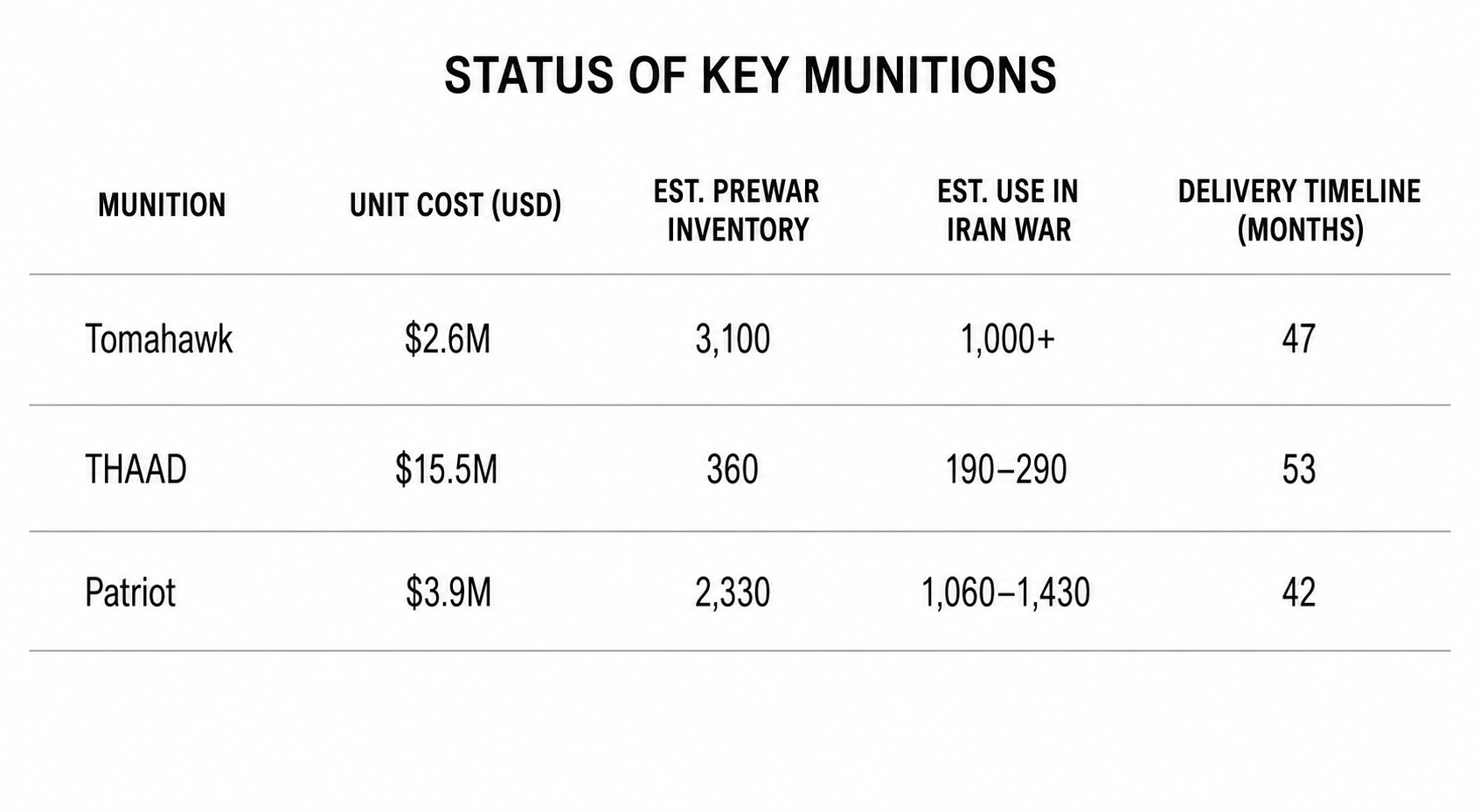
The Military Spend link also includes running totals of food assistance, healthcare, housing, and educational needs that could have been funded by these sums. And for what? As of July 31, Trump admitted at his July Camp David cabinet meeting there was no end in sight. So we have thrown away our munitions reserves, at the expense of caring for Americans, for no gain.
I wish I could say that Ohio would benefit by replenishing these stockpiles with our state’s defense industries, but we do not make these products here. Perhaps Texas, Arizona, and California will benefit. We make tanks, but now that funding for Ukraine is in question, Ohio is not benefiting by assisting Ukraine, as I outlined in my article for The Land, ⁷ and our defense industries do not profit from war with Iran.
Congressional Approval
Who approved this widespread suffering in Ohio, the country, and the world, not even counting Iranian casualties, at a cost exceeding $38 billion? Trump did. In spite of Congress’s repeated effort to debate a War Powers Resolution to compel the Trump Administration to define goals and objectives and justify the cost, Congress has refused to hold the administration accountable.
Vice President and former Ohio Senator JD Vance called the 1973 War Powers Resolution “fundamentally fake and unconstitutional.” ⁸
Senator Bernie Moreno posted on his official website Trump’s praise for Moreno’s refusal to pass the resolution. ⁹
Since Trump launched the war on February 28, Senator John Husted has voted five times against war powers resolutions that would have reined in the president’s authority. ¹⁰
And alleged wife beater Congressman Max Miller has voted against the act four times.
District 14 Representative David Joyce also has consistently voted against the act.
Only GOP Representative Warren Davidson of Southern Ohio has voted in favor of the act.
The 1973 War Powers Act was put in place after the Vietnam War to prevent U.S. presidents from committing the United States to war. Trump justifies his $38 billion expenditure by calling the war a “skirmish,” insisting he does not need congressional authority. Democratic Party candidates running against Husted, Miller, and Joyce in this year’s midterms pledge to vote in favor of the resolution and end the war. The war, and its justification, are now a battleground issue in Ohio, a state where foreign policy is rarely a factor.
JCPOA
The Obama Administration, after months of negotiations among diplomats and experts, passed the Joint Comprehensive Plan of Action, or “Iran Deal,” on July 14, 2015. The United States, EU, Russia, China, and Iran all agreed on the deal. The plan allowed Iran to retain some enriched uranium in exchange for intrusive, regular inspections by the International Atomic Energy Agency and a commitment to not acquire nuclear weapons. The deal also unfroze potentially $30 billion in assets frozen since the 1979 Iranian revolution. The plan was successful for three years, until Trump unilaterally withdrew in 2018, ending IAEA inspections, after which Iran immediately returned to enriching uranium.
Prior to withdrawing from the JCPOA, Trump fired the nation’s leading nuclear non-proliferation experts, beginning with Assistant Secretary for Arms Control Tom Countryman, who oversaw the negotiations of the JCPOA and who was on a negotiating mission with Russian and British nonproliferation experts in Amman, Jordan, when he received a phone call to return to Washington. This is all documented in Pulitzer Prize winner Ronan Farrow’s book, War on Peace, ¹¹ and later confirmed to me personally during subsequent conversations with Countryman. And Trump continued, gutting the experts who negotiated the plan, thereby eliminating our institutional knowledge of nuclear safeguards and Iran’s nuclear program.
Trump’s long-standing fetish with Iran allegedly began during the 1978 hostage crisis, when he was consumed with American humiliation. This long-standing grudge, combined with the obsession with destroying everything Obama, and topped with a long-standing friendship with the equally crooked and amoral Israeli Prime Minister Bibi Netanyahu, made “wiping out Iranian civilization” Trump 2.0’s primary foreign-policy objective. He was determined to go to war with Iran, even though he did not know why, nor did he have to justify his objectives to our allies, the U.S. Congress, or the American people.
Any deal Trump puts together with his Keystone Cops negotiating team of Jared Kushner and Steve Witkoff is doomed to yield a much worse deal than the JCPOA, with long-standing principles of Freedom of the Sea international law violated by giving up free passage of the Strait of Hormuz. Trump is also likely to throw in more money than the $30 billion in frozen assets foreseen in the JCPOA. The outcome will be a huge diplomatic, economic, and military loss for the United States, and a significant win for the resilient, proud, and now united Islamic Republic of Iran. This is what a foreign policy without diplomacy looks like.
Who Is Iran?
This massive failure was conducted against the backdrop of total ignorance of Iran and its culture. Any successful negotiation requires research into one’s opponent’s position, including motivation and knowledge of objectives. A simple financial transaction, the kind Trump likes, is much simpler and geared to a one-off situation. In diplomacy, you are in a long-term relationship where every step goes to build that relationship, usually to mutual benefit.
In April alone, Trump floated the following counterproductive negotiating positions:
April 5, Truth Social (Easter Sunday post): “Open the Fuckin’ Strait, you crazy bastards, or you’ll be living in Hell.”
April 6 or 7: “The entire country could be taken out in one night, and that night might be tomorrow night. ... Because of the power of our military, every bridge in Iran will be decimated, every power plant in Iran will be out of business, burning, exploding and never to be used again.” (Author’s note: all war crimes.)
April 7, Truth Social (deadline day): “A whole civilization will die tonight, never to be brought back again.” ¹²
Four months later, nothing has changed. On the August 2 CNN GPS show, renowned Iranian expert Dr. Sanam Vakil responded to host Farid Zakaria’s question of how to get out of the conflict: “We’ve seen bombing does not work, it is time to return to diplomacy.”
In 2005, when I was Chargé d’Affaires in Ashgabat, Turkmenistan, a senior Farsi-speaking Hungarian diplomat visited, looking for a beer and pork break. At that time, Iran was still receiving enriched uranium from Russia, allegedly for civilian use with its Bushehr nuclear reactor. “As an oil- and gas-producing nation, why does Iran need nuclear energy?” I asked. “You have to understand Iran, the national culture remains that of the descendants of the great Persian Empire of 500 BC, that ruled the then-known world. You cannot tell a single Iranian of any political or religious persuasion that Iran is less equal than any world power. If the barbaric Russians and Americans can have nuclear weapons, Iran should have them too.”
Your 13-year-old son can Google how to build a nuclear weapon. Furthermore, no amount of bombing will destroy Iran’s considerable brain trust. Iran will always have the know-how and, we are seeing through its ongoing cooperation with Russia and China, will always have access to uranium.
Empty rants of denying Iran nuclear weapons only consolidate Iranian resolve. This resolve is strengthened at the expense of our daily gas prices, depleted weapons, and allied support. Maybe we can wait until the November midterms, but we have to end this madness on November 3.
Stay Angry.
Ambassador (retired) Jennifer Brush is a 30-year national and international diplomat with specialties in nuclear non-proliferation, the Balkans, Central Asia, and Mongolia. She was born in Solon, where she currently resides, and is President of the Solon Democratic Club.
Footnotes
News 5 Cleveland: “Ohio farmers face steeper prices as diesel and fertilizers soar”
Ohio Country: “Farms and farm lands are declining across Ohio”
Columbus Underground: “Ohio businesses blame Trump tariffs, Iran war for economic downturn”
Cleveland.com: “Trump policies have cost Ohio households thousands since January 2025”
Sen. Bernie Moreno: Trump praises Moreno for helping defeat Democrats’ war powers resolution
Senate Majority: “Sixty days in, Jon Husted is still signing off on Trump’s war”