

Hey, Angry Patriots!
Here is another candidate comparison from The Angry Ohioans. The mission is simple: look at who is running, examine what they have done, explain the policies they are campaigning on and give my opinion underneath each policy.
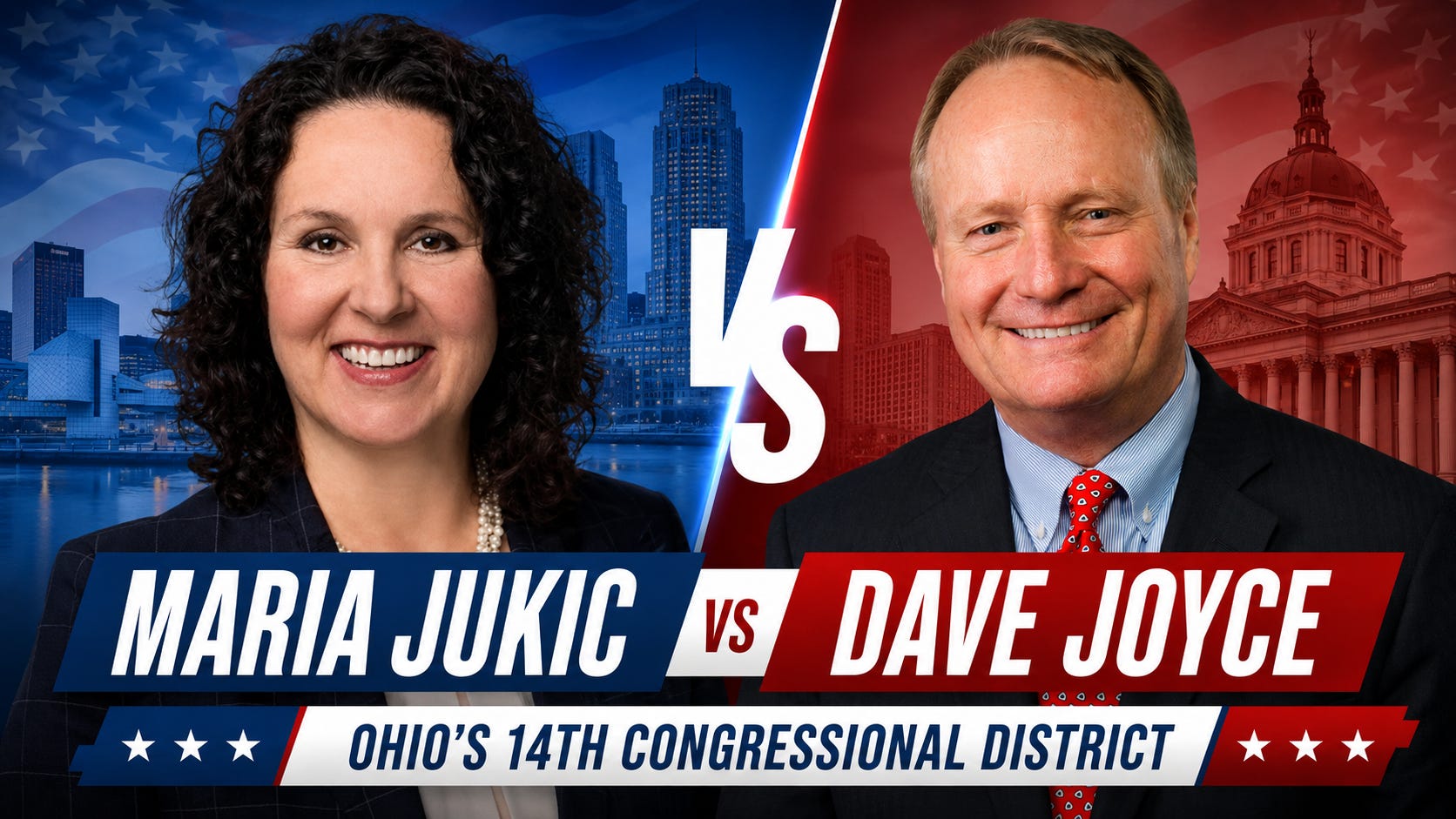
We will also look at the district itself, including its new boundaries, political makeup and the communities these candidates are asking to represent. We will examine their backgrounds, experience and campaign finances, including who is funding them and whether any donations deserve a closer look.
I have included links throughout the article so you can review the candidates’ websites, policy positions, financial reports and public records for yourself. Then, at the end, I will bring everything together and give my overall assessment of the candidates, the race and what voters should consider before making their decision.
What Is Ohio’s 14th Congressional District?
Ohio’s new congressional map was adopted in October 2025 and will be used beginning with the 2026 election. According to the Ohio Secretary of State’s official legal description, the new 14th District has a 2020 census population of 786,630 people.
The district includes all of:
Ashtabula County
Geauga County
Lake County
Trumbull County
It also includes portions of:
Mahoning County
Portage County
Major population centers include Mentor, Painesville, Willoughby, Eastlake, Ashtabula, Conneaut, Chardon, Warren, Niles, Girard, Aurora, Ravenna and Canfield, along with portions of Austintown Township.
One boundary correction is important. Youngstown is not in the new 14th District. It is in the 6th District. Kent and Streetsboro are also not in the new 14th. They were moved into the 13th District.
This is a strongly Republican district. Had the new boundaries existed in 2024, Donald Trump would have carried the district by approximately 60% to 39% over Kamala Harris. That is roughly a 21-point Republican margin.
That does not make the race unwinnable for a Democrat, but it is the reality Maria Jukic is facing. She is not simply running against an incumbent. She is running against an incumbent in a district whose new boundaries strongly favor Republicans.
Meet Maria Jukic
Maria Jukic is the Democratic nominee challenging Dave Joyce.
According to her campaign biography, Jukic grew up in Cleveland in a working-class Croatian immigrant family. Her mother was a UAW member at Fisher Body and her father worked with imaging systems.
Jukic earned a bachelor’s degree in American Studies from the University of Notre Dame, a law degree from Cleveland State University and a master’s degree in theology and religious studies from John Carroll University. She also spent time in Croatia as a Fulbright scholar and worked with humanitarian and human-rights organizations.
She worked for the Cleveland Clinic for approximately 24 years, including helping develop its Arts and Medicine Institute.
Jukic was elected to Euclid City Council in November 2019 and represented Ward 7 from 2020 through 2023. During her four years on Council, she chaired the Sustainability and Parks Committee and worked on parks and lakefront projects. She did not seek reelection in 2023. City of Euclid
Jukic attempted to run as an independent for Congress in 2024, but she did not make the ballot after the Trumbull County Board of Elections invalidated enough petition signatures to leave her below the required number.
In 2026, she entered the Democratic primary and defeated Bill O’Neill and Carl Setzer to win the nomination.

Meet Dave Joyce

Dave Joyce is the Republican incumbent and has represented Ohio’s 14th Congressional District since January 3, 2013.
Joyce was born in Cleveland and earned an accounting degree and law degree from the University of Dayton. He worked as a public defender before becoming Geauga County prosecutor from 1988 through 2012. He was elected to Congress in November 2012 and is currently serving his seventh term.
Joyce’s campaign biography emphasizes his law-enforcement career, advocacy for the Great Lakes, work related to the opioid epidemic and support for military funding, economic growth and fiscal restraint.
Joyce serves on the House Appropriations Committee, including its Defense, Financial Services and General Government, and Transportation, Housing and Urban Development subcommittees. He chairs the Financial Services and General Government Subcommittee. He also serves on the House Homeland Security Committee.
Campaign Finance: Through June 30, 2026
The candidates’ FEC reports show an enormous financial gap.
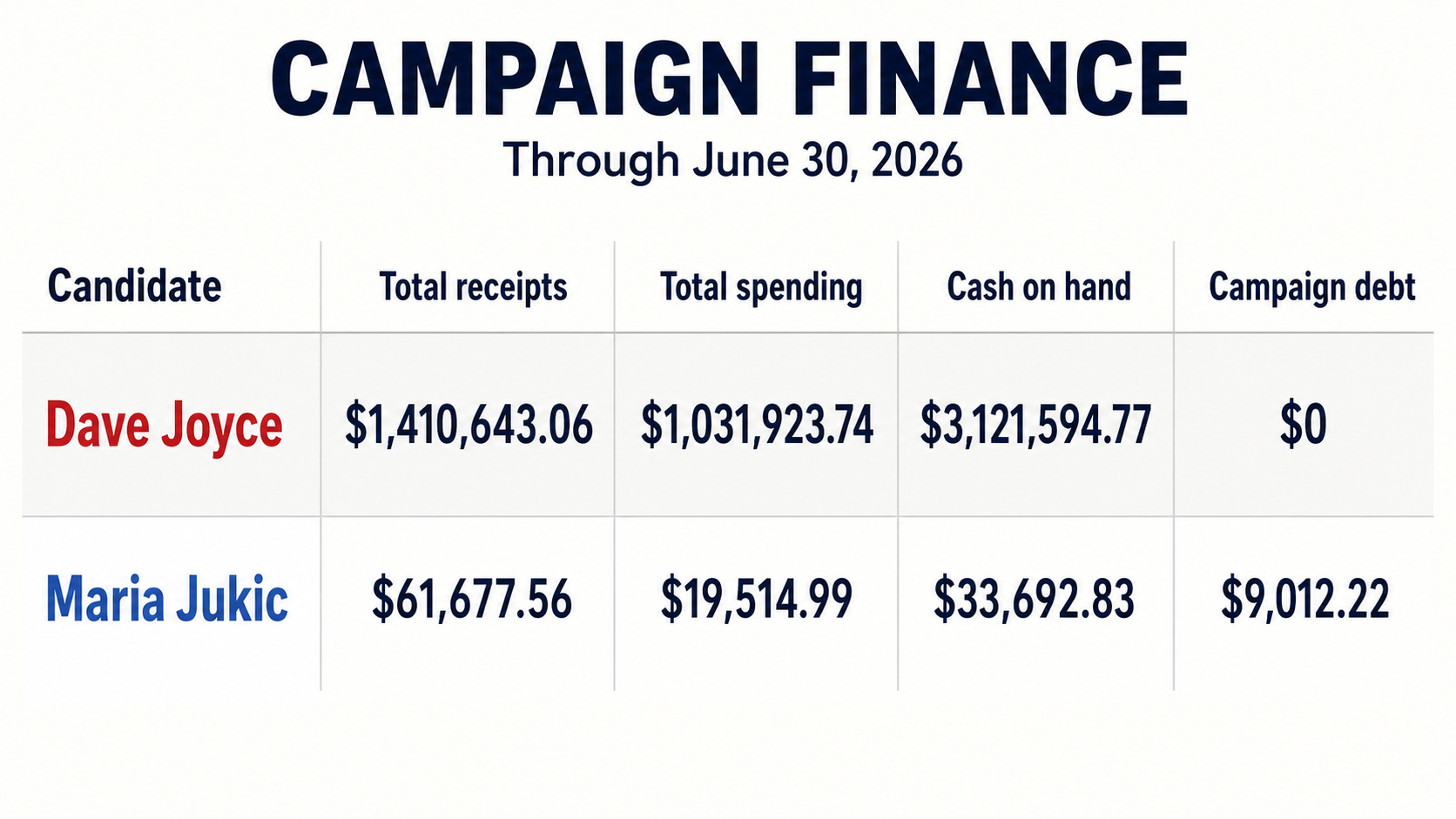
Joyce reported approximately 23 times more receipts and nearly 93 times more cash on hand than Jukic.
There is an important qualification. Joyce entered this election cycle with approximately $2.74 million already in his campaign account, accumulated during previous cycles. Jukic’s current campaign did not begin reporting until February 2026. The cash comparison shows the actual resources available to each campaign, but it does not mean Joyce raised all $3.1 million during this election cycle.
Where Joyce’s Money Comes From
Of Joyce’s $1.41 million in receipts, the FEC reports:
$967,101 from other political committees
$383,806.12 from individuals
$59,735.94 in other receipts
That means approximately 68.6% of Joyce’s receipts came from PACs and other political committees, while about 27.2% came from individuals. Dave Joyce’s FEC report
The PAC records include substantial contributions from industries affected by the committees on which Joyce serves.
PACs connected to major defense and aerospace contractors contributed at least $98,000, including PACs associated with Northrop Grumman, General Dynamics, Lockheed Martin, RTX, Boeing, BWX Technologies, Blue Origin, Leidos, BAE Systems, General Atomics, Huntington Ingalls, Parsons, Peraton and Science Applications International Corporation.
That is important because Joyce sits on the House Defense Appropriations Subcommittee. It is not proof that Joyce performed a favor for any contributor. It does show that companies with a direct interest in federal defense spending view his campaign as worth supporting.
Financial-sector PACs include:
American Bankers Association PAC: $10,000
Goldman Sachs PAC: $5,000
Capital One PAC: $5,000
PNC PAC: $5,000
Joyce chairs the Appropriations Subcommittee on Financial Services and General Government, which makes those contributions relevant to voters evaluating who has access to him.
Energy and industrial PACs include:
Marathon Petroleum PAC: $10,000
Chevron PAC: $10,000
FirstEnergy PAC: $7,500
Constellation Energy PAC: $6,000
Koch Industries PAC: $5,000
Vistra PAC: $3,000
Other noteworthy PAC contributions came from AIPAC, Comcast, Charter Communications, T-Mobile, Google, Walmart, Home Depot, Kroger, MGM Resorts, the National Automobile Dealers Association, insurance organizations, real-estate groups, healthcare associations and several labor unions. The complete committee-contribution records can be searched through the FEC receipt database.
High-dollar individual contributors include private-equity executives Stephen Schwarzman of Blackstone and Marc Rowan of Apollo, Anduril Industries founder Palmer Luckey, corporate executives, consultants and several contributors who identified themselves in FEC records as lobbyists.
Where Jukic’s Money Comes From
Jukic reported:
$61,305.75 in individual contributions
$80.04 in candidate contributions
$291.77 transferred from another authorized committee
No party committee contributions
No other political committee contributions
Approximately 99.4% of her receipts came from individuals. The filings support her campaign’s claim that it is not taking corporate PAC money through June 30. Maria Jukic’s FEC report
The concern for Jukic is not an conflicts of interest, it is if can she raise enough. She ended June with only $33,692.83 in cash and $9,012.22 in campaign debt while facing an incumbent with more than $3.1 million available.
That money gap does not decide the election by itself, but it affects advertising, staffing, field operations, direct mail and the campaign’s ability to communicate across six county areas.
On the Issues
Policy Count From Their Campaign Websites: Jukic 10, Joyce 0
Jukic’s campaign website contains ten detailed policy sections explaining what she supports and what she intends to fight for in Congress.
David Joyce’s campaign website does not contain a comparable policy platform. To give voters a fair comparison, we had to look beyond his campaign website and use position pages from his official congressional website, along with his legislative record and public statements, to determine what he supports.
It is always disappointing when candidates do not clearly explain what they are running on. For most voters, getting to know a candidate begins with a Google search and a visit to the candidate’s website. That website should tell them who the candidate is, what they believe and what they intend to do if elected.
Yes, Joyce is the incumbent.
Yes, he has more than a decade of legislation, votes and public statements for voters to examine.
But voting records and congressional legislation are not easy to search or understand, especially for people who do not follow politics every day. His positions should be clearly and directly presented on his campaign website. Voters should not have to conduct a research project to figure out what someone seeking their vote actually supports.
Maria Jukic
Agriculture: Jukic supports more stable trade policy, stronger competition in agricultural markets, affordable crop insurance for family farms, support for vineyards and specialty crops and policies protecting farmland from development.
Matt’s take: Agriculture and trade policy are huge issues, and so is insurance. Farmers and farmland are under increasing pressure from rising financial burdens, unstable trade policy, and a shrinking number of people willing to do the work. It is good to see Maria include these issues in her platform, and I especially like that she specifically mentions supporting vineyards and specialty crops.
Artificial Intelligence: Jukic supports a federal AI rights framework, human review of important automated decisions, protections against algorithmic discrimination, worker-transition funding, privacy protections and labeling requirements for AI-generated material.
Matt’s take: AI will play an increasingly large role in decision-making, so I support human review of important automated decisions, especially when it comes to the military and armed conflict. Worker-transition funding also makes sense, and frankly, we should have been doing more of that when jobs were moving overseas in the 1990s. Privacy protections are important, particularly when AI companies use people’s data or intellectual property to train their models.
I would need more specifics on what a federal “AI rights framework” and protections against “algorithmic discrimination” actually mean in practice.
I am also not convinced about requiring labels on AI-generated material. There can still be a tremendous amount of human creativity behind work created with AI. I see AI as another tool, similar to word processors, spell check, Grammarly, Photoshop, Canva, and other technologies that have made it easier for people to create and express themselves. It can also serve as an important accessibility tool for people who previously struggled to participate in certain forms of writing, art, or other creative work.
Yes, AI can produce plenty of slop, but so can every other creative tool. We’ve had terrible clip art, bad Photoshop, and bad writing for decades. Ultimately, people can distinguish between good and bad work, and consumers will decide what they actually want to read, watch, or look at. If the content is bad, they won’t consume it.
Campaign Finance and Ethics Reform: Jukic supports overturning Citizens United through a constitutional amendment, requiring disclosure of dark-money spending, publicly matching small donations, banning congressional stock trading and strengthening restrictions on former officials becoming lobbyists.
Matt’s take: How could you say no to any of this? I am 100% in favor of overturning Citizens United. As for requiring disclosure of dark-money spending, I would go further. We should not have dark money in politics in the first place.
Public matching of small donations is a good idea, and I would like to see something similar to New York’s system. I have written more about how I think campaign finance reform should work on TheAngryDem.com.
Obviously, members of Congress should be banned from trading individual stocks, and those rules need to actually be enforced. The revolving door between elected office, lobbying firms, and corporate boards also needs to stop.
I applaud this entire section of her platform.
Cost of Living: Jukic supports expanding the Child Tax Credit, increasing childcare funding, requiring data centers to pay for grid upgrades, addressing price gouging, expanding housing construction, raising the minimum wage and challenging corporate consolidation.
Matt’s take: I’m in favor of all of these.
Expanding the Child Tax Credit and increasing childcare funding both make sense. However, I also think we need to consider what we are incentivizing. The more we subsidize childcare without addressing wages, the more we reinforce an economy where both parents are expected to work full time and send their children to daycare or school for most of the day.
I would rather see wages reach a point where one full-time professional income can realistically support a family, giving parents more choice over whether both need to work full time.
Data Centers: Jukic opposes large-scale data-center development in communities that do not want it and supports ending federal subsidies, requiring disclosure of water and energy use, protecting residential ratepayers, restoring environmental enforcement and conditioning federal assistance on community approval.
Matt’s take: This all seems reasonable.
Environment and Climate Change: Jukic prioritizes Lake Erie protection, EPA funding, stronger enforcement against polluters, clean-energy investment, conservation assistance for farmers and an energy transition that protects workers and maintains grid reliability.
Matt’s take: Lake Erie is one of our greatest natural resources and should have strong protections. The challenge is balancing those protections with development and agriculture.
That means addressing runoff from cities and development that enters local watersheds, while also working with farmers to reduce fertilizer and other agricultural runoff that eventually reaches the lake.
Healthcare: Jukic supports lowering the Medicare eligibility age from 65 to 62, addressing healthcare monopolies, expanding Medicare drug-price negotiations, supporting rural hospitals and community health centers, relieving medical debt and eventually establishing universal coverage.
Matt’s take: This seems like another candidate who is hesitant to simply run on healthcare for all and establish a clear path toward it as the end goal. Call it Medicare for All, Medicaid for All, or something else, but make universal healthcare the objective.
Lowering the Medicare age, negotiating drug prices, supporting community health centers, and relieving medical debt are all positive changes. But, in my opinion, these are still incremental fixes to a much larger problem. Healthcare should be a protected right, and our long-term policy should go towards healthcare for all.
Social Security: Jukic opposes benefit reductions and supports raising or eliminating the payroll-tax income cap, considering contributions from investment income and creating a bipartisan working group focused on long-term solvency.
Matt’s take: Absolutely protect Social Security. If you pay into the system, you are owed those benefits, and the government has a responsibility to honor that commitment. At the same time, I’d love to hear somebody say that the private equity executives who gut companies, raid pensions, and destroy workers’ retirements to enrich themselves should be put in fucking jail.
Tax Policy: Jukic supports working-family tax relief, closing the carried-interest loophole, taxing investment income more like wages, reducing corporate tax avoidance, raising the minimum wage and restoring Congress’s authority over tariffs.
Matt’s take: Make Congress work again. Congress needs to restore its authority over tariffs and everything else it has handed over to the executive branch. But at the same time, if somebody isn’t talking about reducing the deficit, controlling congressional spending, getting the budget under control, and finding a way out of nearly $40 trillion in national debt, I don’t take their tax policy seriously.
Dave Joyce: as a reminder, I had to search the Internet for these policies because he has nothing on his website
Agriculture: Joyce supports rural broadband, voluntary water-quality programs, addressing agricultural tax and workforce problems and protecting Ohio’s farming economy.
Matt’s take: Rural broadband? It’s 2026. Dave Joyce has been in Congress for seven terms, and we’re still talking about rural broadband like it’s some new policy goal. Get that shit done. Internet access is a necessity. And why are we still acting like physically running cable everywhere is the only solution? Satellite broadband technology exists right now and can connect places that traditional infrastructure struggles to reach. Stop talking about rural broadband and actually get people connected. What a fucking joke.
Economy and Jobs: Joyce supports reducing regulations, promoting domestic manufacturing, lowering inflation through fiscal restraint, expanding job training and helping small businesses compete globally.
Matt’s take: Nothing wrong with promoting domestic manufacturing, lowering inflation through fiscal restraint, expanding job training, and helping small businesses compete globally. I’m 100% on board with all of that. Reducing regulations, though, is something I would judge regulation by regulation. Some regulations are unnecessary burdens, while others exist for very good reasons.
Education: Joyce says the federal government should provide schools with funding and flexibility while leaving local education decisions to school districts and parents.
Matt’s take: I would love to know Dave’s opinion on Ohio’s school voucher program. If the position is that education decisions should be left to local school districts and parents, where does he stand on using public education dollars to fund private-school tuition? I think he is in support.
Energy: Joyce supports an all-of-the-above energy strategy centered on domestic production, including Ohio oil and natural gas, and opposes environmental regulations he believes would increase prices or eliminate American jobs.
Matt’s take: I agree with this. We need to produce energy any way we can. I wish we were building more wind, solar, distributed energy technologies, an upgraded and more distributed grid, and nuclear power. We should be aggressively investing in fusion as well. If China beats us to commercially viable fusion, then goodnight.
Federal Budget: Joyce identifies fiscal responsibility and a balanced budget as priorities, although the federal-budget page on his official website does not currently provide a detailed plan explaining the spending cuts or revenue changes he supports.
Matt’s take: Again, I can’t take anybody seriously who isn’t talking about the roughly $1.8 trillion annual deficit and nearly $40 trillion national debt, especially with the bond market where it is. Make Congress work again. Congress has the power of the purse, and you’re not serious about fiscal responsibility unless you’re talking about using it.
Great Lakes: Joyce supports continued federal investment in the Great Lakes Restoration Initiative and points to his work authorizing and reauthorizing the program as a central accomplishment.
Matt’s take: There aren’t many Ohioans who don’t understand the incredible resource we have in the Great Lakes. Protecting them, keeping them clean, accessible, and usable, and preserving one of the largest freshwater systems on Earth should be of utmost importance.
Healthcare: Joyce supports access to affordable coverage for people with preexisting conditions but favors a patient-centered, market-oriented system with less federal involvement in healthcare decisions.
Matt’s take: I’m going to assume a “market-oriented” system with less federal involvement means no healthcare for all. So, boo. Again, if we’re not talking about healthcare being affordable, accessible, and a human right, whether that means healthcare for all, Medicare for All, or Medicaid for All, then you’re not serious about healthcare reform, in my opinion.
Immigration: Joyce supports increased border security, additional action against drug trafficking and a bipartisan overhaul of what he describes as a broken immigration system.
Matt’s take: I agree with this. Our immigration system is broken. I have stories.
Infrastructure: Joyce supports federal investment in roads, bridges and broadband but argues that projects should not be financed through large tax increases or additional deficit spending.
Matt’s take: I agree that we shouldn’t be funding infrastructure through more taxes and deficit spending. We desperately need to future-proof and modernize our infrastructure, including high-speed rail, and maybe that warrants a major capital expenditure. But with our current fiscal situation, we need to figure out how to pay for it.
National Security: Joyce supports maintaining high levels of military readiness and using his Appropriations Committee position to fund defense operations, military families and American interests overseas.
Matt’s take: I agree with this, but national security also means making sure the men and women serving in our military are taken care of during and after their service. That includes mental healthcare, physical healthcare, support for military families, and helping service members successfully transition into civilian life.
Social Security and Medicare: Joyce says Social Security and Medicare must be protected for current and future beneficiaries while arguing that Congress must address their long-term solvency, but his page does not identify the specific reforms he would support.
Matt’s take: Agree. And I’ll say it again: I wish somebody would say they would put private equity executives and venture capitalists in jail when they gut companies and destroy workers’ pension systems. People work their entire lives for those pensions. They should not be treated as another pile of money for investors to raid.
Summary
We have to call a spade a spade here. Ohio’s 14th District is roughly R+21, and Dave Joyce is a seven-term incumbent with a massive financial advantage. He is not a loud, boisterous, rock-the-boat Republican. He is an established incumbent people are comfortable with, and in a district this safe, he does not have to campaign the same way a challenger does.
Maria Jukic does. She is a former councilwoman, attorney, and longtime healthcare executive who has put detailed policies on her website and is actively trying to explain what she would do in Congress. I applaud that. She is campaigning, putting ideas out there, and trying to communicate with voters with the resources she has.
The financial difference is substantial. Joyce has more than $3.1 million in cash compared with Jukic’s roughly $34,000 at the end of June. Without major outside investment or the DCCC making this a targeted Red to Blue race, that is an enormous gap to overcome.
It is also difficult to compare a challenger with a seven-term incumbent apples to apples. Joyce has years of committee work, legislation, congressional terminology, and votes to draw from. He can point to an extensive record, positively or negatively. A challenger has none of those advantages because she has never served in Congress.
That is the inherent advantage of incumbency, especially in a heavily gerrymandered district. But Maria is putting herself and her policies out there, campaigning for the job, and giving voters something substantive to evaluate. That deserves acknowledgment.
Thank you! I wish you hd mentioned that Dave Joyce has never had an in person townhall in 13 years and the fact that he has received campaign donations from the GEO group.
Congressman Dave Joyce needs to stop bragging about his record of voting with President Trump 97% of the time. This is NOT a badge of honor; it is dereliction of duty. Primary among the duties of Congress is to provide a check upon excesses of the executive branch. It has become woefully apparent that the president has been behaving with unchecked power since the beginning of this term. Examples of this unchecked power include violations of the US Constitution. Violating Rule of Law by defying court rulings, overriding spending limits set by congress and exceeding executive authority. The president has also violated Due Process required in the Constitution by detaining and deporting people with no legal due process. Representatives in Congress swear an oath to the Constitution not to the president, yet these excesses went unchecked. Another important duty of a member of Congress is to listen to and represent the people of the district. I searched for reports of town hall meetings with constituents in Joyce’s 13 years in office and found none. Sparse telephone town halls leave constituents frustrated. Only a few callers can get through in the brief time allotted and most who call only get a busy signal. General calls to his offices get no reply, most emails get a generic reply if any reply at all. I have taken at least fifty comment forms with constituent questions and comments directly to his local office and none of the people who submitted those forms have ever received an answer. His website is full of photo ops but no responses to tough questions, no possibility of real time follow up and little beyond platitudes.