


U.S. healthcare is a sprawling mess, and there’s no clean place to point and say “this is where it broke.” So I picked a starting point that made sense to me: the classroom, where most healthcare careers begin. My background is in nursing, so that’s the lens I’ll use — and what I found is a system where private equity is quietly reshaping, and warping, how we train the next generation of nurses.
Ohio offers a few routes into nursing. The fastest is the LPN track — about a year of schooling, followed by the NCLEX, the national licensing exam. LPNs can already perform many RN-level tasks. From there, an LPN-to-RN bridge program (typically a few semesters) leads to an Associate’s degree, and a second NCLEX exam to earn RN licensure. Other options skip the LPN step entirely: direct-entry RN/Associate degree programs, or accelerated BSN (ABSN) programs for those who want a bachelor’s-level credential faster.
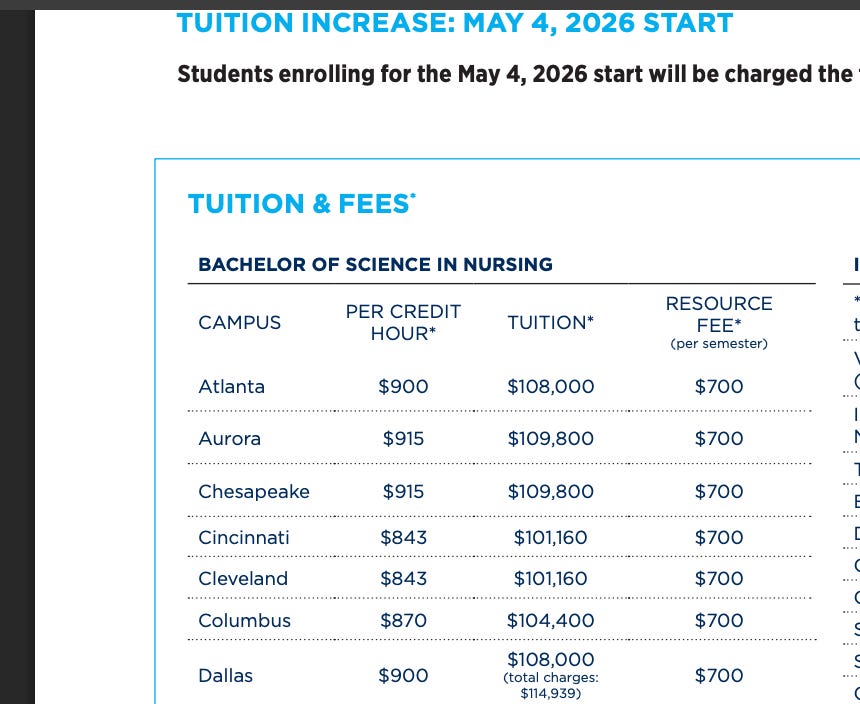
Schools such as Fortis, Hondros, Valley College, Bryant and Stratton College, Arizona College of Nursing, and Polaris Career Center are schools that prey on peoples desires to better themselves by offering “no prerequisite” starts to nursing school. They charge an inexplicable amount of money for attendance, which students will be shackled to for a good part of their lives. For example, Arizona College of Nursing, which is owned by Searchlight Capital Partners, is a major global private equity firm.1 On its website it is notably hard to find an exact price for tuition, so I had to go over some twists and turns to find out that in Cleveland, the school charges $843 per credit hour or a total of $101,160 for the total cost of the program.2 To give you a price comparison, the Associate degree RN program at TRI-C costs between $8,000 and $10,000 and most of that would be subsidized by FAFSA, or WIOWA grants through the State.3
Arizona College of Nursing has been marred in controversy.
Their main campus in Tempe, AZ was placed under probation by the Arizona Board of Nursing due to complaints of noncompliance with program policy and standards, inadequate clinical faculty, and decline in program completion rates.
When opening their Connecticut location, they were met with resistance from the Board of Nursing due to their troubles from the Tempe Campus. The Nursing Board revoked their approvals for the College’s Hartford Campus because the Board stated they were not transparent about what was happening in Arizona. The Hartford campus ultimately opened, however the agreement with the college and Connecticut Board of Nursing is missing public documents, and according to a local news investigation, both parties had a “desire to avoid litigation.” 4
In 2022, the college faced a lawsuit in Texas where a group of 20 students alleged the school was committing fraud and violating the Texas Deceptive Trade Practices Act. The group of students stated the school was overcharging for classes, making classes more difficult in an attempt to fail them, which includes testing on subject matters that were never taught.
Arizona College of Nursing recently received program approval from the Ohio Board of Nursing. Time will tell to see what arises from the school.
Another local school worth naming: Hondros College of Nursing.
It’s marketing promises “the better way to become a nurse,” but its reputation tracks closely with Arizona College of Nursing’s — and so does its price tag, which runs well above what nursing education should cost. Hondros is a subsidiary of American Public Education, Inc. (NASDAQ: APEI), and like its counterpart, it front-loads costs and bills students monthly instead of by semester — a structure that keeps students on the hook longer and makes it harder to walk away once they’ve started paying.
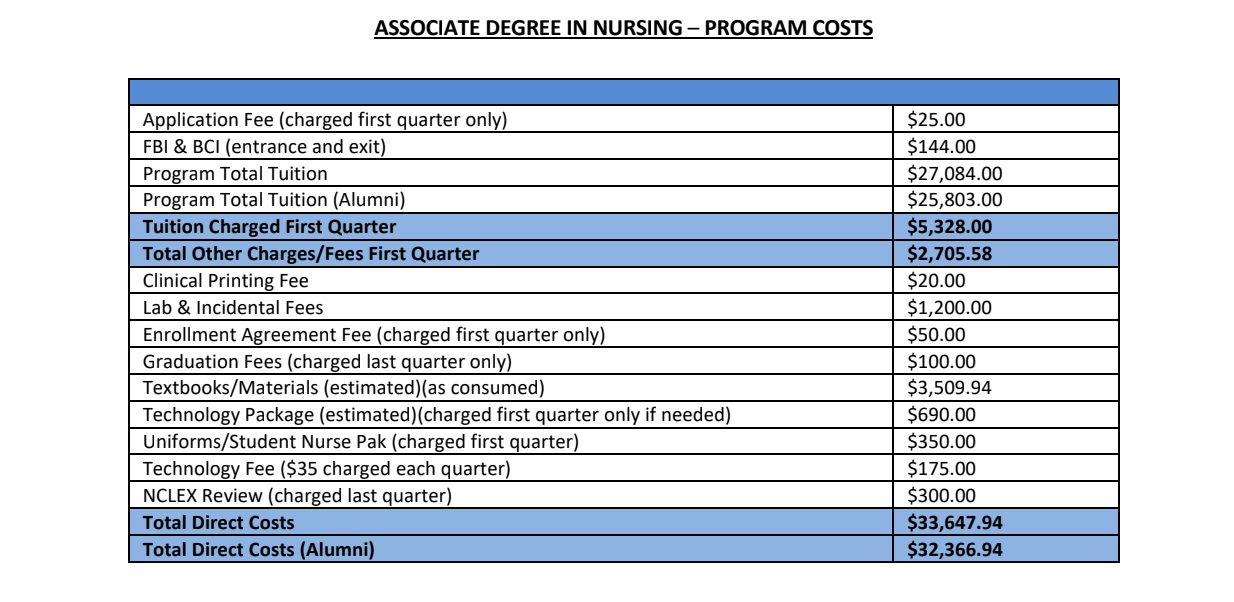
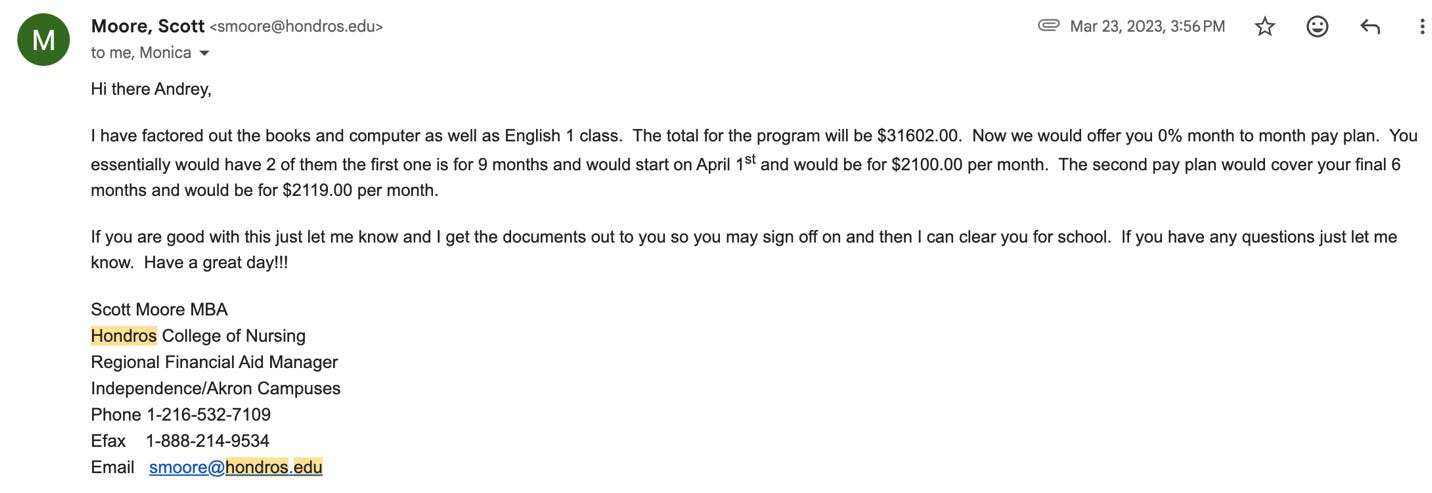
Life doesn’t pause for a nursing program.
Family emergencies, a new baby, a financial crisis — these things happen, and sometimes school has to wait. But Hondros isn’t built to accommodate that reality. Buried in the contract every student signs is a clause stating that once the term has started, you owe a percentage of tuition regardless of whether you finish — drop out, take a leave, doesn’t matter. So on top of tuition that’s already inflated, students who hit a life crisis get hit with a bill for classes they never completed.
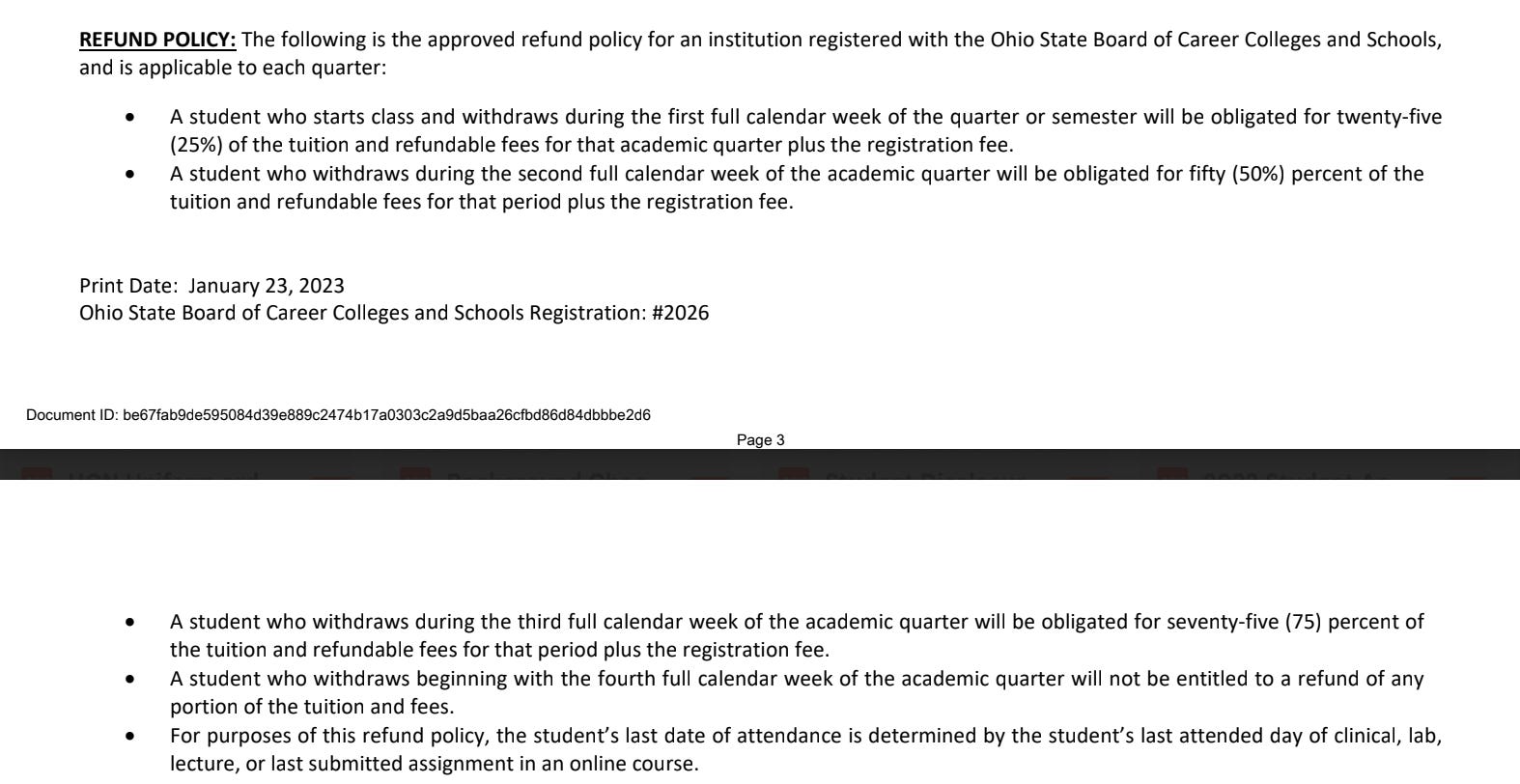
Entrapping a student with debt then placing a burden on them if they need to excuse themselves from school is NOT “The better way to become a nurse” rather the better way for Wallstreet to take advantage of people who want to better their lives.
I know this struggle personally.
I failed prerequisites, failed out of classes, dropped out at one point — and still made it through to earn both my LPN and RN licensure. That story isn’t unique. Plenty of nurses carry a version of it, along with struggles that never make it into a conversation. Which is exactly why piling more pressure onto students already fighting to get through nursing school is the wrong move. But that’s what for-profit schools like Hondros do. On top of the financial burden, they enforce rigid course-repeat policies: score below a “C,” or withdraw from a class, and you get exactly two chances to pass it. Miss both, and you’re done — no matter what was happening in your life at the time.
I believe in perseverance, because I’ve lived it. There’s something to be said for a person who fails, then claws their way back and succeeds anyway — it forges a kind of resilience you can’t fake. Give me a nurse who stumbled through a hard class but refused to quit. That failure isn’t a red flag. It’s proof they don’t give up when things get hard. That’s exactly who I want at my bedside.
Furthermore, evidence suggests nurses who repeat courses are not “bad nurses” in any stretch, if anything predatory policies such as the two-strike rule only further exacerbates the nursing staffing issues that the country faces.5 Institutions beat them down even before they enter an already toxic practice. In education we need to be supportive, and nurture the next generation of healthcare professionals, rather than beating them down.
Graduating from Hondros doesn’t end the problem — it just moves it further down the road.
Many healthcare employers hesitate to hire from for-profit schools like Hondros over accreditation concerns, and graduates who want to pursue a BSN often hit a wall: reputable universities won’t accept transcripts from schools without national nursing accreditation. That accreditation comes from one of two bodies — ACEN or CCNE. Hondros has neither. What it has instead is ABHES accreditation, a different (and less widely recognized) standard. The result: many bachelor’s programs simply won’t take Hondros credits, pushing graduates back into another for-profit school just to finish their degree. Take Ohio State’s own admissions criteria, screenshotted below — it explicitly requires a nursing program accredited by one of the recognized bodies, not just any accreditor.

I never completed Hondros’s program myself.
I’ve talked to enough students and nurses who did graduate from the Hondros program — the same word comes up again and again: awful. And you don’t have to trust my word for it. Spend ten minutes on Reddit or any nursing forum, and you’ll find the same story on repeat: students at for-profit schools describing an education that took their money and gave little back in return.
That’s the real cost of private equity’s grip on nursing education — it preys on people whose only crime is wanting to do good in the world. Nurses don’t choose this field for the money. They choose it to advocate for people, to show up in the moments no one else will. So to every school marketing itself as “the better way to become a nurse”: prove it. Live up to your own words.
Stay Angry.
https://searchlightcap.com/portfolio/arizona-college-of-nursing/
https://arizonacollege.edu/wp-content/uploads/2026/01/AZC_Catalog_BSN_20260101_No26_V1b.pdf
https://www.tri-c.edu/paying-for-college/tuition-and-fees/index.html
https://hartfordbusiness.com/article/arizona-college-of-nursing-gets-green-light-to-open-east-hartford-campus/
https://pubmed.ncbi.nlm.nih.gov/30865153/