

Below is something I found interesting. The TLDR: On Polymarket a total of over $4000 in trading volume is manufacturing an 87% frontrunner.
Multiple accounts, controlled by a single funding source, can dominate an entire market. That market, in turn, can shape what voters see when they search for information. And that perception can influence behavior in a real election.
This was brought to my attention by an Angry Patriot and compiled into an article for The Angry Ohioan. I think it is very telling about how the thumbs can push on the scales of democracy to inorganically attempt to display outcomes.
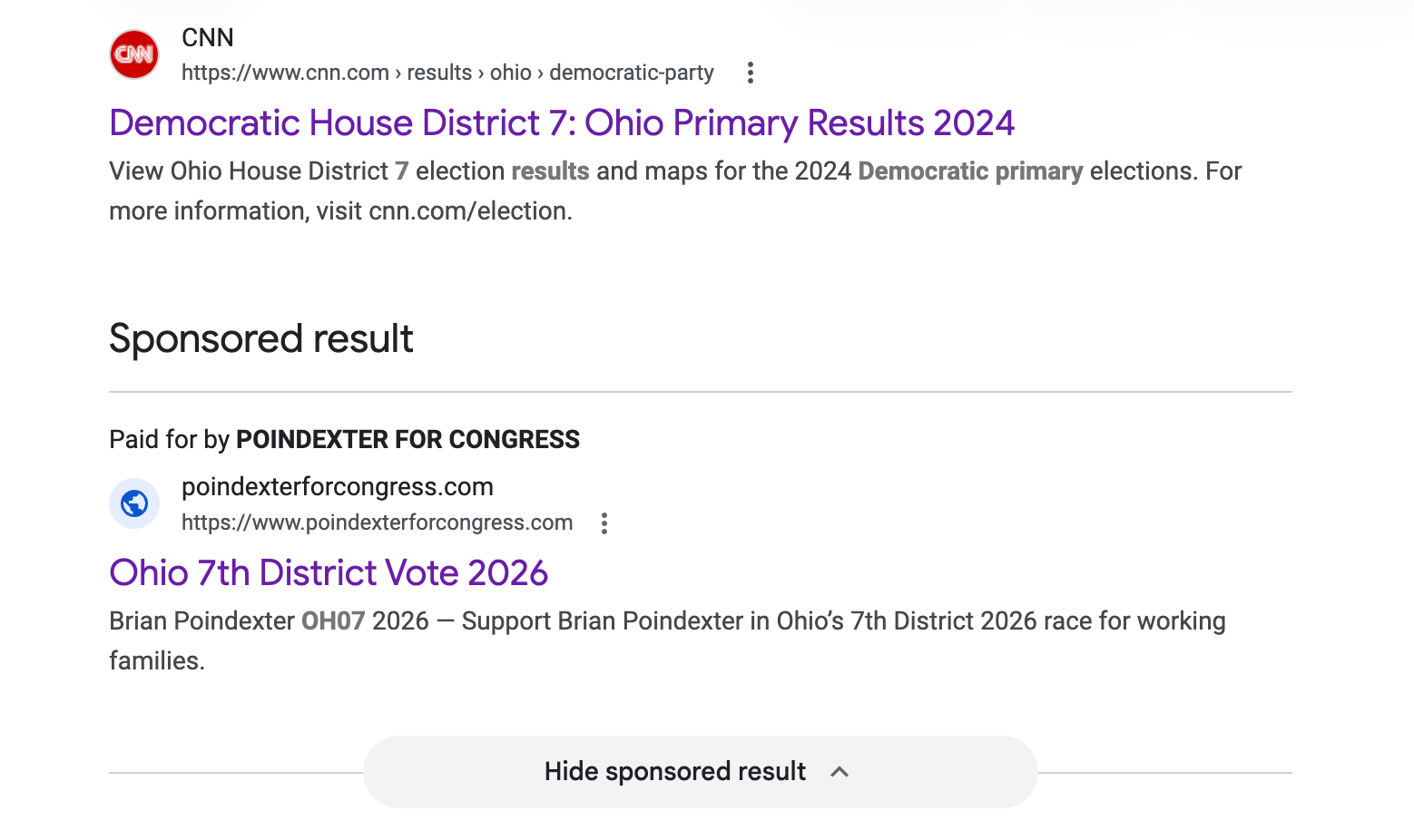
Twelve days before voters go to the polls in Ohio’s 7th Congressional District there are still no public polls in this race. But when you search for “OH-07 Democratic primary winner,” one candidate is sitting at roughly an 87% probability on a major prediction market. That number is not just buried on some obscure website. It is surfaced directly in Google search results, alongside established sources like Ballotpedia and major media outlets.
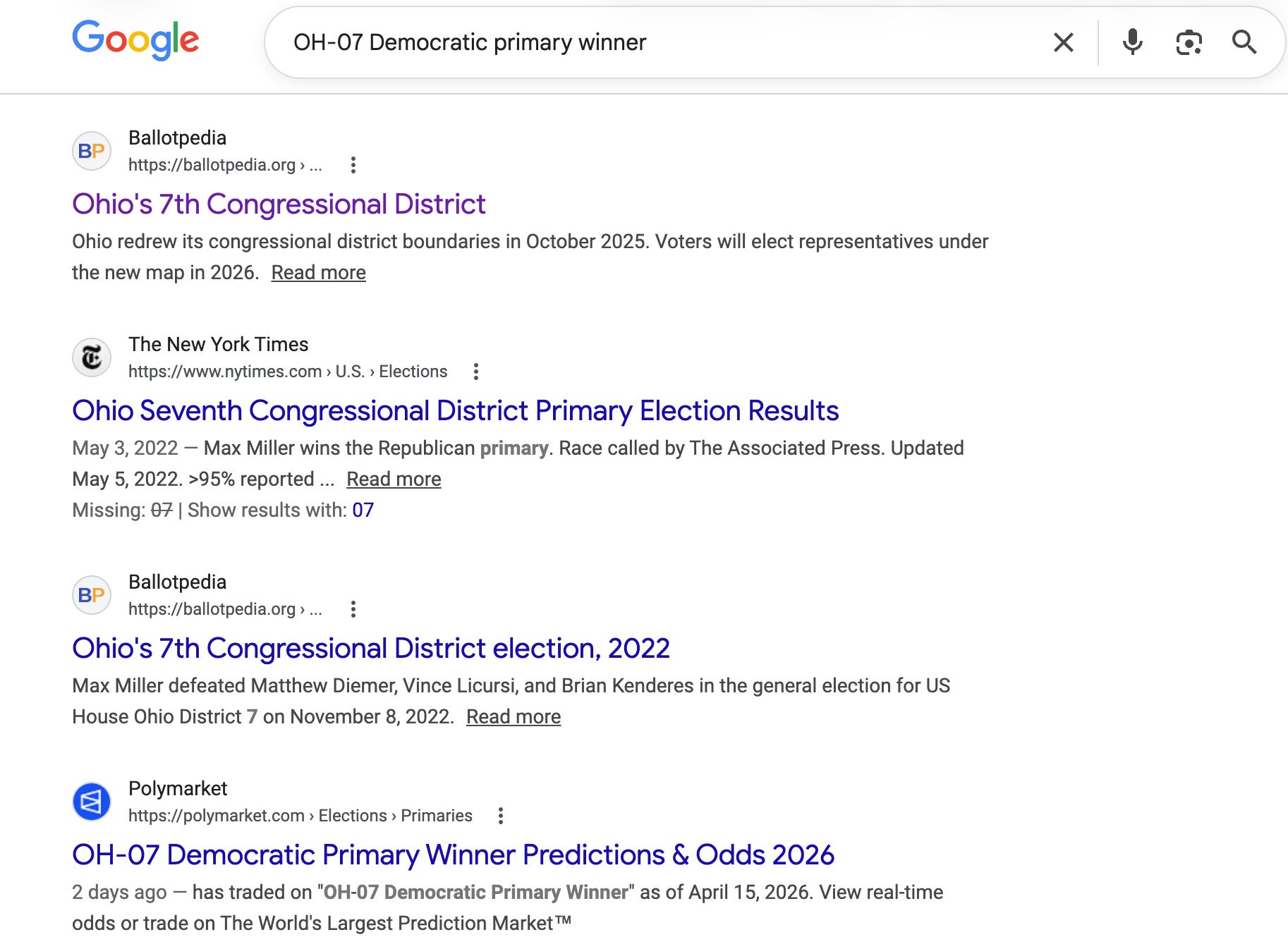
This creates a powerful feedback loop. A voter searches for information. They see a dominant probability. The impression is immediate and clear: this race is already decided. Except it isn’t. That 87% number was not discovered through organic market behavior. It was constructed, deliberately, with a relatively small amount of capital deployed in a highly coordinated way. And every step of that construction is visible on a public blockchain.
What is Polymarket?
Polymarket operates as a blockchain-based prediction market where users trade on real-world outcomes. The price of a “Yes” share reflects the implied probability of an outcome. In theory, this creates a market-driven consensus. In practice, especially in low-liquidity environments, it creates an opportunity. The entire OH-07 Democratic primary market has a total traded volume over $4,000. That is not a deep market. That is a fragile system where relatively small, coordinated activity can meaningfully shift perceived probabilities.
In a market this thin, you do not need millions of dollars to move perception. You just need coordination across accounts that appear independent but are not. When those conditions are met, the output is not a reflection of reality.
The Pattern
The behavior does not appear to be random and it is not consistent with independent traders reacting to new information. It shows a repeatable structure.
First, the scale is immediately noticeable. A small number of accounts dominate the majority of transactions, leaving very little room for organic participation.
Second, the direction of trades is not dispersed across candidates based on changing probabilities. It is concentrated and systematic. Multiple accounts are buying “No” positions across nearly every candidate in the race, suppressing their implied probabilities. At the same time, other accounts are buying “Yes” on a single candidate, pushing that candidate’s number upward.
This is a two-sided operation. One side removes weight from the entire field. The other side adds weight to a single outcome. The result is mathematically inevitable. If every alternative is pushed down and one candidate is pushed up, that candidate’s probability inflates dramatically, even if no real-world conditions justify it.
This is not how profit-seeking traders behave. Profit-driven actors typically concentrate capital where they expect returns and adjust positions based on changing information. They do not systematically suppress seven candidates in coordinated waves while simultaneously inflating one. The behavior observed here is not optimized for profit. It is optimized for perception.
Ten Accounts. One Master Wallet.
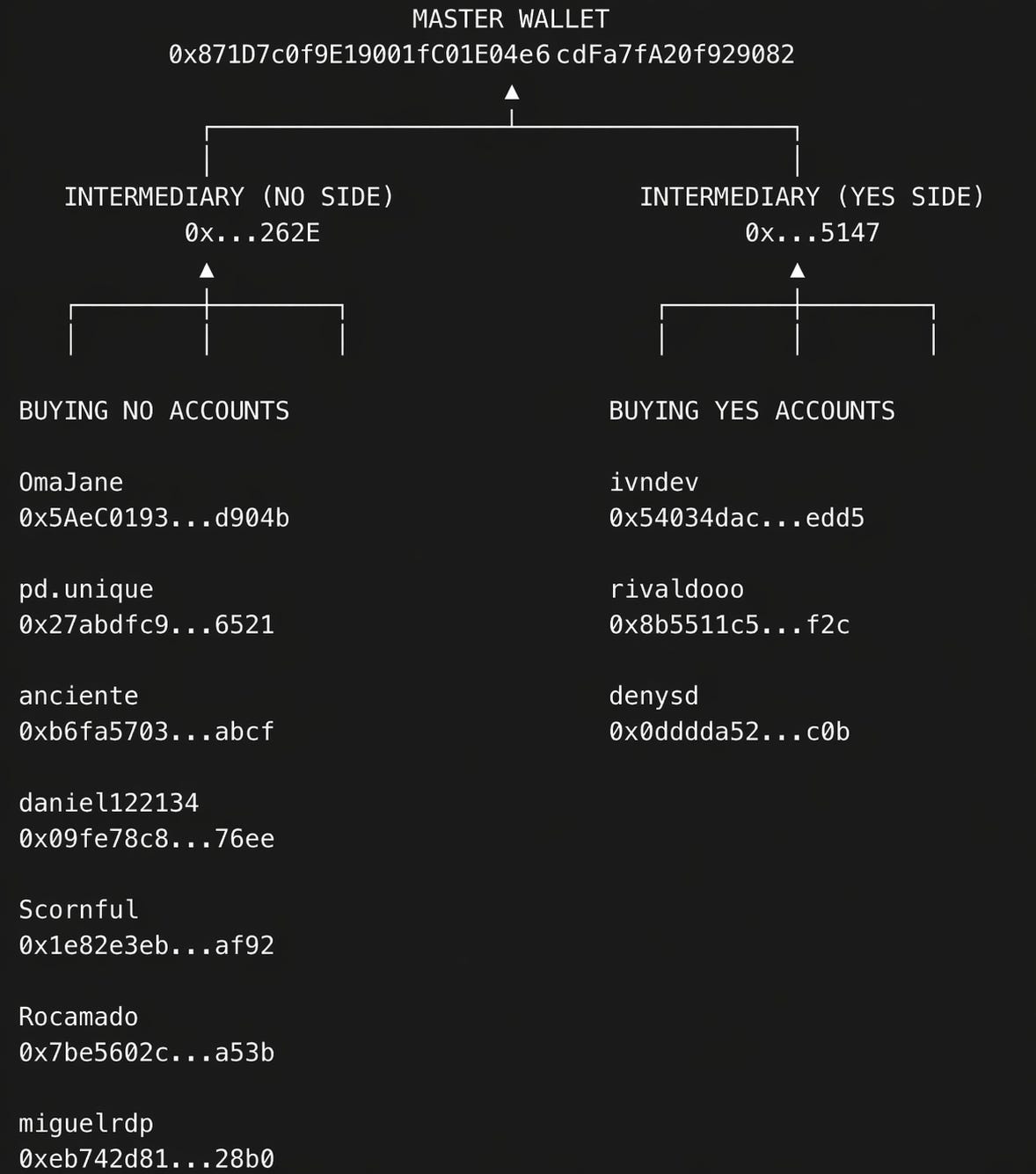
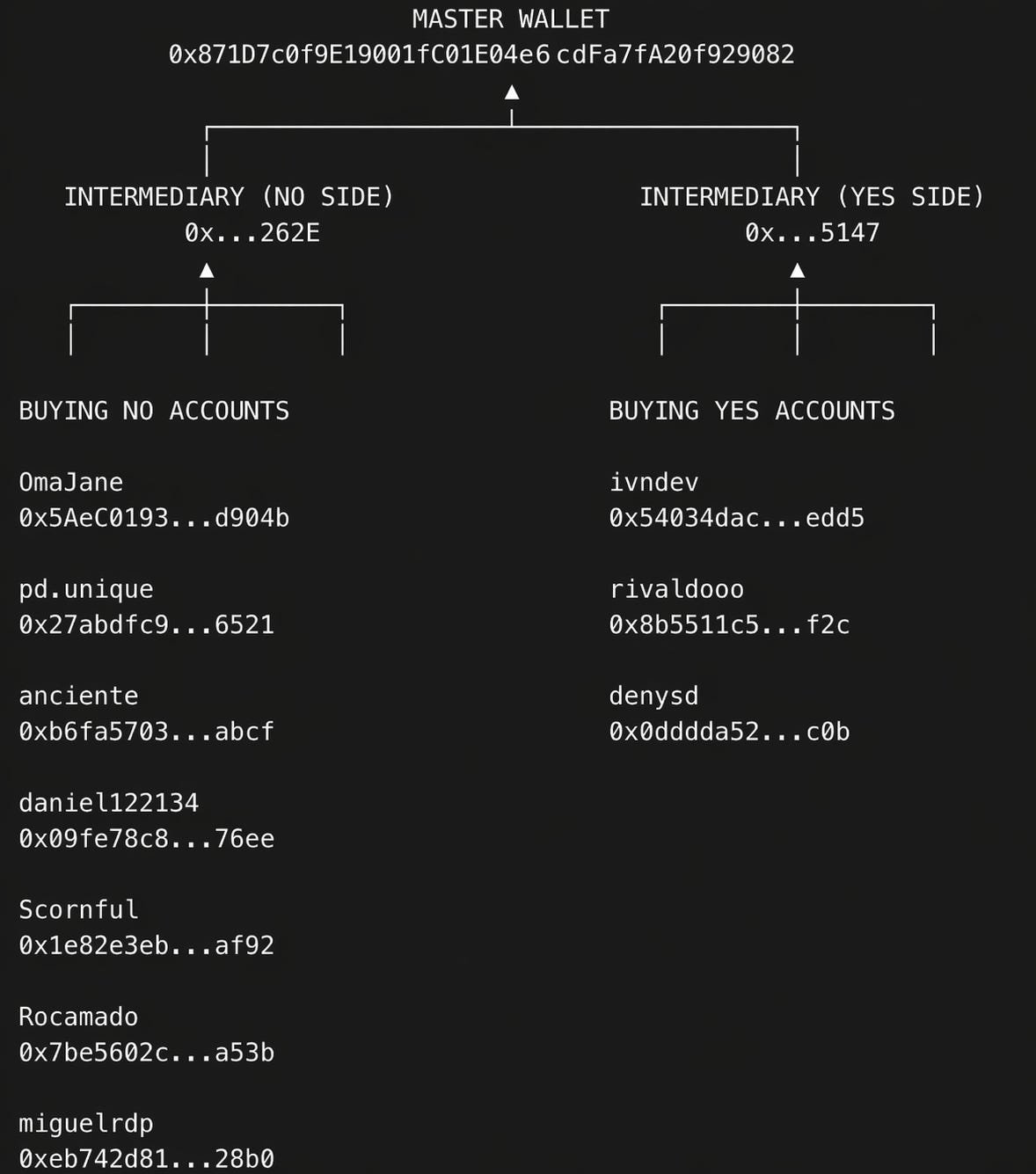
To determine whether this activity was truly coordinated, each account involved in the activity log was traced through Polygonscan, the public blockchain explorer for the Polygon network where Polymarket operates. The result is unambiguous. Ten of the accounts that dominate activity in this market trace back, two levels up the blockchain, to the same funding source:
0x871D7c0f9E19001fC01E04e6cdFa7fA20f929082
Seven accounts were consistently buying “No,” suppressing every candidate except one:
OmaJane — 0x5AeC01932a51836BC151B5aA515cCEA15a7d904b
pd.unique — 0x27abdfc9393c72a6330a3be987da4b46c726e521
anciente — 0xb6fa57039ea79185895500dbd0067c288594abcf
daniel122134 — 0x09fe78c8b9f10fb9c7c0a584bfab4205c76876ee
Scornful — 0x1e82e3eb816aaf755ac9b44bc9d98f01b08aaf92
Rocamado — 0x7be5602c32426ad785094317ede035221de3a53b
miguelrdp — 0xeb742d8155e5031bc8b0a4046633d679f27428b0
Three additional accounts were buying “Yes,” directly inflating a single candidate’s odds:
ivndev — 0x54034dac401d43dcb8113b16b3e7486f5e82edd5
rivaldooo — 0x8b5511c5451476dffd58529c77c3ebe7b0497f2c
denysd — 0x0dddda528f1c0459f3ef67fc02bc925dea5c6c0b
Ten accounts, operating in coordination, funded from the same origin. On a public blockchain, shared funding ancestry is not speculative. This is the equivalent of finding multiple bank accounts all tied back to the same source, executing complementary actions at the same time. One entity controls both the suppression and the inflation.
The structure of the activity removes any plausible argument that this is random or coincidental behavior. The accounts were executing a coordinated strategy across both sides of the market. Some of these accounts were created shortly before the market itself launched, indicating premeditation rather than organic participation.
The master wallet behind this activity held substantial capital across chains, far exceeding what was needed to bet on this single market.
It’s Not Just Ohio. The Same Pattern Across the Country
This is where it gets interesting. When you expand beyond Ohio’s 7th, the structure scales. The same wallets at the center of this operation, 0x871D7c0f9E19001fC01E04e6cdFa7fA20f929082, has deployed capital across ten races in six different states. As of April 18, 2026, that wallet held approximately $334,717, more than enough to systematically influence multiple low-liquidity markets at once.
The pattern remains consistent regardless of geography. In competitive or Republican-leaning districts, the operation is used to manufacture frontrunners early like in Ohio’s 7th Congressional District.
That same structure appears in Pennsylvania’s 7th Congressional District and in Wisconsin’s 3rd Congressional District, where the bet creates the appearance of early dominance. The pattern also extends to California’s 22nd Congressional District and even into statewide races like the Maine Senate.
In Michigan’s 13th Congressional District, the operation appears behind a challenger running against a sitting Democratic incumbent. In New York’s 10th Congressional District, a safe Democratic seat covering Brooklyn and lower Manhattan, the same pattern emerges. And in New York’s 7th Congressional District, again, the same structure is deployed. In these races, the objective is not to reflect uncertainty, but to create the illusion of momentum behind a specific challenger in environments where primaries determine the outcome.
Across all ten races, the execution is identical. One master wallet. Multiple coordinated accounts. “No” positions suppressing the field. “Yes” positions inflating a target candidate. Thin markets converted into controlled environments. The geography changes. The candidates change. The mechanics do not.
Why This Works
Prediction markets carry an implicit authority because they are perceived as aggregating information. When that activity is coordinated and market is thin, the output becomes a distortion rather than a signal. When that distorted signal is then amplified through search engines and paired with paid advertising, it becomes something else entirely. It becomes a narrative.
Voters encountering that narrative are not making decisions in a vacuum. They are responding to perceived momentum. They are reacting to what looks like consensus. In a crowded primary with no reliable polling, that perception can influence turnout, fundraising, and strategic voting. The betting does not need to change every mind. It only needs to shift enough perception to matter.
A Note on What This Does Not Claim
This analysis does not identify the individual or entity behind the master wallet. That information is not available through blockchain data alone. It does not make allegations against any specific candidate or campaign. It does not speculate on intent. It documents what can be verified: a coordinated set of accounts, funded from a single source, systematically trading on both sides of a prediction market in a way that produces a specific and misleading outcome.
Conclusion
What begins as a small number in a thin market becomes something much more significant when examined closely. So far a total of over $4000 in trading volume is enough to manufacture an 87% frontrunner. Ten accounts, controlled by a single funding source, can dominate an entire market. That market, in turn, can shape what voters see when they search for information. And that perception can influence behavior in a real election.
This is not theoretical. It is observable. The blockchain record does not disappear. It does not change. It shows exactly what happened, step by step. What you do with that information is up to you.
Guess we’ll have to think more—-oh darn it…that’s work