

Hey, Angry Patriots!
Amy Acton has decided not to debate Vivek Ramaswamy. Strategically, I understand that decision. Politically, it may even be the smart move.
But this is bigger than what helps Amy Acton win an election.
Modern political debates are broken. They reward shamelessness, encourage lying and turn serious questions about governing into a competition for viral clips. But the answer to a broken debate system cannot be to eliminate debates and allow candidates to communicate entirely through advertisements, scripted interviews and their own social-media bubbles.
Acton does not owe Ramaswamy a debate.
She owes one to the people of Ohio.
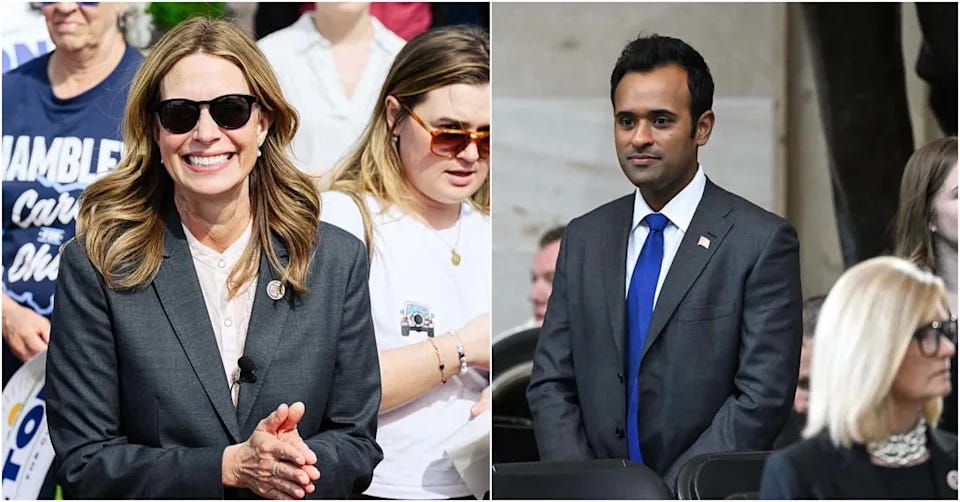
The Acton Campaign Has a Legitimate Argument
Acton’s campaign manager, Phil Stein, said her focus is “on talking with Ohioans, not platforming a scam artist” who has spread false and disgusting claims about Acton and her family.
That is not an unreasonable concern.
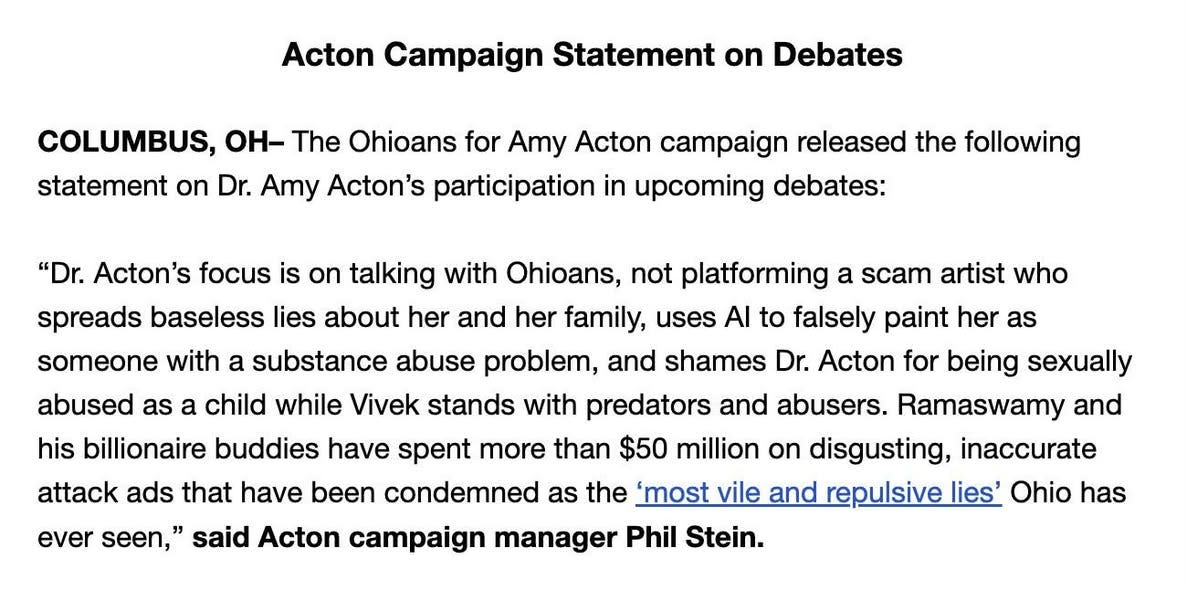
According to the campaign, Ramaswamy and his billionaire supporters have spent more than $50 million on inaccurate attack advertisements, including AI-generated material depicting Acton as having a substance-abuse problem and attacks involving the sexual abuse she suffered as a child.
I understand why Acton does not want to stand on a stage and pretend this is a normal political disagreement between two candidates operating in good faith. If one candidate believes the other is deliberately spreading lies, rewarding that behavior with a statewide television audience feels like walking directly into a trap.
D.J. Byrnes (The Rooster) made that argument in an op-ed defending Acton’s decision saying, “debates,” which only favor the most shameless liar on the stage in their current form:
I agree.
However, let’s look the phrase “in their current form”
The format is broken. The public’s right to see candidates challenged in real time is not.

Debates Have Become Auditions for Social Media
Political debates are no longer designed primarily to help voters understand how candidates would govern. They are designed to manufacture moments.
Candidates are incentivized to say something outrageous, interrupt their opponent or deliver a rehearsed insult that can be cut into a 20-second TikTok, Instagram Reel or YouTube Short. The campaign posts the clip, partisan accounts repeat it and supporters share it as proof that their candidate “destroyed” or “owned” the other side.
Recent reporting from The Atlantic shows how far this political-content economy has gone. The publication documented an operation called Elephant Clipping, run through a company in Latvia, that reportedly paid contractors, many apparently outside the United States, to produce short videos promoting Republicans.
Participants were told they could use artificial intelligence to generate ideas even if they knew nothing about American politics. The operation reportedly had a $300,000 monthly budget and paid clippers based on the number of views their videos received. The clips were then posted through accounts intended to resemble ordinary Americans expressing spontaneous political opinions.
This is the environment in which a modern debate operates. Candidates are not only speaking to the people watching the full event. They are supplying raw footage to campaigns, political organizations, paid clippers and partisan influencers who will strip each moment of context and feed it into an algorithm.
That explains why Acton’s campaign does not want to give Ramaswamy two hours of material.
It does not explain why Ohioans should accept having no debate at all.
Democrats Cannot Change the Principle When It Benefits Them
The Ohio Democratic Party made its position on debates very clear when Mike DeWine declined to debate Nan Whaley in 2022.
At the time, the party argued that refusing to debate was part of a “disturbing trend” among both Democrats and Republicans. It cited polling showing that 84 percent of likely Ohio voters wanted candidates for the state’s highest offices to debate one another.
The party said:
“Debates are the equivalent of a job interview for candidates running for office.”
It argued that debates allow voters to see how candidates think on their feet, respond to criticism and answer difficult questions. It also said candidates should defend their records and positions regardless of their opponent or the forum.
I agree with that.
But if Democrats believed Mike DeWine owed voters a debate, then Amy Acton owes voters one too.
The principle cannot be that debates are essential when a Republican refuses and obsolete when a Democrat refuses. Either candidates have an obligation to face one another in public, or they do not.
It is true that the candidate demanding a debate is often the candidate who thinks he needs it. DeWine had little political reason to help Whaley in 2022. Ramaswamy now believes debating Acton would benefit him.
That is campaign strategy. It should not determine whether Ohioans get to see the people seeking control of their state government answer questions in the same room.
This Problem Goes Far Beyond Amy Acton
Candidates and elected officials increasingly behave as though they do not owe the public unscripted access.
Traditional town halls are disappearing. Some elected officials hold controlled telephone events instead, where questions can be screened and the conversation can be managed.
Candidates refuse interviews with news organizations they consider biased. Republicans avoid cleveland.com and The Plain Dealer.
Democrats object to other editorial boards.
Candidates and political parties dismiss the League of Women Voters, newspapers and other civic organizations whenever they believe the institution will not give them favorable treatment.
The Cuyahoga County Democratic Party has also opposed having judicial candidates participate in Judge4Yourself, arguing that the process is biased.
Whatever anyone thinks about that criticism, the result is the same: voters lose another opportunity to see candidates questioned and compared.
Every politician now has a reason to avoid scrutiny. The newspaper is biased. The moderator is unfair. The audience is hostile. The opponent is a liar. The organization cannot be trusted.
If every candidate gets to reject every forum they dislike, public accountability disappears. What replaces it?
Campaign advertisements. Friendly podcasts. Edited videos. Fundraising emails. Telephone town halls with screened questions. Ideologically aligned “independent” media. Social-media feeds designed to show supporters exactly what they already believe.
We are allowing candidates to build private political realities and invite voters into them. Nobody has to leave their own camp, encounter an opposing argument or answer an unexpected question.
Fix the Debate Instead of Killing It
The traditional debate format needs to change.
First, debates should include real-time fact-checking. We have the technology to do it. A nonpartisan team could review claims as candidates make them and display the results on screen. Campaigns could be permitted to submit their own sources or fact-checking systems before the debate, but the process and standards would have to be public.
If candidates distrust one artificial-intelligence system, let each campaign bring its own approved research agent. Use several systems, human researchers and primary documents. When the evidence repeatedly points to the same answer, display it.
Second, moderators need control of the microphones. If a candidate repeatedly interrupts, talks over an opponent or refuses to follow the rules, turn off the microphone. Candidates should not be permitted to bully moderators simply because everyone is afraid of appearing biased.
Third, candidates should receive the topics beforehand.
I do not care if they know the general questions in advance. This is not a high-school quiz. I want candidates to give complete, informed answers about taxes, education, housing, abortion, healthcare, energy and the state budget.
Giving them time to prepare would produce better answers and make dishonesty less defensible. If you know the topic and still arrive with false information, that tells voters something important.
Fourth, questions should be crowdsourced from Ohioans. Let voters submit and rank questions. Require the candidates to address the issues people are actually discussing rather than whatever produces the highest television ratings.
Finally, there must be follow-up questions. Candidates should not be allowed to ignore what was asked, repeat a campaign slogan and wait for the clock to expire. If the answer does not address the question, the moderator should say so and ask it again.
The debate should be a job interview, just as the Ohio Democratic Party once argued. It should not be professional wrestling with lecterns.
Acton’s Strategy Makes Sense. Her Decision Is Still Wrong.
I agree with Acton’s campaign that Ramaswamy would try to turn a debate into a collection of viral moments. I agree with The Rooster that the current format rewards shameless behavior. I also believe declining the debate may be the safer campaign strategy for Acton.
But I still disagree with her decision.
We should not applaud candidates for retreating further into controlled media environments. We should demand a better forum and then demand that both candidates participate in it.
Social media already allows politicians to tell us only what they want us to hear. Algorithms keep voters inside partisan bubbles. Campaigns and outside groups can manufacture clips, manufacture outrage and even manufacture the appearance of grassroots support.
A real debate is one of the few opportunities to make both candidates enter the same room, answer the same questions and confront ideas they cannot completely control.
The goal should not be to protect Amy Acton from Vivek Ramaswamy.
It also should not give Ramaswamy another stage for political theater either.
Amy Acton should debate Vivek Ramaswamy.
But she/we/Ohioans should demand a format with enforceable rules, controlled microphones, voter-submitted questions, meaningful follow-ups and real-time fact-checking.
Do not cancel the debate. Fix the damn debate.
I agree with your assessment of the use by candidates and others of the "debates". Karen Kasler, Bureau Chief of the Statehouse News Bureau, interviews statewide candidates one-on-one on The State of Ohio news show on Ideastream/PBS. Governor candidates get one-half hour each, others 15 minutes. She asks the same general questions of each and pushes back when she hears BS. Look for the show.
It is not Amy Acton's responsibility to solely "fix" the debate issues. As you stated, it is not in her best interest as a candidate to do so. Ramaswamy refuses to provide proposed policies to media. Would he do so in a debate or bring up falsehoods and culture wars? Why not promote the League of Women Voters as the alternative to beginning the process of improving the debacle that debates have become? Their forums are well run, with questions included from audience members. They do not allow behaviors that are disruptive. Candidates owe their constituents honest answers with policies they hope to enact. Not bait. Fix the process first.