

One of the easiest ways to understand whether a political party still believes in its own values is to watch what it does when those values become inconvenient.
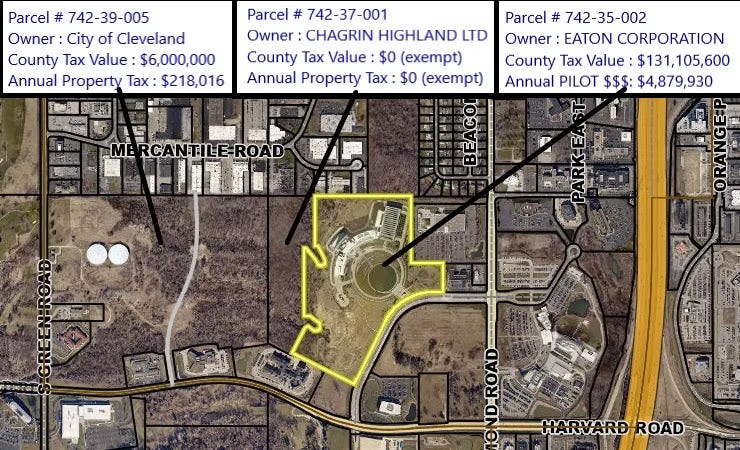
That is why I believe the fight over the Eaton TIF in Beachwood matters.
On the surface, this may look like a narrow local policy dispute. In reality, it is a long-running example of how public money, political protection, and party self-preservation can slowly merge into the same thing. And what makes it worse is that this is not some new warning that nobody saw coming. The concerns were already there years ago.
By the time you get to 2026, nobody gets to pretend this is confusion. This is choice.
What I Was Warning About
Back in late 2023, I laid out the issue clearly. Beachwood City Council was being asked to extend the original 30 year Eaton TIF for another 30 years. That would let the city continue capturing roughly $1.2 million a year in non-school property tax revenue that otherwise would go to county agencies once the original TIF expired.
That is important because the Eaton headquarters was already built. The property had already dramatically increased in value. The development had already happened.
So the central justification for a TIF was gone. (TIF, Tax Increment Financing:
A public financing tool where a government captures the future increase in property tax revenue from a development to pay for infrastructure or project costs, instead of letting that incremental tax go to general public services during the TIF period.)
A TIF is supposed to exist to help make something happen that otherwise would not happen. It is not supposed to become a permanent machine for redirecting tax revenue after the fact just because a loophole makes it technically possible. My argument was not just that the extension was bad policy. It was that it violated the basic rationale used to justify TIFs in the first place.
That is the core of this issue. Once the project is already complete, what exactly are you incentivizing anymore?
The Problem Was Already Identified Years Earlier
That is where the timeline becomes impossible to ignore.

In 2021, David Brock, now chair of the Cuyahoga Democrats, wrote publicly about TIFs and their consequences. He acknowledged that TIFs can be ethical only when the development would not occur “but for” the TIF and when the project is part of a broader public vision instead of a mechanism to enrich private interests. He also warned that in practice TIFs often fail that test, that they can lack transparency and oversight, and that they can divert funding away from schools, libraries, and health and human services.
He went even further than that. He argued that the only guaranteed beneficiaries in many TIF arrangements are private developers and businesses, not residents, and that a new mindset is needed, one that places residents and their needs above wealthy corporatists.
That is not vague language. That is not ambiguous. That is a direct statement of values and a direct warning about how these deals often work.
So when I was making the case in 2023 that the Eaton extension violated the intended purpose of a TIF, this was not some novel theory. It was entirely consistent with the framework Brock himself had already laid out two years earlier.
And now it is 2026.
This issue was already visible in 2021. It was being applied concretely in Beachwood by 2023. So if party leaders and elected figures still will not confront it in 2026, that is a political decision.
When Stated Values Stop Meaning Anything
This is where the Democratic Party, especially at the local level, keeps failing its own test.
The party loves to talk about public investment, fairness, education, libraries, community services, and responsible government. It loves to present itself as the side that protects the public good from private extraction. But those values mean nothing if they disappear the moment enforcement becomes politically uncomfortable. See $1 billion and rising for a new jail.
Because that is exactly what happened here.
The most reasonable conclusion is not that the problem became less serious. It is that protecting relationships, protecting position, and protecting a political base became more important than acting on the principle.
The Real Corruption Is Often Institutional
(This is not an allegation of illegal conduct, but a critique of political behavior.)
A lot of people hear the word corruption and think only of envelopes of cash, bribes, or obvious criminal conduct. But a lot of corruption in politics is much more normalized than that.
It is the corruption of selective silence.
It is the corruption of saying the right thing when there is no cost, then disappearing when the issue touches your own coalition, your own structure, or your own power relationships.
It is the corruption of treating public money like a strategic asset to be held, captured, redirected, and defended as long as your side benefits from it.
It is the corruption of pretending that legality resolves morality.
That is what makes the Eaton issue so revealing. The argument for extending the TIF was not that it was morally sound or rooted in the original purpose of the tool. The argument was that a temporary loophole created a window to do it. My entire point was that something being legal does not make it right. And if Democratic politics is reduced to exploiting loopholes while still claiming the language of public ethics, then the party is becoming exactly what it claims to oppose.
People Over Politics, or Nothing Changes
This is why more and more people feel like politics has become an inside club.
They watch the same people talk about values, then go silent when values conflict with power.
They watch public institutions get squeezed while officials rationalize it as strategy.
They watch party figures protect the structure instead of challenging it.
And over time, they stop believing that any of it is really about people.
They start believing, with good reason, that too many people in politics are more afraid of losing influence, appointments, standing, or internal support than they are concerned with protecting taxpayers and defending the public good.
That is why this cannot just be treated as a Beachwood story. It is a much bigger indictment than that. It is about what happens when policy becomes secondary to party management. It is about what happens when fundamental Democratic values are reduced to rhetoric while the machinery of local power keeps moving in the opposite direction.
If the standard in 2021 was that TIFs should only be used when they truly serve the public and meet a legitimate “but for” threshold, then that standard should still matter in 2026. If it does not, then the problem is not the lack of a standard. The problem is the lack of courage to apply it.
That is where this stands now.
As a test of whether the people who claim to believe in public accountability are willing to mean it when it costs them something.
Stay Angry
Keep an eye out for the next story in this series, where I will break down the Fairmount Temple TIF and how it fits into this broader pattern.
Contributing Author: Mike Burkons is a former Beachwood City Council member and Beachwood-based commentator focused on local government, development, and public accountability.
He is also the host of “Everything Is Local,” where he breaks down municipal politics and the decisions shaping Northeast Ohio communities