


Miller raised in this race reported $2,142,561.93 raised.
The Poindexster reported $603,155.59.
That’s a significant fundraising gap for Poindexter, but its early yet. The gap in fundraising is not the story. The story is who is donating.
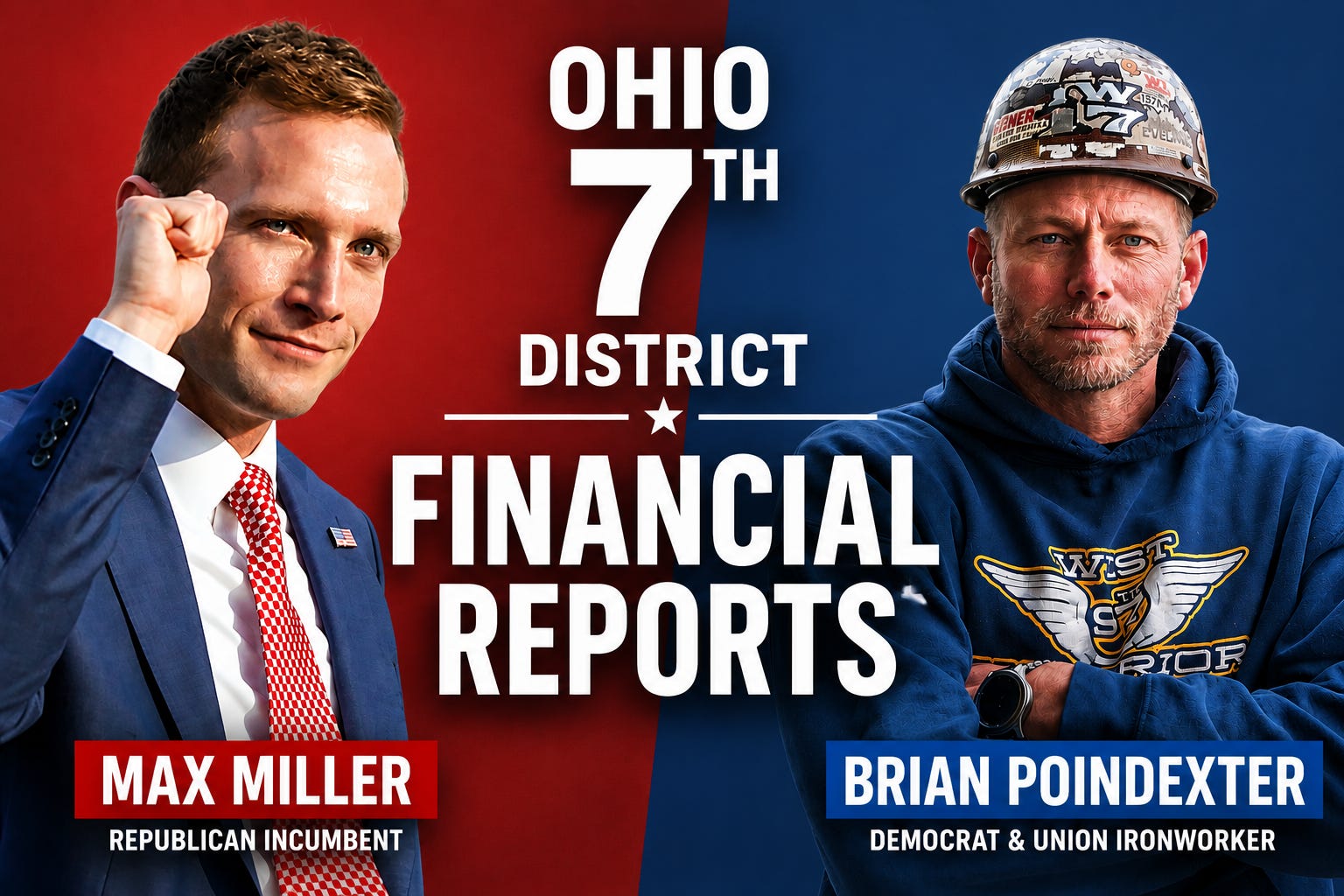
The Federal Election Commission’s second-quarter reports came due Tuesday, covering April 1 through June 30. They are the first full financial X-ray of the general election since Brian Poindexter, a union ironworker from Brook Park, won the May primary and set up a race against Rep. Max Miller that Cook Political Report, Sabato’s Crystal Ball, and Inside Elections all recently moved off safe-Republican, even while all three still favor Miller to win. (Signal Ohio) We break down some of the donors below.
Two Different Reports
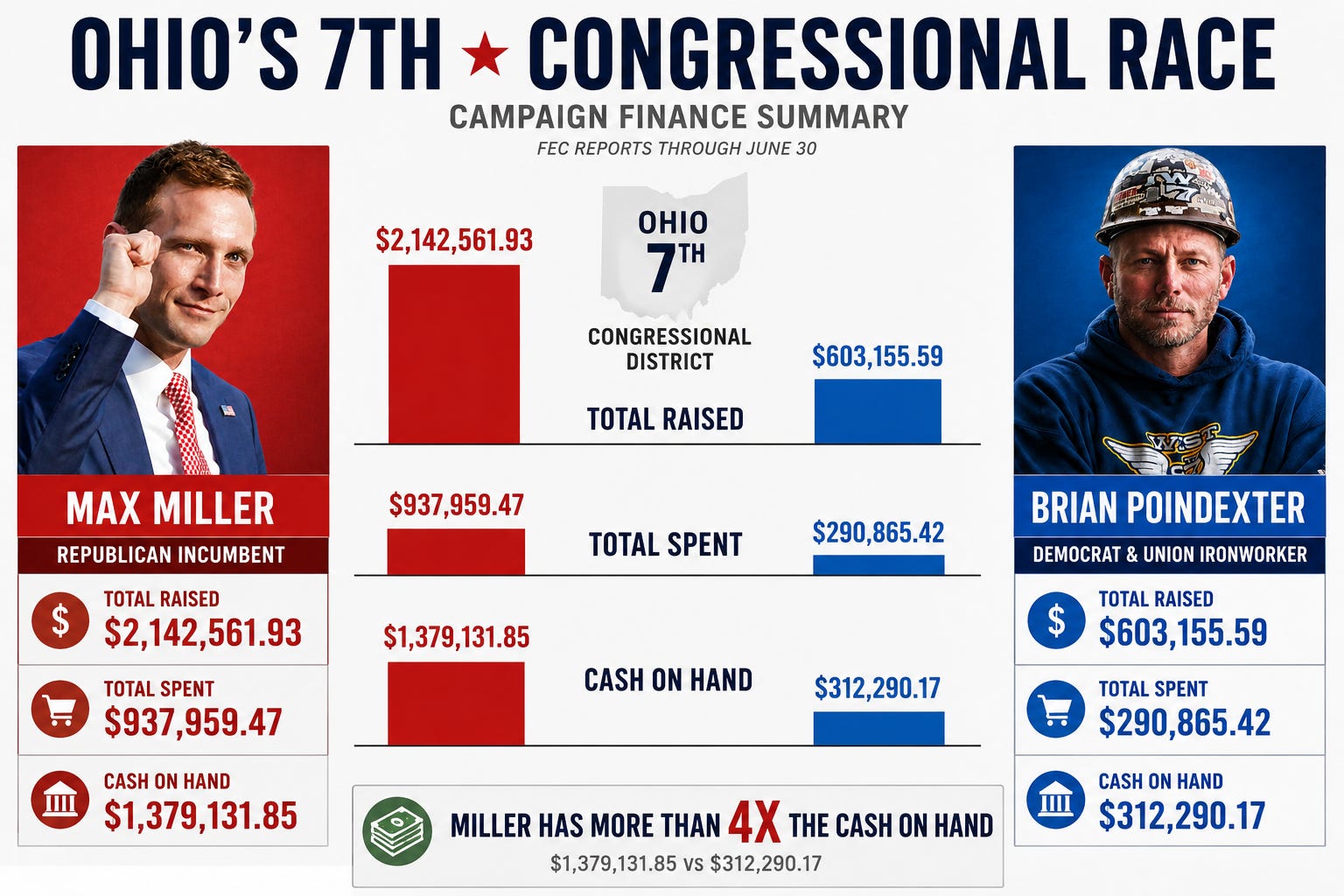
Max Miller, the Republican incumbent, reported $2,142,561.93 raised this cycle, $937,959.47 spent, and $1,379,131.85 in the bank as of June 30. That last number is the one that matters, because cash on hand can steer a lot of momentum right before election day.
Brian Poindexter reported $603,155.59 raised, $290,865.42 spent, and $312,290.17 on hand. Miller has more than four dollars in the bank for every one Poindexter does. (FEC, Ohio House District 07, 2026)
Where Miller’s Money Comes From
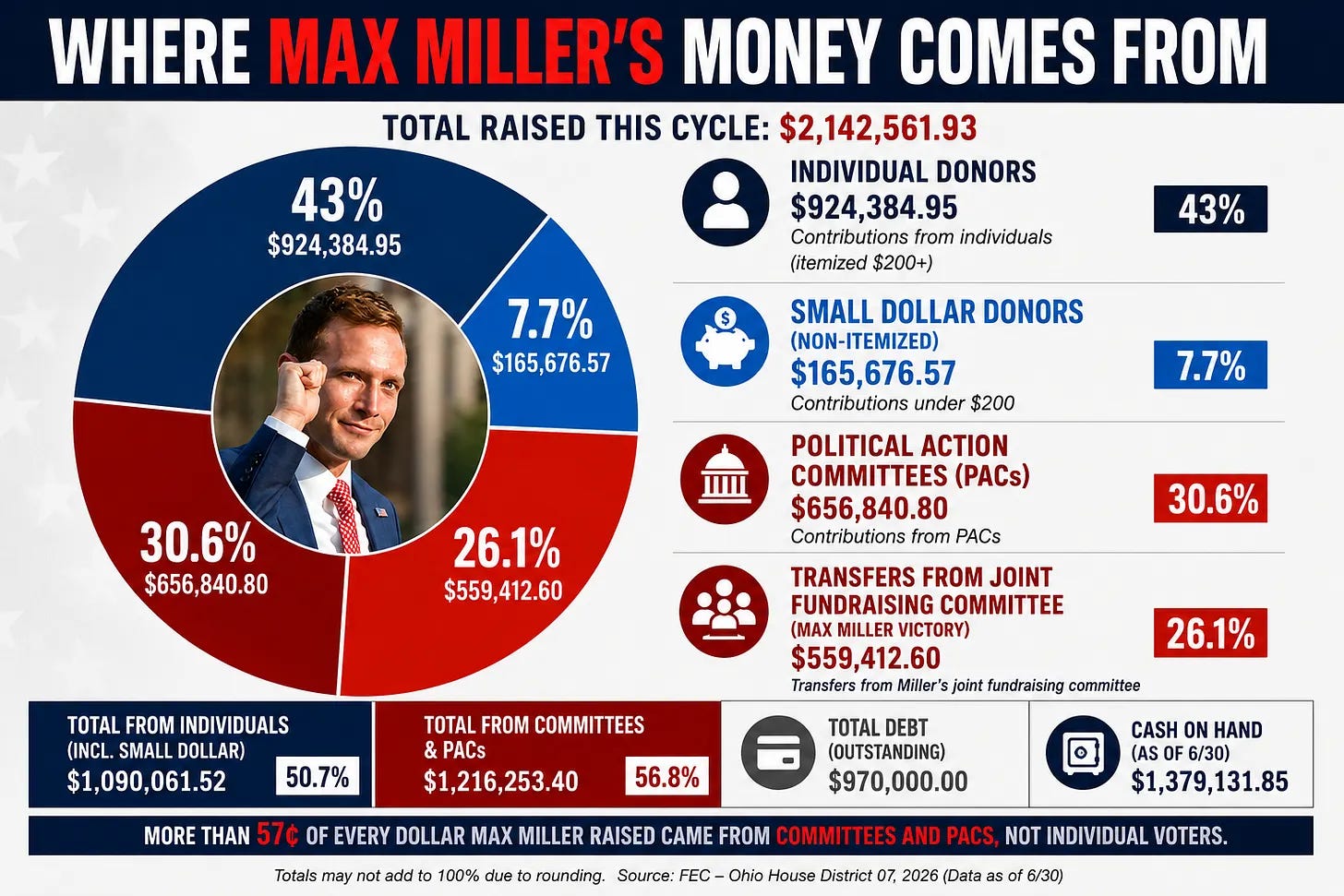
Start with what did not come from voters. Of Miller’s $2,142,561.93, individuals gave only $924,384.95. That’s 43%. The non-itemized small-dollar money, the sub-200-dollar checks campaigns love to wave around, made up only $165,676.57 of that total and only about 7.7% of the total.
The majority of Miller’s money came from committees, not people. Political action committees gave him $656,840.80. Another $559,412.60 arrived as transfers from his own joint fundraising committee, Max Miller Victory. Add those two and you get more than $1.2 million, about 57 cents of every dollar he raised, moving through Committees and PACS. (FEC)
Who are the PACs? The biggest is AIPAC, the American Israel Public Affairs Committee, at $24,500 across the primary and general. The Republican Jewish Coalition PAC gave $14,000. Then the corporate roster, most of it at the $5,000 maximum: the National Association of Real Estate Investment Trusts, MGM Resorts International, Stanley Black and Decker, and Lubrizol, the Ohio chemical maker. (FEC receipts)
The real-estate money is not incidental. Miller is a member of one of Cleveland’s wealthiest families, which built its fortune founding and selling the real-estate giant Forest City Enterprises. (Signal Ohio) His money map looks like his biography. Corporate PACs, a joint-fundraising machine, and a national donor network writing 7,000-dollar maximums out of New Jersey, Texas and Colorado, not Parma.
Two of those maximum checks are worth naming. Anatoly Yakovenko, the CEO of Solana Labs, wrote $7,000 from Boulder. Donald Wilson, who founded the Chicago trading firm DRW, wrote another $7,000. Both are crypto executives, and both gave in March, the same month Miller was doing something specific for their industry. (FEC receipts) (Tiffin Ohio) Both men’s companies carry federal legal histories. Yakovenko is a named defendant in an unproven civil racketeering suit over the Pump.fun memecoin platform, which he is contesting. An SEC case against Wilson’s trading firm, Cumberland DRW, was dismissed last year under the Trump administration, on regulatory-reform grounds rather than the merits. (Tiffin Ohio)
Miller sits on the Ways and Means Committee, which writes the tax code. He voted for the CLARITY Act, the crypto deregulation bill the House passed last year. He co-wrote a draft that would exempt small stablecoin purchases from capital gains tax. And he is, by his own account, a convert. At a blockchain summit in March, the same month those checks came in, he told the industry, “It’s because of your industry and people like you as to why I’m up here passionate about cryptocurrency.” (Tiffin Ohio) The people writing him 7,000-dollar checks are the people he thanked for connecting him to crypto.
Miller’s committee also reports $970,000 in debts it still owes. The war chest is real. So is this bill. (FEC)
Where Poindexter’s Money Comes From
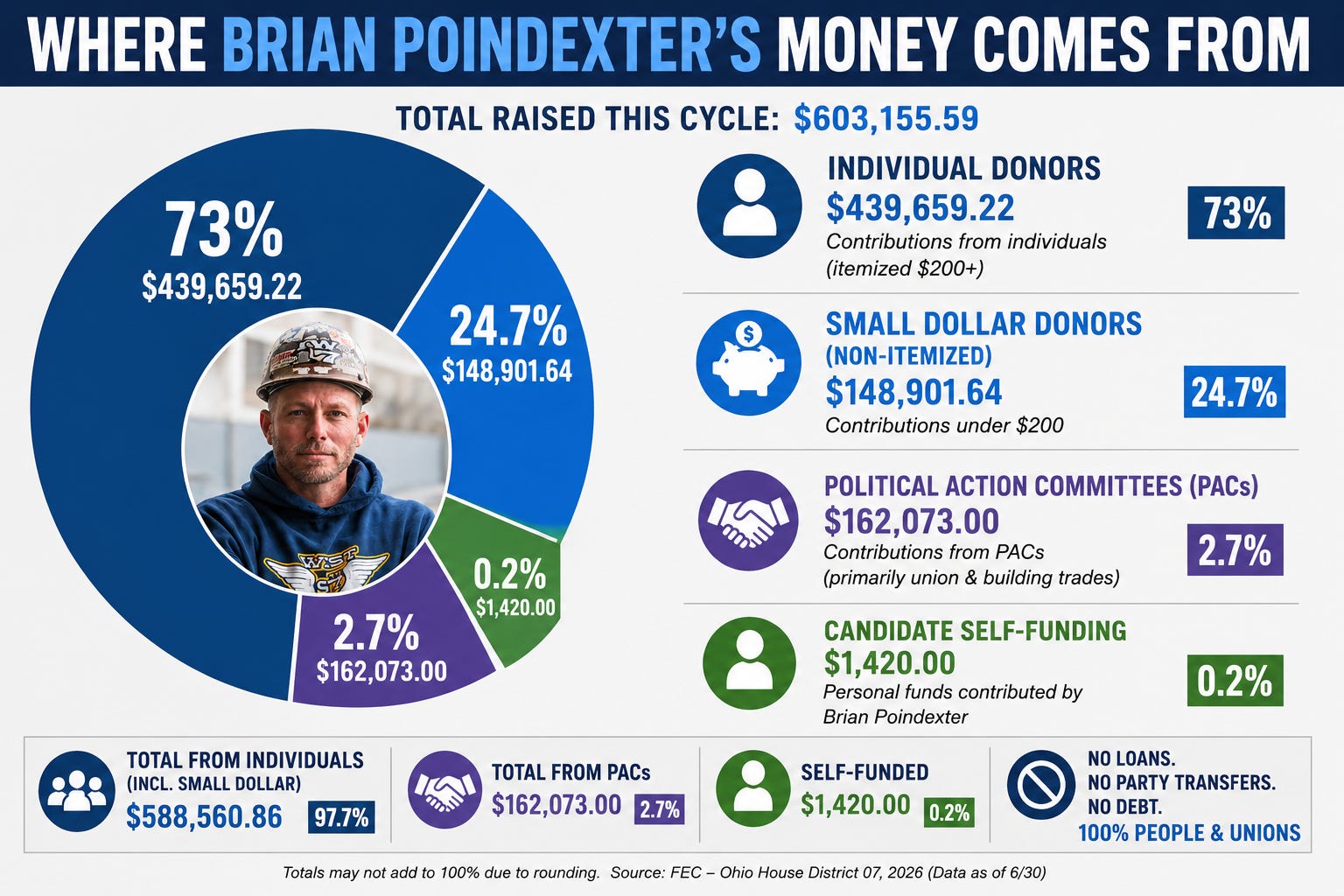
Poindexter raised $603,155.59, and he raised it differently. Individuals gave $439,659.22, or 73% of his total. His non-itemized small-dollar money came to $148,901.64, roughly a quarter of everything he raised and the single largest slice of his haul. He put in $1,420 of his own. He took no loans and no party transfers, and he carries no debt. (FEC)
His PAC money, $162,073 in all, reads like a union hall. The building trades wrote him $5,000 checks one after another. His own union, the Iron Workers, the Bricklayers, the Elevator Constructors, the Machinists, the Communications Workers of America, the United Auto Workers, the Painters, and the Longshoremen. (FEC receipts)
The interesting thing is that Labor did not line up entirely behind the union candidate. Three building-trades committees, the Operating Engineers Local 18, the Plumbers and Pipefitters, and the Firefighters, put their $5,000 into Max Miller, the incumbent, not Poindexter. (FEC receipts) Incumbency has its own gravity. Some of the trades are hedging.
There is one more layer, and it is the one that matters most. The biggest money in Ohio 7 is not in either candidate’s own report. It is being spent around them, by groups whose names are not on the ballot.
The Outside Money Democrats Don’t Want to Advertise
Independent expenditures are the dollars spent for or against a candidate by groups that are legally forbidden from coordinating with the campaign. On paper, the candidate technically has nothing to do with them, but some campaigns are better enforcers of this boundary than others. In practice, there is at the very least, passive coordination.
Here is what the FEC has logged in Ohio 7 so far.
Jobs and Democracy PAC has reported $570,203.89 supporting Brian Poindexter. BDA PAC, the independent-expenditure arm tied to the centrist Blue Dog Democrats, has reported $198,019.35 supporting him. (FEC) Local reporting, which captures the fast-turnaround filings the summary tables leave out, puts the totals higher still, at roughly $1 million in pro-Poindexter ads and about $360,000 in pro-Poindexter mailers during the primary. (Signal Ohio)
An ironworker who won a primary on $150,000 in small checks had close to a million dollars in outside air support spent to get him there.
So who is Jobs and Democracy PAC?
They are the Democratic arm of a spending network called Public First, seeded by a $20 million donation that Anthropic, the artificial-intelligence company, made to the network’s nonprofit in February. The network’s stated purpose is pushing for tougher federal regulation of AI, which should be read as fighting for more control of regulation of AI. (OpenSecrets) As to why an AI firm based in San Francisco, not Ohio, spent more than half a million dollars, by the FEC’s own count, to help elect a Brook Park city councilman in suburban Cleveland, Poindexter says he doesn’t know. “I think they see in me somebody who can win this seat,” he told Signal Ohio. AI is a point of contention across this state with the majority of Ohioans
The Number Nobody is Talking About
Now look at what is missing from the outside-money ledger.
There is no independent expenditure logged against Poindexter. None supporting Miller. Zero. The House Majority PAC, the main Democratic outside group, has still not reserved a dollar of general-election air time in Ohio 7. (Signal Ohio) And the Republican side, for all Miller’s cash on hand, has not yet drawn a single outside dollar to defend him.
That silence is the tell. The big institutional players on both sides are watching Ohio 7 and keeping their options open. The only outside money that has actually moved is the AI network and the Blue Dogs, both betting early and both betting on the challenger. Miller has the bank account. Poindexter has the early believers. Nobody with real reserves has committed yet.
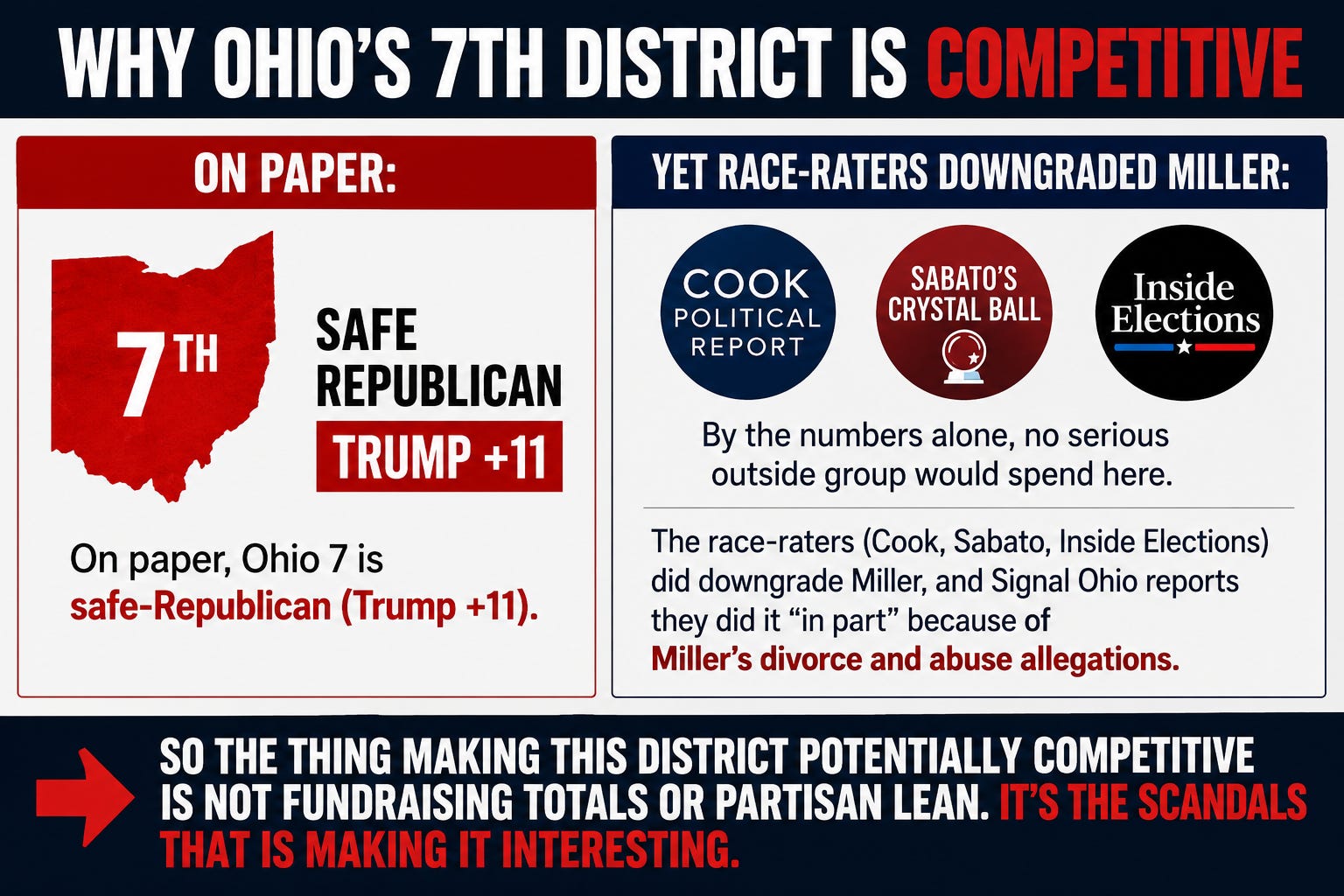
On paper, Ohio 7 is safe-Republican (Trump +11). By the numbers alone, no serious outside group would spend here. Yet the race-raters (Cook, Sabato, Inside Elections) did downgrade Miller, and Signal Ohio reports they did it "in part" because of Miller’s divorce and abuse allegations. So the thing making this district potentially competitive is not fundraising totals or partisan lean. It's the scandals that is making it interesting.
What Does this All Mean?
Donors are hedging bets on Max Miller’s scandals, which could prove to amount to a very late (like last 2-3 weeks) influx of money for his campaign if things stay quiet. That should be a motivator for Poindexter to push hard on fundraising, and at this writing, he is significantly behind Miller with cash on hand.
Miller is the candidate of the institutions. Corporate PACs, his family's real-estate world, pro-Israel money, a joint-fundraising machine, and crypto executives writing maximum checks to the man drafting their tax breaks.
Poindexter is the candidate of the building trades and the small-dollar donor, lifted into the general election by an AI company's super PAC and the centrist Blue Dog Democrats group. One coalition is richer and more institutional. Both are carrying an agenda that is not the district's.

Campaign donations are never neutral. On either side. The crypto donors want the stablecoin exemption Miller is writing. The AI network wants a vote it can count on for tougher regulation of its rivals. When either of them spends, it is buying a position, not cheering a hometown kid.
For voters following this race, Watch the independent-expenditure line at the FEC's Ohio 7 page for yourself. Not the candidates' totals, the outside money.
This where the decision to actually contest this seat will show up first, in close to real time, weeks before the election.
So the bottom line is “Who will vote with the current administration?”