


Op-ed Disclaimer: This essay reflects the personal views of its author. Opinions published by The Angry Democrat / The Angry Ohioan are intended to encourage debate and discussion, and do not necessarily represent the views of the publication, its editors, contributors, or affiliated projects.
Sooner or later, nursing homes touch all our lives. Whether it’s a parent, a grandparent, or eventually ourselves, few of us will escape some encounter with long-term care in America. And yet, for an industry so deeply woven into the fabric of aging and dying with dignity, what we’ve built is anything but dignified.

Roughly 15,000 nursing homes operate across the United States today. Seventy percent of them exist to turn a profit. Only 30 percent are nonprofit, and even that distinction, as we’ll see, offers little real protection to the families who place their trust and savings in these institutions. [1]
In an earlier piece, we examined how private equity has quietly reshaped nursing education, extracting value from an industry meant to train caregivers. Here, we turn to the other end of that pipeline: the facilities themselves, where for-profit and nonprofit nursing homes alike have found ways to exploit both the families paying for care and the workers providing it.
What emerges is a system rife with neglect, one that leaves society’s most vulnerable seniors exposed to substandard conditions while the people hired to care for them are stretched thin, underpaid, and overworked. This is not a story of a few bad actors. It is a story of an industry structured, in many cases, to profit from the very corners it cuts.
When the Rating System Itself Can’t Be Trusted
For families beginning the painful search for a nursing home, the government offers what seems like a straightforward solution: the CMS Five-Star Quality Rating System. On paper, it’s a simple tool. Plug in a facility’s name, get a score, and make an informed decision. In practice, it’s far less reliable than it appears.
CMS bases its ratings on three components: health inspections, staffing levels, and quality measures. The inspections are conducted by outside surveyors and carry some independent weight. But the other two, staffing and quality, are self-reported by the very facilities being graded.
That distinction matters enormously. It means a nursing home with real, documented problems can, through the numbers it chooses to submit, transform a one- or two-star rating into a glowing four or five stars.
This is not a hypothetical loophole. A New York Times investigation by reporter Katie Thomas examined more than 50 nursing homes that the federal government itself had flagged on a special watchlist for serious quality concerns. The finding was damning: two-thirds of those facilities still carried four- or five-star ratings, propped up almost entirely by the self-reported staffing and quality data CMS allowed them to submit. [2]
In other words, the very system designed to protect families from bad actors can be gamed by the bad actors themselves, and often is.
A Watchlist That Turns Away the Watched
The Special Focus Facility program, run by the Centers for Medicare and Medicaid Services, exists to flag the worst-performing nursing homes in the country and subject them to the kind of intensive, sustained oversight that ordinary facilities never receive.
It sounds like exactly the safeguard a vulnerable population needs. There’s just one problem: the program is capped at 88 facilities nationwide, even though more than 500 nursing homes currently meet the criteria to be on it. [3]
The reason isn’t a lack of bad facilities. It’s a lack of money. Monitoring a facility under the Special Focus Facility program is resource-intensive, requiring far more frequent inspections and follow-up than CMS’s routine oversight allows. The agency simply doesn’t have the budget to extend that level of scrutiny beyond a small fraction of the homes that need it. [4]
The result is a kind of triage by default. Hundreds of facilities that, by the government’s own standards, warrant urgent intervention are left off the list entirely, not because they’re safe, but because there isn’t enough funding to watch them.
A Reform Bill That Never Got Its Chance
The Nursing Home Reform Modernization Act of 2021 was, on paper, exactly the kind of ambitious overhaul long-term care advocates had been demanding for years. Among its provisions was additional funding to expand the Special Focus Facility program so that oversight could finally extend beyond 88 facilities to the hundreds more that needed it.
It never got the chance. Like so much legislation caught in the machinery of a divided Congress, the bill quietly died when the 117th Congress adjourned.
Its ambitions went well beyond funding. The bipartisan bill would have required CMS to establish a ranking system for both Medicare skilled nursing facilities and Medicaid nursing facilities, replacing the current patchwork with something more rigorous.
It would have created an advisory council tasked with studying the ranking process itself, including the metrics used, the data sources relied upon, and the quality controls in place, and using those findings to build a system with real teeth. Facilities that ranked poorly would face escalating enforcement actions until they met the required standards, while high-performing facilities would risk losing that designation if their performance slipped.
The Nursing Home Reform Modernization Act may have died a quiet death on its own, but its key ideas didn’t disappear entirely. Key provisions were folded into the Build Back Better Act, the sprawling social spending package that passed the House in November 2021. For a moment, it looked like reform might arrive through the back door.
The version that passed the House included several nursing home provisions. By the time it reached the Senate, two more had been added, including language that would have expanded the Special Focus Facility program to cover at least 3.5 percent of all nursing facilities. This would have raised the cap from roughly 88 facilities to approximately 550, alongside $800 million in grant funding for states to improve staffing and infection control in long-term care settings. [5]
Then came the retreat. As the bill moved through the Senate, Senators Joe Manchin of West Virginia and Kyrsten Sinema of Arizona balked at the scope and cost of its healthcare and spending provisions. Much of the original ambition was stripped away to secure their votes.
What survived the negotiations, and what didn’t, would go on to define the final product. The bill that eventually passed, reshaped, scaled back, and rebranded as the Inflation Reduction Act of 2022, squeaked through the Senate only with a tie-breaking vote from then-Vice President Kamala Harris. [6]
The One Big “Beautiful” Bill vs. the Affordable Care Act
Anything short of universal healthcare that is free at the point of contact is only putting a Band-Aid on the healthcare crisis in our nation.
In my interview with Jake Underwood on The Jake Underwood Show, I highlighted the issues with the Affordable Care Act, including how subsidies for the program are unsustainable and how underlying problems, such as rising healthcare costs, drive up the overall cost of the ACA.
In a future article, we will look at how both healthcare bills negatively affect all Americans. To stay on topic for this article, however, we will look at something else that is not manageable: staffing in nursing homes and how both acts mandate unreasonable metrics in the nursing home setting.
The One Big Beautiful Bill Act is in no way a landmark healthcare bill. The bill placed a moratorium on the 24/7 registered-nurse staffing requirement for nursing homes and eliminated specific minimum hours for nursing staff to deliver care to your loved ones until 2034.
This lets nursing homes staff their facilities in a manner that is neither safe nor conducive to proper care.
Current staffing levels in many nursing homes are poor, to put it lightly. I have worked in a few, so I will speak from personal experience.
At one facility in the Cleveland area, I was the nursing supervisor, and nurses would constantly have ratios ranging from one nurse for every 15 patients to one nurse for every 30 patients. At times, a nurse would be lucky to have any help from nurse aides.
Many times, care would go incomplete because of staffing issues. We cannot place the blame on the nurses, either. They do their best to prioritize care and get everything done during their shifts.
It is impossible to provide quality care to large numbers of residents. Nursing homes need to stop giving nurses and aides unrealistic patient ratios.
The Insane Cost of Long-Term Care
Let’s call it what it is: long-term care is a cash grab.
Facilities have long taken advantage of residents and their family members.
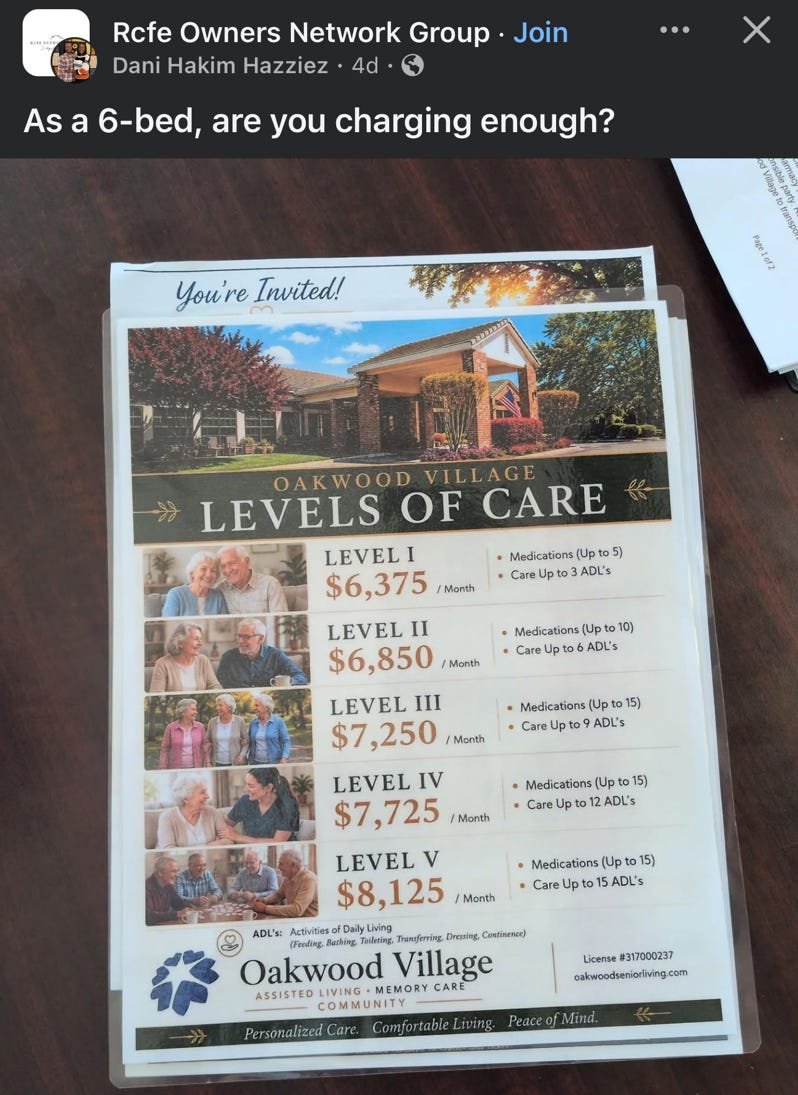
Oakwood Village is a group of facilities in California and Utah. As noted in its advertisement, the company charges residents according to the amount of care they may need.
Unbeknownst to prospective residents and their families, nurses and nurse aides do not pay attention to what “level” a resident is, nor are they told by management. Nurses and nurse aides have licenses and certifications. If they provide some care but refuse to provide all the care a resident needs, that could be considered abandonment of patient care, and a nurse could subsequently lose their license for refusing care.
Therefore, facilities charging according to medication amounts and activities of daily living, or ADLs, is a complete cash grab and nothing more.
For those reading who are unfamiliar with ADLs, they are activities of daily living, including getting dressed, bathing, brushing one’s teeth, and other basic tasks.
As a nurse, I would not give a hoot what level a resident is. If they have 30 medications and need help with 10 ADLs, I would not care if they were classified as a level-one resident.
They need care, and I chose to go into nursing to help people, not to classify them into financial categories.
Nursing Homes in Ohio: The Racket Putting Profits Ahead of People


Another facility to examine is Dublin Glenn, located in Columbus, Ohio. It is owned by Continental Senior Communities, which owns facilities across Ohio, Michigan, Pennsylvania, and Kentucky.
In the pictures above, one can see that Dublin Glenn charges an insane amount of money per month while offering nurse aides only $16 per hour. It also has a structure similar to Oakwood Village, charging a monthly rate plus a premium depending on how much care a resident may need.
I personally worked as a travel nurse at this location, and it was a lackluster experience.
Besides charging residents an insane amount of money and underpaying staff, although nurses were paid $30 per hour, which is around the industry standard, the facility had some shoddy nursing practices.
One night, the facility brought in a new resident who began entering other patients’ rooms, pulling them out of their beds, and beating them. When nurse aides attempted to intervene, they were met with violence. The nurse aides and I had to intervene to ensure the safety of the other residents and the resident in question.
Accordingly, I had to document what happened so the physicians could adjust medication dosages as needed.
The next day, I received a phone call from the director of nursing asking me to change my documentation because the Ohio Department of Health would cite the facility.
I stated that I would not falsify any documentation and that bringing in residents who were inappropriate for the facility was a patient and employee safety issue.
I was asked not to return to Dublin Glenn thereafter.
Next, we will look at another facility: Greenbrier Health Center in Parma Heights, Ohio, a facility marred by issues.
I was the night-shift supervisor for the facility, and the way it treated residents and nurses left much to be desired. Residents were seen as an income stream and nurses as the people who provided that income.
Management spent little to no money on resident activities, equipment, supplies, or food. Many times, when residents needed to be cleaned up, the facility had no wipes available to clean them.
The nursing administration would routinely ask nurses to complete tasks outside the scope of their practice, which means tasks certain nurses are not legally allowed to perform.
Whenever there was a safety concern involving a patient, nurses would come to me and ask what should be done. In my mind, if it was serious or the patient needed emergency testing, I would always advocate for what was best for the patient and call 911 to have them sent to the hospital for further evaluation.
The parent company of Greenbrier, CommuniCare, has an internal process under which a nurse must call the company’s nurse practitioner and “get permission” to send the patient to the hospital.
This was a corporate policy intended to ensure that hospital readmission rates remained low so that the facility could receive as much reimbursement from Medicare as possible.
As a nurse, I have developed my sense of, “Oh shit, something is wrong here,” and I am not going to have someone else tell me not to advocate for a patient.
I always received pushback from the administration, but the patients I sent out had severe issues that needed an acute response.
One last note on Greenbrier: a few years ago, Northeast Ohio experienced massive power outages due to tornadoes and storms that rolled through the region. I was the supervisor the night that happened.
Administrators came in to “assist” with ensuring that rooms had power. Residents gathered near the front entrance, trying to find whatever little comfort they could in the heat.
I found ice cream in the kitchen and started handing it out to keep residents cool.
The nursing administration saw what I was doing and told me that I needed to charge each resident because the ice cream was company property and the facility sold it to make extra money.
They then put a padlock on the freezer.
I waited until the administrators left, opened the freezer with a bolt cutter, and handed the ice cream back out to the residents.
Not only did the administration refuse to hand out ice cream to residents during a blackout, but it also created safety hazards throughout the facility by running wires through hallways and into residents’ rooms. It didn’t care to tape down the wires or ensure resident or employee safety.
The administrators came in to check boxes, say they had done something, and leave.
After those few nights, the director of nursing and assistant director of nursing resigned, but there were new sheriffs in town.
The new nursing administration did not like that I advocated for residents. It subsequently turned off all my facility accounts and removed my ability to pick up shifts until I spoke with the administrators.
I went into that meeting and, without going into detail about the level of disrespect they had for patients and employees, handed them my resignation and left.
I left with my dignity still intact, knowing that I had done what was best for the residents on a wild night.
Profits should never come before people, and people should never be taken advantage of during a crisis.
For HIPAA compliance, I will state that no patient-identifying information was photographed and no photographs of patients were taken.


Greenbrier is not the only facility worth mentioning.
The now-closed Westlake Rehab, which was located on Crocker Road, had a resident escape and later be found dead in a nearby golf course pond. [7]
The facility was eventually shut down because of staffing issues and serious patient concerns that had accumulated throughout the years.
I reached out to one of the facility’s previous administrators, who had little to say. In my personal experience, many healthcare workers feel gagged from talking about working conditions because they fear retribution from one powerful entity or another.


I also reached out to the nursing home administrator who was working at the time of the resident’s death. I received no reply. That individual has since allowed their nursing home administrator license to expire.
House of Loreto in Canton, Ohio, was recently shut down by the state because of “severe care failures and neglect that placed residents in real and present danger.”
The Catholic Diocese of Youngstown sold the facility to Hari Group LLC in March 2025. Following the sale, new and inexperienced management cut staff and operational costs. [8]
A January 2026 inspection by the Ohio Department of Health revealed that 12 of the facility’s 29 residents were at serious risk and that six residents had already suffered actual harm. [9]
Some of the department’s most serious findings are listed on the Ohio Attorney General’s website. [10]
Other “honorable mentions” include Foundations Health Solutions, The Avenue, and Saber Healthcare Group. All have laundry lists of lawsuits and allegations involving neglect and poor employee relations.
We find this primarily in corporate-owned nursing homes, where staffing is short and resources are scarce, but the monthly fees are outrageous.
If one thing is certain, it is that we do not care about our elderly.
We need to do something, and it all starts with giving a damn about elderly people and people with disabilities in our nation. Right now, the evidence points to the fact that we absolutely do not care, and most of the industry’s problems stem from that.
It will only get worse from here because, the longer we wait, people will literally get eaten alive. [11]
Stay Angry
Guest Writer: This article was contributed by a local Angry Patriot.
The Angry Democrat / The Angry Ohioan welcomes submissions from local writers and community members who want to contribute thoughtful commentary on the Democratic Party, our democracy, public policy, and issues affecting Northeast Ohio and beyond.
Interested in writing for us? Contact us at Matt@theangrydem.com
Bibliography
Medicare Payment Advisory Commission, June 2025 Report to Congress: Medicare and the Health Care Delivery System
Katie Thomas, “Medicare Star Ratings Allow Nursing Homes to Game the System,” The New York Times
Special Focus Facilities vs. Special Focus Facility Candidates, Journal of the American Medical Directors Association
Centers for Medicare and Medicaid Services, Revisions to the Special Focus Facility Program
United States Senate Roll Call Vote 325, 117th Congress, Second Session
“71-Year-Old Man Drowns After Wandering Away From Westlake Rehab Center,” Cleveland 19 News
“State Seeks Closure of Canton’s House of Loreto Nursing Home,” The Canton Repository
“Family of Woman Killed by Alligator Sues Florida Retirement Community,” NBC News
I was just in a nursing home for less than three weeks for rehab for my broken leg. I felt relatively safe but looking back I am so glad to be home out of there. I had issues with a night nurse there who I had taken off my care and she harassed me for a few days. I will never go back to any nursing home.