

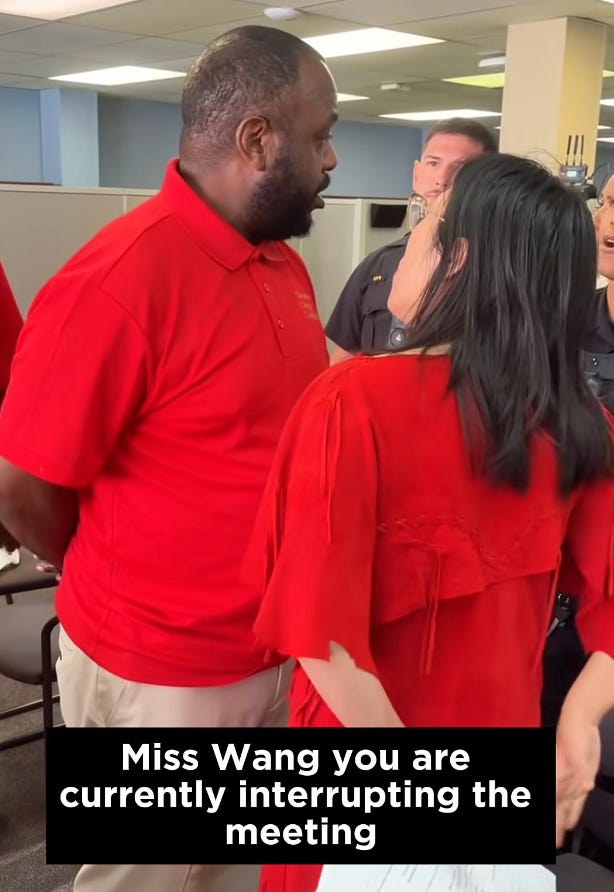
There has been a lot of discussion about what happened at the August 26 Cleveland Community Police Commission meeting involving former Commissioner Teri Wang and Pastor Aaron Phillips.
Most of that discussion has focused on whether Wang disrupted the meeting, whether Phillips tried to intimidate her and which one was more responsible for the confrontation,
I watched the meeting and read the transcript. I do not know Wang and have never met her in person. I am not here to defend everything she has done at this meeting or others. The commission has documented a longer history of confrontations with her, and commissioners and staff have said they feel harassed and unsafe. I am not dismissing that.
That is becoming a familiar trick in local government. Officials do not have to answer an accusation if they can make the accuser the only subject anyone discusses.
What Happened at the Meeting
The meeting began with a transparency problem before Wang ever reached the microphone.
When the commission arrived at the portion of the agenda for approving meeting minutes, no minutes were available. The chair asked whether any had been generated. A staff member said they would check SharePoint. The chair then acknowledged that the commission probably had “a backlog of minutes.”
That is important because one of Wang’s first complaints was that minutes had not been published.
Under Ohio’s Open Meetings Act, meeting minutes must be promptly prepared, maintained and made available for public inspection. That does not automatically mean the commission intentionally violated the law. It does mean Wang’s complaint was based on a real and acknowledged problem.
When Wang began her public comment, Phillips interrupted her almost immediately. To the chair’s credit, he stopped her clock and instructed Phillips to let her finish.
Wang then raised questions about missing minutes, grants administered through the commission, public access to grant applications and participation in a surveillance-technology workgroup.
When her time expired, Wang continued addressing Phillips. The two exchanged taunts. Phillips asked whether she was an American citizen. Wang continued speaking, the confrontation escalated and officers stepped between them. The meeting was recessed for an hour and 15 minutes. Wang was eventually cited for disorderly conduct after refusing to leave during the recess.
There was disruption. Wang contributed to it. Phillips contributed to it. Only Wang was cited.
All of those things can be true.
The Questions Behind the Disruption
Wang’s delivery was confrontational, but the substance of her public comment included questions that can be checked.
The commission admitted it had a backlog of minutes.
Wang also said she could not obtain grant applications and related documents. Ohio’s Public Records Act allows any person to request public records. Wang does not need to be a commissioner, journalist or attorney to make that request.
That does not mean every line of every application must be released. Some information could fall under a legal exemption. But if the commission or city is withholding records, it should identify what it is withholding and the legal reason why.
Wang also questioned repeated grants to the Cleveland Clergy Coalition, which Phillips leads. Public records show that the coalition received a $45,000 commission grant in 2023. In the next published award matrix, the United Black Fund recommended another $35,604 award.
Repeat funding is not proof of wrongdoing. The commission’s own rules allow previous recipients to apply again.
But repeated public funding creates a legitimate public interest in seeing the applications, scoring criteria, contracts, payments and performance reports. The public should be able to determine what was promised, what was delivered and why another award was justified.
Those questions deserve answers even if Wang made them in the most aggravating way possible.
What Signal Cleveland Left Out
Signal Cleveland’s story contains useful reporting. It documents the commission’s complaints about Wang, previous confrontations, the city Law Department’s response, the special prosecutor and the disorderly-conduct citation. It also reports that both Wang and Phillips exchanged taunts and that Phillips questioned her citizenship.
But the article is overwhelmingly framed around the commission’s claim that Wang is preventing it from working.
It does not tell readers that the commission admitted it had a backlog of minutes immediately before Wang spoke.
It does not investigate whether her public-records requests were fulfilled or denied.
It does not examine the grants awarded to the Cleveland Clergy Coalition or ask whether the performance records are available.
It does not answer whether the surveillance workgroup is open to the public.
That omission changes the story.
Readers are left with a character study about Wang’s behavior instead of enough information to decide whether any of the claims underneath that behavior have merit.
I am not accusing Signal Cleveland of taking bribes or participating in a conspiracy, as some commenters did. There is no evidence for that. My criticism is simpler: Signal followed the conflict but did not follow the records and money behind it.
What People Said Under Signal’s Story
Facebook comments are not a scientific poll. They are self-selected, emotional and sometimes hostile. But they can still show where public skepticism is concentrated.
The largest group of commenters focused on Phillips. They questioned why he approached Wang, why he interrupted her and why his question about her citizenship was not treated more seriously. Many believed Signal’s framing minimized his role while placing the responsibility for the entire confrontation on Wang.
Another significant group focused on the unanswered financial and transparency questions. These commenters wanted more reporting about the grants, Phillips’s political relationships, the Flock surveillance debate and the commission’s own inability to produce records.
A smaller but noticeable group viewed Wang as a chronic disruptor whose conduct has prevented meetings from functioning. Their position was that officials had already tolerated too much and should have removed her sooner.
There was also a broader sentiment that the commission itself is dysfunctional. Several people argued that Wang is being used as a convenient scapegoat for an institution that struggled to complete its work even when she was not present.
The comments did not produce a clear defense of Wang’s behavior. What they showed was widespread confusion with making her behavior the entire story.
Rob Loftis offered this perspective:
“Everything that happened here needs to be seen in the light of the original purpose of the Cleveland Police Commission and the ongoing efforts to keep it from fulfilling its mission. The CPC was established by Issue 24, which was an initiative put forward by the families of people who had been killed by the police, including Samaria Rice, the mother of Tamir Rice. The goal from the beginning was to have a body that could discipline or fire corrupt and abusive police officers, without being overruled by the Chief of Police or the Director of Public Safety. From the beginning, those of us who worked to get issue 24 passed knew that there would be massive effort buy people in positions of power to keep anyone from holding the police accountable.
There is a standard strategy for blocking government agencies from imposing unwanted regulation. First, you sabotage the operation of the body. Then you announce to the public that the body is dysfunctional and should be abolished.
A lot of what we’re seeing right now advances this agenda. The difficulty the commission has faced obtaining needed documents, the hiring or appointment of people who don’t seem committed to the cause of police accountability, and the disruption of public meetings, all create the impression that the work of the Commission is impossible, and should be given up. People who want to hold the police accountable should be working for a functional community police commission.”
Ardelia Holmes’s Argument Is Different
Ardelia Holmes made a more complicated argument than either defending or condemning Wang.
Holmes said she is no fan of Phillips. She believes the questions involving grant money, Phillips’s support for Flock cameras, his disbarment and his relationship with Mayor Justin Bibb deserve scrutiny. She also described Phillips’s size and posture toward Wang as frightening and intimidating.
But Holmes also argued that Wang’s tactics gave the commission an escape hatch.
The discussion should have been about the money, the missing documents and why certain organizations keep receiving public grants. Instead, Wang continued pointing, speaking and moving toward Phillips after her public comment, allowing the discussion to become entirely about her conduct.
Holmes put it bluntly: “You provided the out.”
If your goal is to force a public body to answer a specific question, your tactics have to keep that question in the center of the room. If your conduct allows officials to replace the question with a debate about you, you have made their job easier.
The discussion underneath Holmes’s post was more divided than the comments beneath Signal’s story. Many agreed that both participants were wrong and that Wang’s tactics repeatedly bury her legitimate points. Others believed Holmes was blaming someone who had been targeted and intimidated.
The conversation eventually turned into arguments about race, gender and how women of color are perceived in public spaces. Some of that discussion was thoughtful. Much of it deteriorated into personal attacks.
Phillips asking a Chinese American woman whether she was an American citizen was unacceptable. At the same time, criticism of Wang’s conduct cannot automatically be dismissed as an attack on her identity.
The standard should be conduct: Who interrupted? Who continued after being told to stop? Who escalated the confrontation? Who was removed or cited? Was the same standard applied to everyone?
Answer the Questions
The commission should not have to tolerate threats, harassment or behavior that prevents it from completing public business. It also should not be able to use Wang’s behavior as a substitute for answering her questions.
Publish the missing minutes.
Release the grant applications, scoring records, contracts, payments and performance reports to the extent required by law. If something is withheld, identify the specific legal exemption.
Explain who participates in the surveillance-technology workgroup and whether members of the public can join.
Apply the same conduct rules to commissioners, guests and members of the public.
Signal Cleveland should also follow up on what its first story left unresolved.
What records did Wang request?
What was provided?
How much has the Cleveland Clergy Coalition received across every grant cycle? What results did its programs produce?
What role did Phillips and his organization play in the Flock debate while receiving public and campaign money?
Maybe Wang is wrong about some or all of it. If so, the records can prove that.
Maybe the commission followed every required procedure. If so, it should be able to demonstrate that without hiding behind a disorderly-conduct citation.
And maybe Holmes is right that Wang’s tactics repeatedly help the people she is trying to expose.
That still does not relieve those people of the obligation to answer.