

I want to ask a question because I do not know if we all fall on the same side of this as Democrats. And that question is…
How do we feel about Flock cameras?
The common phrase is that technology is moving faster than society knows how to deal with it. But the truth is, we have been asking this specific question for a long, long time. Books have been written about it. Political theory has wrestled with it. Science fiction has put it on the silver screen. We have seen authoritarian regimes use surveillance across the globe, and then we sit here in America, the land of the free, and somehow we are still not sure where the line is.
Government surveillance. Private surveillance. Cameras on every corner. License plate readers tracking where we go, when we go there, and what vehicle we drive. The reason this is such a complicated conversation is because it is always framed around safety. And safety is important. Nobody wants stolen cars, kidnappings, violent crime, or people with warrants just driving around with no way for law enforcement to find them.
But safety is not the only thing happening here.
And that is why I want to ask the question about flock cameras.
What Are Flock Cameras?
Flock is a private company that, honestly, has built a brilliant business model. Municipalities and police departments can rent these cameras for a yearly fee, and Flock handles a lot of the logistics. The cameras are placed around cities to monitor vehicles coming in and out of town, traveling through neighborhoods, or passing through certain intersections.
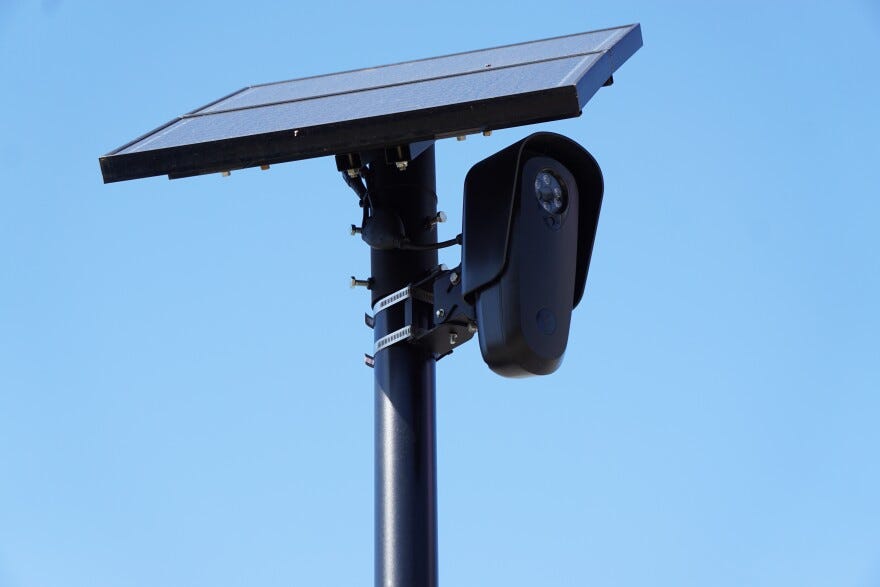
These are automated license plate readers. Their main job is to scan your plate and put it into a searchable database, but they can also log the color, make, model, bumper stickers, and even unique dents on a vehicle.
This is not just a camera taking a random picture. This is a system creating a searchable record of movement. Your license plate connects to your registration. Your registration connects to you. Then the system can build a pattern of where a car goes, when it goes there, and direct who has access to that information.
That is a massive amount of data.
And the back end of this system can be used by police departments and, depending on the sharing settings, other agencies. Cleveland, for example, has about 100 Flock license plate readers in high-traffic areas, and Signal Cleveland described the system as one that captures images of vehicles and stores them in searchable databases that law enforcement agencies can share with each other.
So the question is not just whether this can catch criminals.
Of course it can.
The question is what kind of surveillance infrastructure we are normalizing in order to do it.
Big Brother is Here?
We have talked about Big Brother forever. George Orwell gave us the phrase everybody knows from 1984: “Big Brother is watching you.”

That line is so familiar that it almost feels like a cliché now. But maybe that is the problem. We got so used to the phrase that we stopped paying attention to the thing it warned us about.
The way I have always thought the government would subvert aspects of the Constitution is not necessarily by doing everything directly. It would be by pushing surveillance into private companies, then letting public agencies access the system after the fact.
But that is exactly why this public-private arrangement is so concerning. It is civilian surveillance infrastructure, but with the branding of a private technology platform. It is government power assisted by corporate data systems. It is not just a police officer sitting in a cruiser watching one intersection. It is a networked system that can be searched, shared, and expanded.
And once that system exists, the question becomes who gets access, who watches the watchers, and what happens when the definition of “public safety” changes.
I know people trying to get this information from their local governments. It is like pulling teeth. I will tell you more when I can.
There Is Abuse
This is the part people need to understand. The concerns are not theoretical.
In Shaker Heights, activists said public records showed the city’s Flock camera data was searched nearly 700,000 times between January and April, with only about 1,000 of those searches coming from the Shaker Heights Police Department. Spectrum News reported that nearly 300 searches mentioned immigration or ICE, and that Shaker Heights changed its policy after concerns about immigration-related searches.
That is the concern. A city installs cameras for local safety, then suddenly data can be searched far beyond what residents thought they were agreeing to.
There was also a case involving a Texas search for a woman authorities claimed had self-administered an abortion. Members of Congress wrote to Flock’s CEO saying Texas authorities reportedly used Flock’s automatic license plate reader technology to conduct a nationwide search, reviewing footage from more than 83,000 cameras, including cameras in states where abortion is protected.
That is not a slippery slope. We are down the hill.
There are also the personal abuse cases. In Sedgwick, Kansas, a police chief used Flock license plate readers 228 times over more than four months to track his ex-girlfriend and her new boyfriend’s vehicles. He also used his police vehicle to follow them out of town.
The Institute for Justice has reported that police have used automatic license plate reader networks to track romantic interests at least 16 times in recent years.
So “What are you worried about?”
Is It Safety, or Is It Surveillance?
So my question is simple.
What do you think this is?
Is this surveillance, or is it safety?
Is it for the greater good?
Do we sacrifice a little privacy and freedom for security?
Does the good outweigh the potential abuse?
Are we comfortable being monitored and tracked this way?
Is this just part of a larger corporate surveillance network, where Ring cameras, Flock cameras, police databases, private companies, and government agencies all start linking together into one giant web?
And even if it is, do we believe the old line that you have nothing to worry about if you are not doing anything wrong?
I do not.
The surprising thing is that this is not some futuristic technology we never saw coming. This is not virtual reality or AI suddenly arriving from nowhere. Surveillance cameras, government monitoring, and license plate tracking are not hard to understand. We have been warned about this for generations in books like 1984, in political theory, in science fiction, and in the real-world history of authoritarian governments.

And yet, when it shows up as a subscription service for cities, we somehow still do not know what to do with it.
Where I Fall
I do not want to give up privacy or freedom for the feeling of security.
Maybe that puts me in the minority.
Maybe I am being overly sensitive.
Maybe I live a privileged enough life where crime is not something I have to think about every hour of the day. Maybe people in higher-crime areas feel differently and welcome these cameras because they want any tool available to help protect their neighborhoods.
That is why I am asking the question instead of pretending there is no debate.
But personally, I think the problem is the cameras themselves. Not just the public-private partnership. Not just the access. Not just the policy. The cameras are the infrastructure. Once they are installed, the pressure will always be to expand them, share the data, connect the systems, and justify the next use case.
We see people voluntarily installing consumer-facing surveillance products. We see cities voluntarily subscribing to these systems. We see law enforcement agencies building searchable databases of our movements. We see private companies sitting between the public and the government.
And we call it safety.
Maybe I am wrong. Maybe this is one of those technologies where the benefits outweigh the risks. Maybe this is the cost of living in a modern society. Maybe the answer is not removing the cameras, but stronger rules, better oversight, shorter retention periods, audit trails, warrants, and strict limits on who can access the data.
But I keep coming back to the same thing.
Once the surveillance infrastructure is built, it rarely gets smaller.
So what do you think?
Is the problem the public-private partnership?
Is it the access?
Is it the cameras?
Is it only abuse, or is the system itself the abuse?
Tell me where you fall.
But in the meantime...
Benn Jordan is a tech guy with You Tube channel. He has shown how easy it is to break into the cameras. I don’t like big brother watching. I’m not sure I’m bought into the benefits outweigh the cost. We have found missing Alzheimer’s patients who are lost while driving (yikes) and solved an issue the city was having with stolen vehicles (suburban problem. Most vehicles were unlocked with keys inside the vehicle). But, the capability to abuse the data is not small. The new Ice budget scares me. Anything that might help them accomplish their stated goal is a problem.
Small town life (everyone knew everything about everybody thanks to gossip) magnified, monetized, and expanded—-it seems. Can be useful “Did you know your son put nails in neighbors’ car tires?” Or helpful (“She’s all alone now, let’s keep an eye out for her”) or ? No one is truly Big City anonymous now. It’s a trade off & I don’t know the answer.