

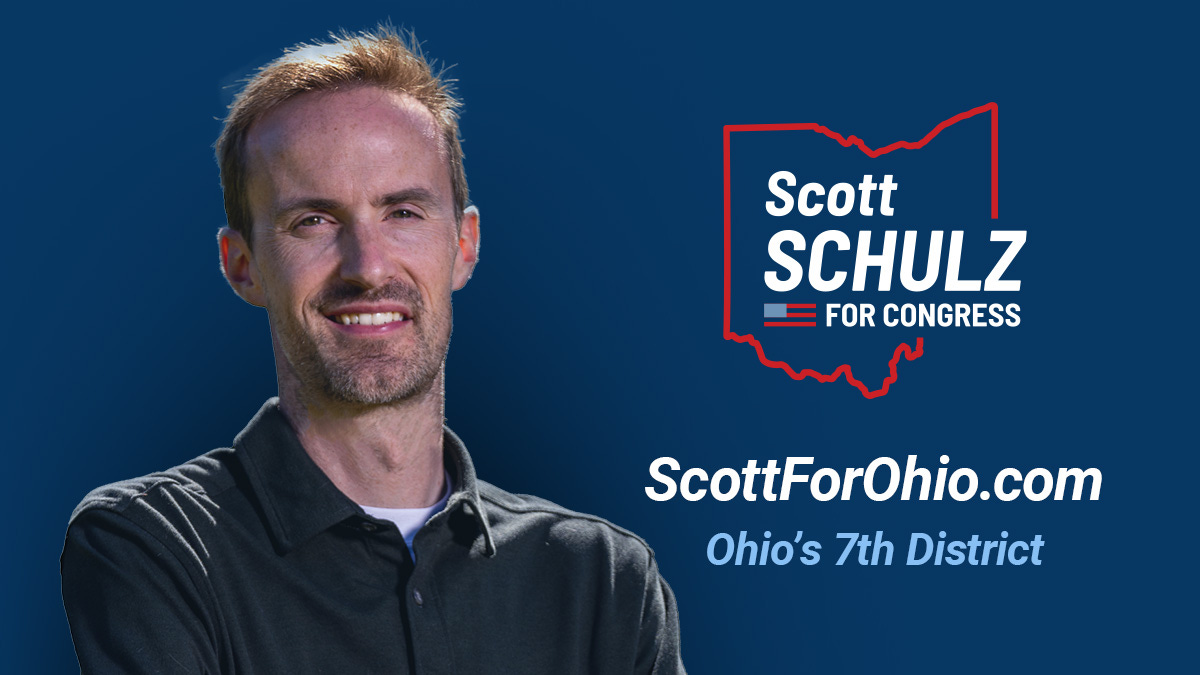
Hey everyone, this is Matt Diemer, the Angry Democrat, continuing the Congressional Interview Series. This conversation features Scott Schulz, who is running for Ohio’s 7th Congressional District.
Scott Schulz is a Democratic candidate for Ohio’s 7th Congressional District and currently serves on the Bay Village Board of Education. He has a background in higher education and workforce development and says his experience in public service, education policy, and community leadership motivated him to run for Congress and focus on issues like healthcare access, economic opportunity, and strengthening public education. You can learn more about him and his campaign here:
https://scottforohio.com/
I’m sorry for the audio quality. I don’t know what happened. We were trying to record live, and this was the first time I used this live streaming software with two guests, so I must have messed something up. I apologize in advance.
Please see the summaries below and the timestamps that correlate with the video to find where the questions you want to hear answered appear in the conversation so you can jump directly to those sections.
Introduction, District Overview, and Opening Setup
00:00:03 - 00:01:12
I opened by introducing Scott Schulz as one of the eight Democratic candidates running in Ohio’s 7th Congressional District. I laid out the shape of the district, reminded people that the eventual nominee will face Max Miller, and pointed viewers to Scott’s website while explaining that live questions could be folded into the conversation.
Scott Schulz’s Background and Why He’s Running
00:01:13 - 00:04:22
Scott walked through his background, including growing up in Alaska, coming from a union family, working in radio and music for a time, then moving into higher education and earning a PhD. He talked about working at Baldwin Wallace, serving on the Bay Village Board of Education during COVID, and said his campaign is rooted both in public-service experience and in wanting to set an example for his daughters by doing something difficult in service of others.
Why He Entered the Race Now and Why the Field Got Crowded
00:04:23 - 00:07:11
I moved into the first constituent question about why he decided to run at this moment and why so many Democrats jumped in late. Scott said Max Miller looks vulnerable and beatable, which drew people into the race, but he also said his own timing came from finishing the term he had already committed to and then watching the effects of recent federal policy on vulnerable communities, especially through his wife’s work as a nurse midwife serving refugees and Medicaid patients.
Core Policies, Education, Immigration, Healthcare, and What Being a Democrat Means
00:07:12 - 00:20:14
This is the first major policy block of the interview. I asked him to lay out three to five policies, explain what makes him different from the other candidates, and define what being a Democrat actually means to him. He framed his answer around compassion, fairness, and leadership, then went deep on preventive healthcare, reforming the ACA, immigration and the asylum process, universal pre-K, public education, union apprenticeships, tuition restraint, and Pell Grants. He also defined a Democrat as someone committed to social justice, opportunity, and protecting people regardless of who they are or where they come from.
Campaign Strategy and How He Thinks He Can Beat Max Miller
00:20:15 - 00:26:11
I shifted into campaign strategy and asked the obvious question: how do you beat Max Miller in a district that still leans Republican? Scott argued that Miller is vulnerable, that the district is more competitive than it looks on paper, and that his own strategy is centered on real people, grassroots energy, data, and a message built around progress rather than slogans. He also contrasted his own approach with what he sees as Miller’s lack of consistency and backbone.
Impeachment, Accountability, and Why He Does Not Want the Campaign Built on Retribution
00:26:12 - 00:28:23
From there I asked whether he would vote to impeach President Trump. Scott said accountability matters and that he would objectively review any articles of impeachment, but he does not want the campaign or Congress to revolve around retribution. His argument was that people’s lives do not get better simply because everything becomes centered on punishment, and that Congress has to do more than just chase impeachment.
Rural Voters, Union Voters, and the “Democrat Elitism” Critique
00:28:24 - 00:34:41
Next I brought in a question about competing in the rural parts of the district, especially with union households and working-class voters who often still vote Republican. Scott said Democrats need to stop oversimplifying rural voters and instead meet them where they are with real arguments about education, opportunity, and economic dignity. That led into an audible from me about the criticism that Democrats can sound elitist, especially when a candidate has a PhD from a liberal arts background. Scott pushed back by arguing that education and analytical skill are exactly what help a representative make informed decisions instead of relying on staff, donors, or lobbyists.
Healthcare Policy, Medicaid, Medicare for All, and the Provider Pipeline
00:34:42 - 00:49:15
At this point the conversation clearly pivoted into a dedicated healthcare section. I framed the question by saying people often interpret politics through the lens of their own profession, and for many voters healthcare is the central issue. I asked him about maintaining Medicaid coverage, whether he supports universal healthcare, and what realistic reform looks like. Scott said universal coverage is the long-term trajectory, but he warned against rushing into a knee-jerk Medicare for All framework without solving reimbursement and hospital stability issues first. He spent a lot of time on preventive care, physician shortages, debt burdens on future doctors, loan forgiveness, nurse practitioners, physician assistants, and the need to strengthen the provider pipeline.
Foreign Policy, Alliances, Ukraine, Iran, Israel-Gaza, and War Powers
00:49:16 - roughly 01:02:55
After finishing the healthcare segment, I spun the wheel and we landed on foreign policy. I asked about America’s commitments across Ukraine-Russia, Iran, and Israel-Gaza. Scott said he believes in alliances and in America being seen as reliable by its partners, but he also argued that foreign commitments need depth, deliberation, and accountability rather than slogans. This section was about the balance between supporting allies, preserving the world order, and not surrendering war-making authority to the executive branch without scrutiny.
AI Policy, Jobs, Education, and Regulating Emerging Technology
01:02:58 - roughly 01:14:08
I then moved into AI policy and governance, framing it as one of the major ethical and economic issues of this century. We talked about whether AI destroys jobs or simply transforms them, how Congress should think about regulation, and how AI touches employment, national security, manufacturing, education, and healthcare. The discussion stayed focused on balancing innovation with worker protections and making sure education systems adapt to technological change rather than just reacting to it.
Congressional Ethics and Insider Stock Trading
01:14:09 - roughly 01:20:12
Toward the end, I asked about congressional stock trading and whether members of Congress should be allowed to personally profit from information they gain while serving. Scott said no, flat out. He said lawmakers should not be trading stocks, that family members should not be used as loopholes, and that there should be real enforcement and actual consequences rather than token penalties.
American Possibility, Hope, Courage, and His Closing Argument
01:39:50 - 01:47:46
In the final stretch, the conversation turned more philosophical. Scott talked about America’s long arc toward justice, the country’s ability to survive major crises, and why he still believes in possibility and hope over pure anger or revenge. I brought up books like Team of Rivals and Profiles in Courage, and that led into his closing case to voters. He argued that he offers new ideas, specificity, and incremental progress that rebuilds trust rather than just recycling slogans. The interview then closed with his final thanks and my wrap-up.
Stay Angry
This interview summary and the accompanying timestamps were generated with the assistance of ChatGPT based on the transcript and are intended to provide a concise overview of the conversation.


