

Cleveland.com and The Plain Dealer’s Today in Ohio podcast recently talked about Flock cameras, and the conversation exposed the real issue.
And Wow!
This is not just about one camera, one police department, or one city contract. This is about whether local surveillance tools can become part of a larger regional, statewide, or national surveillance architecture.
The question now is how these systems connect, who can search them, who can export the data, and whether the public understands that a local camera can become part of a much larger network. So I took a bit of a dive to figure out how this works.
This Is Not One Camera. It Is a Data System.
Flock cameras are automated license plate readers. They capture a vehicle, read the plate, and can log information like make, model, color, location, time, and other identifying vehicle details.
A single Flock camera is one thing. A citywide network of them is another. A network connected to other cities, other agencies, drones, body cameras, CAD systems, police reports, real-time crime centers, and third-party platforms is something else entirely.
That is the part people need to understand.
The surveillance system does not have to be one literal giant database to function like one. It can be a federated system. That means the data may stay in separate platforms, but a software layer can query, display, or match those systems together.
So Flock data can stay in Flock. Drone video can stay in a drone platform. Body camera data can stay in Axon. Dispatch data can stay in CAD. ShotSpotter can stay in SoundThinking. Ring and Nest footage can remain behind separate request systems. But if a real-time crime center, fusion platform, or agency dashboard can connect to those sources, then the person using it can experience it like one operational system.
That is the issue.
Not one database on paper. One searchable surveillance environment in practice.
How This Could Work Technically
The architecture is not that complicated.
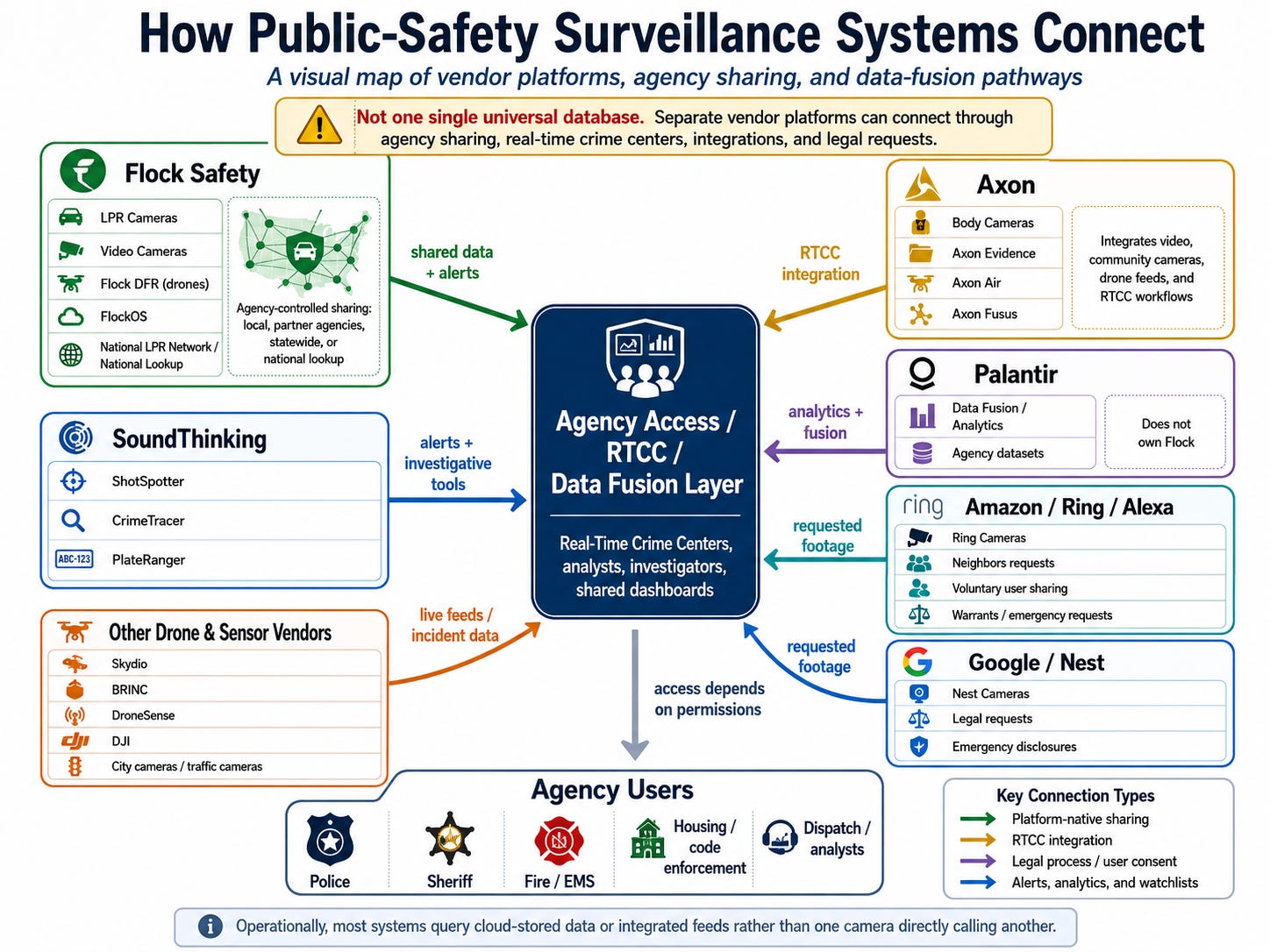
A city or police department buys separate tools. Flock for license plates. Axon for body cameras. Fusus for real-time crime center integration. Palantir for data fusion. ShotSpotter for gunshot detection. Drones from Skydio, DJI, BRINC, or DroneSense. Ring or Nest footage through request systems. CAD and RMS for dispatch and police reports.
Each system collects its own data.
Then an integration layer connects them.
That integration layer can use APIs, scheduled exports, webhook alerts, live video feeds, cloud-to-cloud permissions, partner integrations, or manual data imports. It can match records by plate number, timestamp, GPS coordinates, address, case number, incident type, vehicle description, or person.
That is how a license plate hit can be connected to a police report, a drone flight, a 911 call, a nearby camera, and a map view inside a real-time crime center.
This does not require every camera in America to be “pinged” manually in real time. What is more likely is that systems feed metadata into cloud-based indexes or agency-controlled datasets, then authorized users query those datasets through permissions. From the user’s perspective, it looks like one giant searchable system, even if the data is technically separated underneath.
The Cleveland Problem
Today in Ohio (see audio above) discussed more than 160 immigration-related searches showing up in Cleveland’s Flock audit logs long after the city said it had turned on safeguards meant to block immigration-related searches. Cleveland’s explanation was that fire and EMS drones had “accidentally” been swept into Flock’s national search network, and that out-of-state agencies running broad immigration-related searches caused those drones to appear in the logs.
If Cleveland devices can accidentally end up inside a national search network without anyone noticing for months, then who actually understands this system?
Truthful-ish Is Not Good Enough
This is where private companies and public agencies can be truthful-ish.
A company can say the data is permissioned.
A city can say it turned off certain searches.
A police department can say it controls its sharing settings.
A vendor can say the system has audit logs.
The government does not have to build the entire surveillance state itself. Private companies build the tools. Cities subscribe to them. Police departments use them. Other agencies request or access data through permissions. Then everyone points to someone else when people ask who is responsible. OR… my favorite, someone smart decides to just make an integration software that is a searchable surveillance stack.
The company says it is just the vendor.
The city says it is just a tool.
The police say it is just public safety.
And somehow, the network keeps growing.
The Abuse Is Already Happening
In Shaker Heights, public records reportedly showed enormous numbers of Flock searches, including immigration-related searches, which forced a policy change. In Texas, members of Congress raised concerns that Flock technology was reportedly used in a nationwide search connected to an abortion investigation. In Kansas, a police chief used Flock license plate readers hundreds of times to track his ex-girlfriend and her new boyfriend.
This is what happens when powerful search tools exist, when access is broad, and when oversight is weaker than the technology.
The original justification may be stolen cars, warrants, missing people, or violent crime. But once the infrastructure exists, the use cases expand. Immigration. Abortion. Personal stalking. Political monitoring. Protest tracking. Data fusion. Predictive policing. Whatever comes next.
Once surveillance infrastructure is built, it rarely gets smaller.
Safety or Surveillance?
I want to ask a question because I do not know if we all fall on the same side of this as Democrats. And that question is…
The Real Question for Ohio
This is why Ohio needs to get technical before it gets too comfortable.
The issue is not just a camera taking a picture of a license plate. The issue is the network architecture behind it. Flock ALPRs (Automated License Plate Readers) turn vehicle sightings into structured data: plate number, time, location, vehicle description, agency, camera, and search history. Once that data is stored, it can be queried, shared, audited, exported, or connected to other systems through permissions, network-sharing settings, APIs, and data-fusion tools.
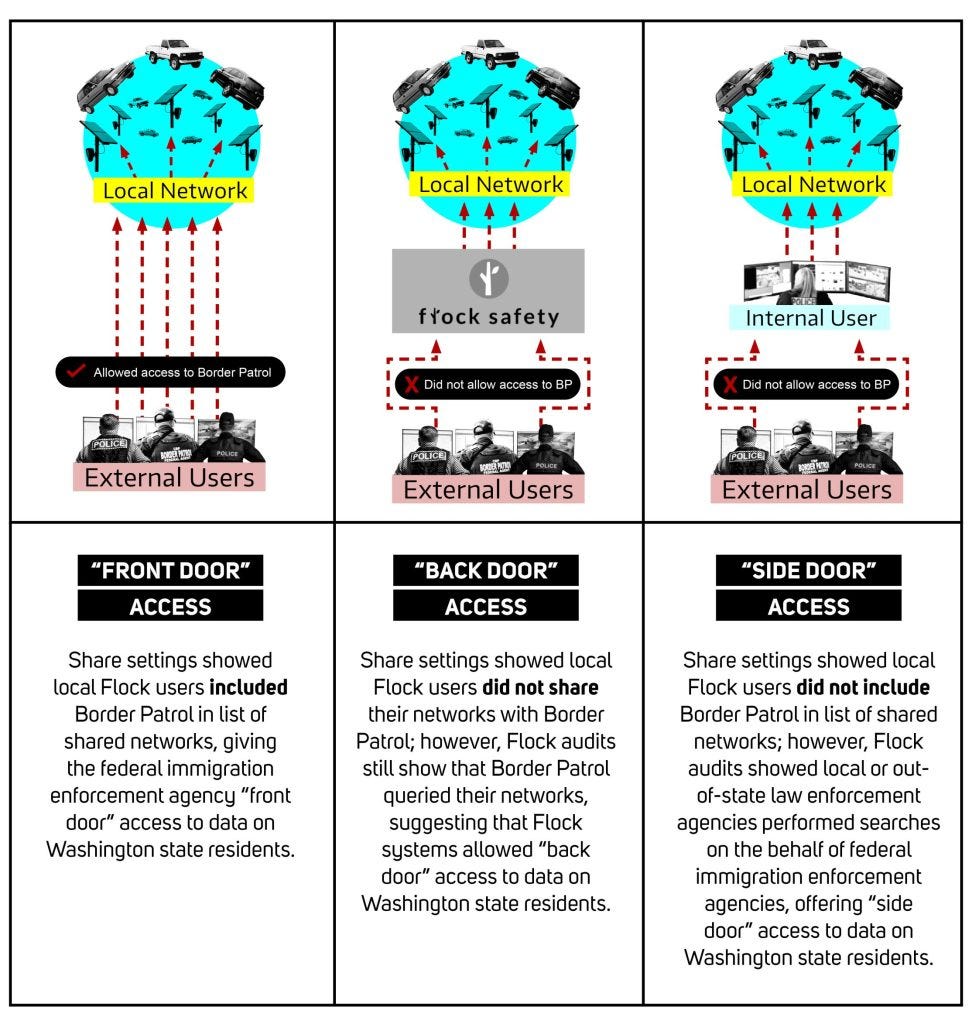
The University of Washington report lays out three basic pathways for access:
Front door sharing: One agency directly shares its camera network or data access with another agency.
Back door access: Another agency’s searches can still surface data, even when there is no clear or explicit sharing agreement.
Side door searches: An authorized agency runs a search on behalf of another agency, including federal immigration enforcement.
That means the real safeguard is not simply whether your city says, “We do not share data.”
The better questions are:
Can another agency access the system directly?
Can another user or network reach the data indirectly?
Can an authorized agency search it on someone else’s behalf?
Because if any of those are true, then the protection is not the written policy. The protection is only as strong as the weakest access point in the network.
That is why “we have controls” is not good enough. Controls only matter if the public knows who has access, what settings are enabled, what networks are connected, what searches are logged, what data is retained, and whether those logs are independently reviewed.
A single license plate reader may feel local. But when the data can be searched across jurisdictions, matched over time, and used to build movement patterns, it becomes something much bigger. It can reveal where someone lives, works, worships, gets medical care, attends meetings, or visits friends. That is not just public driving. That is a behavioral map.
Ohio should not wait until after more abuse happens. We need clear laws on retention, warrants, out-of-state sharing, federal access, immigration enforcement, abortion enforcement, audits, public reporting, and penalties for misuse.
Because once the surveillance stack is built, it will be used.
So tell me where you fall. Is this safety? Is this surveillance?
Is the problem the cameras, the access, the data-sharing, the public-private partnership, or the entire system?
But in the meantime...


